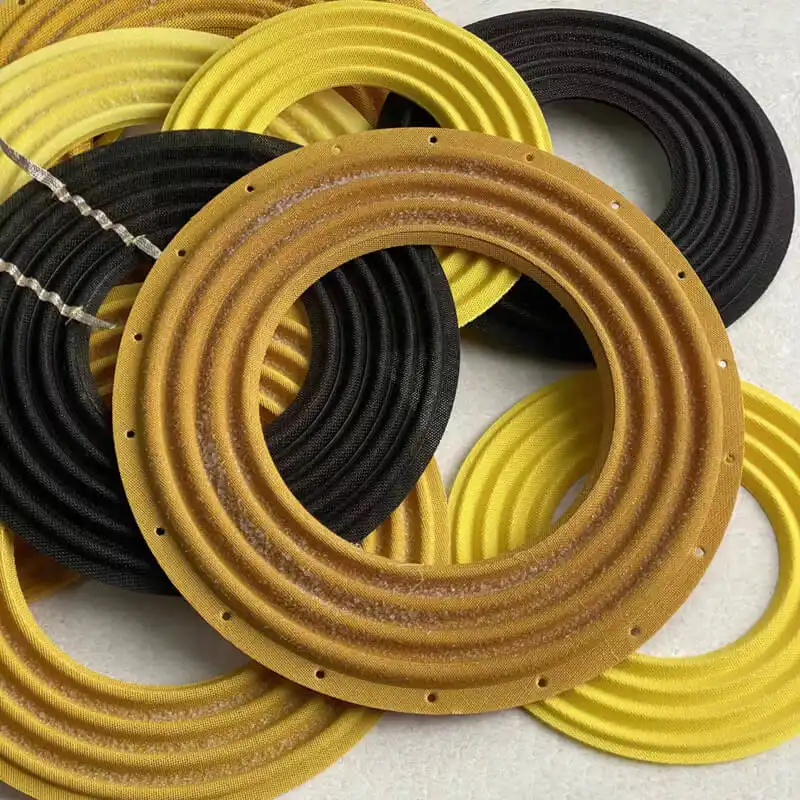
Speaker Spider Quality Inspection Standards for OEM Orders and Batch Production
A practical guide to speaker spider quality inspection for OEM buyers, covering dimensions, material control, elasticity, appearance, and traceability.
Why Speaker Spider Quality Inspection Matters in OEM Production
Speaker spider quality inspection is one of the most important control points in loudspeaker manufacturing because the spider directly affects centering, suspension behavior, voice-coil stability, and long-term reliability. A spider may look simple, but small differences in dimension, resin treatment, corrugation shape, or elasticity can change how a woofer, subwoofer, or full-range speaker performs during assembly and operation.
For OEM orders and batch production, inspection should not be limited to a visual check. Buyers need a clear view of how the factory confirms specifications before production, how incoming materials are controlled, how samples are matched, and how each production lot is checked before shipment. This is especially important when the speaker spider is being matched to an existing design, used as a repair replacement part, or built for a new driver platform.
A practical inspection standard helps reduce common risks such as:
- Voice coil rubbing caused by poor centering or inconsistent inner diameter
- Assembly problems caused by incorrect outer diameter or landing area
- Unstable compliance caused by resin variation or fabric inconsistency
- Batch-to-batch performance drift in repeat orders
- Cosmetic rejection caused by stains, cracks, loose threads, or uneven coating
- Traceability gaps when defects appear after assembly
For speaker OEM teams, sourcing buyers, woofer and subwoofer builders, and repair replacement channels, the goal is not only to receive parts that pass inspection. The goal is to confirm that the spider can be repeated consistently from sample approval through mass production.
Core Specification Checkpoints Before Inspection
A reliable inspection process starts with a complete specification. If the drawing, sample, or RFQ is unclear, the inspection result may not protect the buyer from assembly problems. Before approving production, buyers should confirm the key dimensions and application details used by the factory for both sampling and batch control.
Key dimensions: OD, ID, SOD, FH, and EH
The most common spider dimension checkpoints include OD, ID, SOD, FH, and EH. The exact naming may vary by buyer or drawing format, but each dimension should be clearly defined before tooling, sampling, or mass production.
- OD, outer diameter: Confirms the total outside size of the spider and its fit with the basket or frame landing area.
- ID, inner diameter: Confirms the fit around the voice-coil former and affects centering accuracy during assembly.
- SOD, spider outer diameter or support outer diameter: Often used to describe the functional outside support area or seating range, depending on the drawing standard.
- FH, free height: Indicates the spider height in its free, unassembled condition.
- EH, effective height or elevation height: Used to confirm the formed height or working position needed for the suspension design.
For batch production, dimension checks should be made against approved drawings or confirmed sample measurements. Buyers should ask whether the factory records these values during production and whether tolerance limits are written on the inspection sheet.
Voice-coil group and assembly matching
The spider does not work alone. It must match the voice-coil diameter, former material, cone height, basket depth, surround behavior, and intended excursion range. For OEM orders, the voice-coil group is a critical reference point because the ID and centering behavior of the spider must support smooth movement without rub or tilt.
Buyers should provide or confirm:
- Voice-coil former outside diameter
- Former material and bonding surface
- Required spider ID and glue clearance
- Assembly stack height
- Intended working stroke or excursion demand
- Woofer, subwoofer, midrange, or repair application
When a buyer sends an original sample for matching, the factory should identify the measurable structure rather than only copying the appearance. A spider that looks similar may still behave differently if the fabric, resin, corrugation, or height is not matched correctly.
Material code, fabric, and resin requirements
Material selection affects compliance, damping behavior, temperature resistance, durability, and production consistency. A useful RFQ should include the material code if available, or at least the approved sample, application type, and performance requirement. In spider and damper production, the fabric and resin system are central to quality control.
Before production approval, buyers can ask the factory to confirm:
- Fabric type or material code
- Resin treatment requirement
- Color requirement, if appearance matching matters
- Target stiffness or compliance comparison method
- Corrugation profile and forming standard
- Any special adhesive or bonding area requirement
Incoming material inspection should verify that the fabric and resin used for the approved sample are consistent with the materials prepared for batch production. If a production lot uses a different material source or treatment condition without confirmation, the final speaker performance can shift even when dimensions remain within tolerance.
Practical Speaker Spider Quality Inspection Points
A complete speaker spider quality inspection standard should include dimensional, structural, material, appearance, and functional checks. The inspection method may vary by order size and customer requirement, but the control logic should be clear and repeatable.
Dimension checks
Dimension inspection is the foundation of speaker parts QC. For every OEM batch, inspectors should check critical dimensions against the approved drawing or sample record. OD and ID are usually the first priorities because they directly affect frame fit and voice-coil fit. FH and EH are also important because height variation can change the working position of the suspension.
Typical dimension inspection points include:
- OD and seating diameter
- ID and inner bonding area
- SOD or specified support diameter
- FH and EH
- Glue landing width
- Corrugation width and spacing, when specified
- Overall formed profile
For buyer review, the key question is not only whether the factory can measure the part. Buyers should ask how the factory defines measuring points, what tools are used, and whether the same method is applied from sampling to production.
Flatness and formed height
Flatness affects how the spider sits during assembly. A warped or uneven spider can create stress in the suspension system and increase the risk of voice-coil offset. Flatness inspection is especially important for larger woofers and subwoofers, where the spider diameter and corrugation structure are more sensitive to forming and curing conditions.
Inspection should look for:
- Edge lifting
- Uneven resting position
- Distortion after forming
- Height differences around the circumference
- Deformation caused by storage or packing
Flatness and height should be checked after the spider has stabilized, not only immediately after forming. Buyers can request that the factory keep approved samples as reference parts and compare production lots against them.
Concentricity and centering accuracy
Concentricity is critical because the spider helps center the voice coil in the magnetic gap. If the ID is off-center relative to the OD or corrugation structure, the speaker may assemble poorly even if the individual diameters pass inspection.
Concentricity inspection should confirm alignment between:
- Inner hole and outer edge
- Inner bonding area and corrugation pattern
- Corrugation center and full spider profile
- Voice-coil opening and basket seating area
For high-excursion woofers and subwoofers, centering accuracy becomes even more important. Small offset errors can become more visible under movement. Buyers should ask whether concentricity is inspected visually, with a fixture, or by measurement, depending on the application requirement.
Corrugation consistency
The corrugation controls the movement behavior of the spider. Inconsistent corrugation depth, pitch, or shape can lead to uneven compliance and unwanted rocking. The inspection should compare production parts to the approved sample and check for stable forming across the lot.
Important corrugation points include:
- Number of waves or corrugation rings
- Depth and height of each corrugation
- Uniformity around the full circumference
- Smooth transition between corrugations
- No collapsed, stretched, or cracked forming areas
For sample matching, corrugation should be checked together with material and resin condition. Copying only the wave count is not enough if the wave height, fabric stiffness, or resin loading is different.
Resin consistency and material treatment
Resin consistency has a direct influence on stiffness, recovery behavior, durability, and handling during assembly. Too much resin can make the spider overly stiff or brittle. Too little resin can reduce shape stability and create inconsistent compliance. Uneven resin can also cause local stiffness differences across the part.
Inspection should look for:
- Uniform resin distribution
- No heavy resin pooling
- No dry or untreated areas
- Consistent surface texture
- Stable color and finish within the accepted range
- No cracking caused by over-curing or poor flexibility
Buyers should ask whether resin-treated materials are controlled by material code and lot number. For repeat orders, this is one of the most practical ways to reduce batch consistency problems.
Adhesion area and bonding readiness
The speaker spider must bond reliably to the voice-coil former and frame or landing structure. Poor bonding surface condition can create assembly defects even when the spider itself is dimensionally correct. The inspection should check the inner and outer adhesion areas for shape, cleanliness, and usable width.
Inspection points include:
- Inner glue area width and position
- Outer glue area width and seating surface
- Clean bonding surfaces
- No loose fibers interfering with glue contact
- No oil, dust, heavy resin lumps, or contamination
- No deformation that prevents stable fixture assembly
For OEM production, buyers should confirm the adhesive system used in their own assembly process and make sure the spider surface is compatible. If the spider is intended for repair replacement channels, the bonding area should be easy to identify and consistent enough for reliable installation.
Appearance defects
Appearance inspection is not just cosmetic. Visible defects may indicate process instability, material damage, or handling problems. A small stain may be acceptable for some internal speaker parts, while cracks, loose threads, and broken corrugation are functional risks.
Common appearance defects to control include:
- Stains or contamination
- Loose threads or frayed edges
- Cracks in the corrugation
- Broken or uneven forming
- Heavy resin spots
- Burn marks or discoloration
- Foreign particles
- Deformed inner or outer edges
The acceptable level should match the application. A premium OEM speaker project may require stricter cosmetic control than an internal replacement component, but functional defects should never be treated as normal appearance variation.
Elasticity Comparison and Batch Consistency
Speaker spider testing often includes a comparison of elasticity or compliance. The exact test method depends on the buyer's requirement, available fixtures, and product application. In many OEM projects, the most practical approach is to compare production parts against an approved sample using the same fixture and process each time.
Why elasticity matters
The spider contributes to suspension stiffness and helps control the voice coil's return to center. If elasticity changes, the finished loudspeaker may show different low-frequency behavior, excursion control, or centering stability. For subwoofers and high-power drivers, this can be especially important because the spider is under greater mechanical demand.
Elasticity variation may come from:
- Fabric material differences
- Resin loading differences
- Curing or forming variation
- Corrugation profile changes
- Storage conditions
- Mixed lots or uncontrolled material substitution
Buyers do not always need a complex laboratory test for every project, but they should require a repeatable comparison method. The inspection record should make clear whether the batch matches the approved sample within the agreed range.
Sample matching for repeatable production
When the buyer provides an original spider sample, the factory should create a controlled sample record. This can include dimensions, material notes, corrugation structure, appearance reference, and elasticity comparison. The approved production sample should then become the standard for future orders.
A good sample approval process usually confirms:
- Drawing or measured specification
- Material code or selected fabric and resin treatment
- OD, ID, SOD, FH, and EH
- Corrugation profile
- Voice-coil matching requirement
- Appearance acceptance range
- Elasticity or compliance comparison result
- Packaging and lot identification method
Once the sample is approved, production inspection should not rely on memory or general similarity. It should compare the batch against the approved reference and documented specification.
Batch consistency and lot control
Batch consistency is one of the most important concerns in loudspeaker component quality control. A single sample may work well, but OEM orders need stable parts across cartons, lots, and repeat shipments. This is where lot control and production records become valuable.
Buyers should ask whether the factory can provide:
- Production lot number
- Incoming material lot reference
- Inspection record for key dimensions
- Appearance inspection result
- Sample comparison record
- Packing quantity and carton identification
- Nonconforming product handling process
ERP process control can support this by connecting orders, material records, production steps, inspection records, and delivery information. The buyer does not need access to every internal system detail, but should be able to receive clear lot identification and quality records when needed.
What Buyers Should Ask to See Before Approving Production
Before approving an OEM speaker spider order, buyers should request practical evidence that the factory can control the specification in real production. This does not need to be complicated, but it should be specific enough to prevent misunderstanding.
Documents and samples to request
A useful pre-production approval package may include:
- Approved drawing or confirmed measurement sheet
- Physical pre-production sample
- Material code or material confirmation record
- OD, ID, SOD, FH, and EH measurement result
- Corrugation and height comparison against sample
- Voice-coil group matching confirmation
- Appearance acceptance standard or reference photos
- Elasticity or compliance comparison method
- Packaging method and label format
- Lot traceability plan
For buyers preparing an RFQ, providing more complete information at the beginning can shorten sample development time. If drawings are not available, sending a physical sample with application details helps the factory confirm dimensions, material, and forming requirements more accurately.
Incoming material inspection
Incoming material inspection is a key part of damper inspection and speaker spider quality control. Even if the forming process is stable, inconsistent fabric or resin-treated material can change the finished component. Buyers should ask how the factory checks material before production and how material lots are separated.
Useful incoming control points include:
- Material code confirmation
- Fabric type and condition
- Resin-treated sheet or roll consistency
- Color and texture comparison
- Storage condition control
- Material lot identification
For repeat OEM orders, the buyer should confirm whether the same approved material code will be used unless a change is reviewed and accepted.
In-process and final inspection
Quality control should not wait until the order is packed. In-process checks help catch forming, resin, or dimension issues before a full batch is completed. Final inspection then confirms that finished goods meet the agreed requirements before shipment.
In-process inspection may focus on:
- Forming stability
- Corrugation shape
- Height control
- Edge condition
- Resin appearance
- Early dimension confirmation
Final inspection may focus on:
- Critical dimensions
- Flatness and concentricity
- Appearance defects
- Adhesion areas
- Elasticity comparison
- Quantity, packing, and labels
- Lot records
For larger or repeat OEM orders, buyers can ask for a simple quality report with measured values and inspection conclusions. This gives the purchasing, engineering, and incoming QC teams a common reference.
Nonconforming product handling
Every manufacturing process can produce nonconforming parts. What matters is whether they are identified, separated, and prevented from entering shipment. Buyers should ask how rejected spiders are marked, isolated, rechecked, or scrapped.
A practical nonconformance process should include:
- Clear defect classification
- Separation of rejected parts
- Reinspection after correction, if correction is allowed
- Record of quantity affected
- Root cause review for repeated issues
- Confirmation before shipment if a major issue occurs
This is especially important for OEM projects where one defective spider can create a larger assembly problem after it is glued into a speaker.
Building a Better RFQ for Speaker Spider QC
A strong RFQ helps the factory quote accurately, sample correctly, and inspect consistently. Instead of asking only for price and lead time, buyers should include the technical and quality details that affect production.
A complete RFQ for speaker spiders or dampers should include:
- Application: woofer, subwoofer, midrange, full-range, or repair use
- Required quantity and expected repeat order pattern
- Drawing or physical sample availability
- OD, ID, SOD, FH, and EH
- Voice-coil former size and matching requirement
- Material code or desired material behavior
- Corrugation structure or approved sample reference
- Compliance or elasticity target, if available
- Adhesion area requirements
- Appearance standard
- Packing and labeling needs
- Required inspection report or sample approval process
For buyers working with Qiao Tai or any direct speaker spider manufacturer, the most productive conversations usually begin with clear specifications and a shared inspection standard. A factory founded on repeat component production should be able to discuss sample matching, mold support, specification confirmation, incoming material control, production inspection, and delivery records in practical terms.
The best speaker spider quality inspection standard is not just a checklist at the end of production. It is a control system that links material selection, tooling, sample approval, process inspection, final QC, packing, and traceability. When these points are confirmed before production, buyers reduce assembly risk and improve the chance of stable loudspeaker performance across every batch.
FAQ
What should be checked during speaker spider quality inspection?
Key inspection points include OD, ID, SOD, FH, EH, flatness, concentricity, corrugation consistency, resin distribution, adhesion area, appearance defects, elasticity comparison, and lot traceability.
Why are OD and ID important in speaker spider inspection?
OD affects how the spider fits the basket or frame landing area, while ID affects fit around the voice-coil former. Incorrect OD or ID can cause assembly problems, poor centering, or voice-coil rubbing.
How can buyers confirm batch consistency for speaker spiders?
Buyers can request approved sample records, material code confirmation, dimension inspection results, elasticity comparison, lot numbers, incoming material records, and final QC reports for each production batch.
What information should be included in an RFQ for speaker spiders?
A useful RFQ should include application type, drawing or sample, OD, ID, SOD, FH, EH, voice-coil matching details, material code, corrugation requirement, compliance target, adhesion area, appearance standard, quantity, and inspection report requirements.
Why does resin consistency matter in speaker spider production?
Resin affects stiffness, recovery behavior, shape stability, and durability. Uneven or inconsistent resin treatment can change compliance, create local stiffness differences, and reduce batch-to-batch consistency.
Factory RFQ Next Step
Move from research to a specification shortlist with product examples that can be sent for factory quotation.