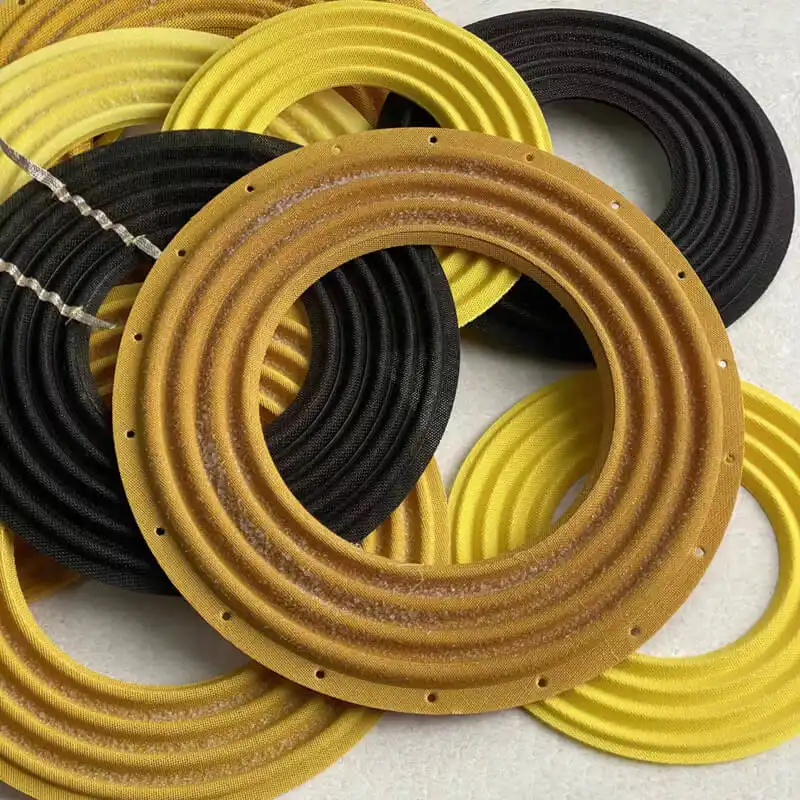
How ERP Process Control Improves Speaker Spider Lead Time, Traceability and Production Consistency
ERP process control helps speaker spider buyers reduce specification errors, track material lots, manage revisions and keep sampling aligned with production.
Speaker spiders and dampers look like simple suspension parts, but small process differences can change the performance of a loudspeaker. A variation in outer diameter, inner diameter, corrugation profile, fabric treatment, resin stiffness or forming height can affect centering, compliance, excursion control and long-term reliability. For OEM speaker teams and component sourcing buyers, the challenge is not only choosing the right spider specification. The larger challenge is keeping that specification stable from sample approval to repeated production batches.
This is where speaker component ERP process control becomes commercially important. ERP manufacturing control is not just an internal factory system for issuing work orders. When used correctly, it connects drawings, BOM data, material codes, mold records, sample approvals, production scheduling, inspection results and shipment documentation. For buyers, that means fewer avoidable specification mistakes, better lot traceability, clearer change management and more predictable delivery.
In speaker spider manufacturing, ERP discipline is especially valuable because many products are custom or semi-custom. A centering spider may be matched to a specific voice-coil group, frame layout, cone assembly and target compliance. Two parts can look similar but perform differently because of material selection, impregnation level, corrugation design or finished height. Process control helps prevent these differences from being lost during quoting, sampling, production transfer or repeat orders.
Why ERP Process Control Matters in Speaker Spider Manufacturing
A loudspeaker suspension component has to be repeatable, not just correct once. The approved sample is only useful if mass production follows the same controlled specification. ERP process control supports that goal by turning buyer requirements into structured factory data instead of relying on scattered emails, handwritten notes or memory.
For a speaker spider or damper order, key control points often include:
- OD: outer diameter
- ID: inner diameter
- SOD: shoulder or support outer diameter where applicable
- FH: free height or formed height, depending on the specification method
- EH: effective height or edge height where used in the drawing
- Voice-coil group or coil former matching information
- Material code and fabric type
- Resin or treatment requirement
- Corrugation shape, count and pitch
- Compliance target or stiffness reference
- Centering requirement and assembly fit
- Mold number or forming tool reference
- Approved sample version and production revision
Without a controlled system, these details can be separated across drawings, RFQ forms, sample labels, production notes and QC reports. ERP manufacturing control helps connect them into a single production instruction set. That reduces the risk of producing a spider with the correct diameter but the wrong material code, or matching the right mold with an outdated revision.
For international speaker factories, woofer and subwoofer builders, and repair replacement channels, the buyer benefit is practical: less time spent clarifying the same details, fewer production surprises and better confidence that the next shipment will match the approved sample.
From BOM Accuracy to Sample-to-Production Consistency
The bill of materials is one of the most important foundations for speaker parts traceability. In spider and damper production, a BOM may include the base fabric, treatment material, adhesive or resin system, forming requirements, cutting process and packaging method. If the BOM is incomplete or not linked to the current product version, consistency becomes harder to protect.
BOM accuracy reduces hidden variation
A spider’s performance is influenced by several inputs that may not be obvious from the finished part alone. Buyers often focus on OD, ID and height dimensions, but the material and process route can be just as important. A controlled BOM helps define:
- The approved material code rather than a generic fabric description
- The required treatment or impregnation level
- The matching mold or corrugation tool
- The cutting and forming process route
- The inspection checkpoints required before packing
- Any customer-specific marking, labeling or packaging requirement
This reduces the chance of substitution errors and helps purchasing teams compare repeat batches against the original approval. When a component is used in a woofer, subwoofer or full-range driver platform, even a small change in stiffness can affect acoustic output or assembly behavior. BOM control gives the factory and buyer a common reference point.
Sample approval should create a controlled production version
A common sourcing problem occurs when samples are developed through several adjustments, but the final approved version is not clearly locked. The buyer may test one version, while production later follows another note or drawing. ERP production control helps prevent this by assigning a defined revision to the approved sample.
For speaker spiders, the sample approval record should ideally connect:
- The final confirmed drawing or specification sheet
- OD, ID, SOD, FH and EH values where applicable
- Material code and treatment requirement
- Voice-coil group or assembly matching notes
- Corrugation profile and mold reference
- Compliance or centering feedback from sample testing
- Approval date or approval status
- Any agreed tolerance or inspection standard
When sample data becomes the basis for the production work order, the gap between development and mass production is smaller. This is especially important for OEM production control, where buyers may need to launch a new driver model, qualify a replacement part or scale a pilot order into ongoing supply.
Revision Control and Change Requests: Avoiding Costly Confusion
Speaker component changes are normal. A buyer may adjust the voice coil, change the cone assembly, modify the basket, request a different compliance range or improve excursion performance. Repair channels may also need sample matching when replacing discontinued or hard-to-source spiders. The problem is not change itself. The problem is uncontrolled change.
ERP-based revision control helps separate current specifications from old versions. It also gives the factory a clearer way to respond when buyers ask whether a change is possible, what it affects and whether a new sample is required.
What revision control should protect
For a speaker spider or damper, a revision may involve one or more of the following:
- Diameter change, such as OD or ID adjustment
- SOD modification for frame or cone fit
- FH or EH change to improve suspension geometry
- Corrugation count, depth or spacing adjustment
- Material code change to alter compliance
- Resin or treatment adjustment to tune stiffness
- Mold change or new tooling requirement
- Voice-coil matching update
- Packaging or labeling change
If these updates are not controlled, old and new specifications may be mixed in quotation records, sample records or repeat orders. This can cause mismatched components, production delays and unnecessary dispute over which version was approved.
Faster response to change requests
A well-maintained ERP record supports faster commercial and technical response because the factory can review the existing BOM, mold information, material stock, process route and past inspection data. Instead of restarting the RFQ conversation from zero, both sides can focus on the specific change.
For example, if a woofer builder wants to adjust spider stiffness while keeping the same OD and ID, the factory can review whether the change is likely to involve material selection, resin treatment, corrugation adjustment or a new mold. If a sourcing team requests a small ID change for a revised voice-coil former, the work-order and tooling records help identify whether the existing process can support it or whether new sampling is needed.
This does not eliminate engineering evaluation, but it improves the quality of the conversation. Buyers get clearer answers because the production history is easier to retrieve.
Work-Order Tracking, Batch Management and Material Lot Traceability
Lead time is not only a scheduling issue. It is also a control issue. When product data, material availability, tooling, process steps and inspection requirements are organized, production can move with fewer interruptions. ERP process control helps by translating the confirmed order into a work order that can be tracked through manufacturing.
Work-order tracking improves visibility
For speaker spider production, work-order tracking can help manage steps such as material preparation, treatment, forming, cutting, inspection, packing and delivery preparation. The exact route depends on the product type and factory process, but the purpose is the same: each order should follow the correct instruction set.
From a buyer’s perspective, work-order tracking supports:
- Better confirmation of production status
- Reduced risk of producing against an outdated specification
- Clearer planning for repeat orders
- Easier handling of urgent or phased shipments
- More reliable communication when a change request appears mid-process
When the production team can see which revision, BOM and inspection standard apply to the work order, it becomes easier to maintain consistency across batch production.
Material lot traceability supports quality investigation
Speaker parts traceability becomes especially important when a buyer is building multiple driver models or distributing replacement components across different markets. If a performance issue is found during incoming inspection or speaker assembly, the ability to trace material lots and production batches can shorten the investigation.
For spider and damper components, useful traceability may include:
- Material lot or roll information
- Treatment or process batch reference
- Production date or work-order number
- Mold or tooling reference
- Inspection record for critical dimensions
- Packing lot or shipment reference
This information helps determine whether an issue is isolated to one batch, related to a material lot, connected to a specification revision or caused by an assembly change outside the spider itself. Strong batch management does not guarantee that every issue disappears, but it makes quality communication more factual and efficient.
Specification Checkpoints Buyers Should Confirm Before RFQ and Production
ERP process control works best when the buyer’s RFQ is clear. Vague requests such as "standard spider" or "same as sample" can lead to unnecessary sampling cycles. A practical RFQ should give the supplier enough information to confirm feasibility, match the intended application and prepare a stable production record.
Core dimensional and assembly data
For most speaker spider inquiries, buyers should prepare:
- OD and ID measurements
- SOD if the spider has a shoulder or special landing area
- FH and EH if these are relevant to the suspension geometry
- Thickness or stack-up considerations where applicable
- Voice-coil outer diameter, former type or coil group reference
- Basket and cone assembly fit requirements
- Required centering behavior in the driver design
Clear dimensions help the factory evaluate whether an existing mold can be used, whether modification is needed or whether a new tooling approach is required.
Performance and material references
A spider is not selected by size alone. Buyers should also provide any available performance or material references, such as:
- Target compliance or stiffness range
- Sample part for matching
- Material preference or existing material code
- Corrugation style from an approved design
- Application type, such as woofer, subwoofer, midrange or replacement repair part
- Expected excursion and durability requirements, if defined by the speaker design team
When the exact compliance data is not available, a physical sample and application details can help guide sample matching. The key is to record the approved result once the sample is confirmed, so the production batch is not treated as a new interpretation.
Quality and documentation expectations
Buyers should also clarify the inspection and documentation expectations before mass production. For example:
- Which dimensions are critical to check before shipment?
- Are OD, ID, SOD, FH and EH all required on the inspection report?
- Does the buyer need material lot traceability?
- Should the shipment be separated by production batch?
- Are labels required to show part number, revision, batch or work-order reference?
- Is a golden sample or retained sample needed for future comparison?
These details allow ERP factory process management to support the buyer’s quality system rather than only the supplier’s internal workflow.
How Process Control Improves Lead Time Without Cutting Corners
Shorter lead time does not come from skipping inspection or rushing unclear specifications. In speaker component manufacturing, dependable lead time usually comes from reducing preventable delays. ERP process control helps by making the order easier to confirm, schedule, produce and verify.
Common delay points include missing dimensions, unclear material selection, outdated drawings, unconfirmed sample revisions, mold uncertainty and late packaging changes. A controlled ERP workflow can reduce these delays because the necessary information is linked before production begins.
For repeat orders, the lead-time benefit can be stronger. If the approved part number, BOM, mold reference, material code, inspection standard and packaging method are already controlled, the next purchase order requires fewer clarifications. The supplier can check material availability, issue the correct work order and plan production more efficiently.
For new projects, ERP does not replace technical sampling, but it improves the handoff from sample development to batch manufacturing. The approved sample becomes a production-controlled item rather than a one-time workshop result. This is valuable for OEM teams scaling a new speaker model and for sourcing teams that need reliable repeatability over multiple shipments.
Practical Buyer Takeaways
ERP process control is often invisible until something goes wrong. When a wrong revision is shipped, a material change is not documented, or a repeat order no longer matches the sample, the cost of weak process control becomes clear. For speaker spiders, dampers and centering suspension parts, the commercial value of ERP is the ability to keep many small technical details aligned.
Buyers should look for suppliers that can communicate clearly about:
- How approved samples are linked to production specifications
- How BOM data and material codes are controlled
- How revisions are separated from older versions
- How work orders are issued and tracked
- How material lots and batches are recorded
- How inspection results are connected to the shipment
- How change requests are reviewed before production
Qiao Tai, a speaker spider and damper factory in Guangzhou Panyu founded in 2006, operates in a product category where specification confirmation, sample matching, mold support and batch production are closely connected. For buyers evaluating any loudspeaker suspension supplier, the same principle applies: process control should protect the approved design from RFQ through delivery.
A good spider is not only a well-formed component. It is a controlled component with the right dimensions, material, corrugation, compliance and centering behavior repeated across production batches. ERP manufacturing control gives both the buyer and the factory a more reliable way to achieve that result.
FAQ
What is speaker component ERP process control?
Speaker component ERP process control is the use of an integrated factory system to manage product specifications, BOM data, material codes, sample approvals, revisions, work orders, inspection records and batch traceability. For speaker spiders and dampers, it helps keep dimensions, material selection, corrugation, compliance and production instructions aligned.
How does ERP control improve speaker spider lead time?
ERP control improves lead time by reducing preventable delays caused by missing dimensions, unclear material requirements, outdated drawings or unconfirmed sample revisions. When the approved BOM, mold reference, inspection standard and packaging method are already controlled, repeat orders can be confirmed and scheduled more efficiently.
Which spider specifications should buyers confirm before RFQ?
Buyers should confirm OD, ID, SOD where applicable, FH, EH, voice-coil group or former size, material code or material preference, corrugation style, target compliance, centering requirements and sample matching needs. Clear RFQ data helps the factory evaluate tooling, sampling and production feasibility.
Why is revision control important for speaker spiders and dampers?
Revision control prevents old and new specifications from being mixed during quotation, sampling or repeat production. It is important when changes involve diameter, height, material, treatment, corrugation, mold, voice-coil matching or packaging. Controlled revisions help ensure mass production follows the approved version.
How does material lot traceability help speaker OEM teams?
Material lot traceability helps OEM teams investigate quality or performance questions more efficiently. If an issue appears during incoming inspection or speaker assembly, batch records can help identify whether it is related to a specific material lot, production order, tooling reference, revision or shipment batch.
Factory RFQ Next Step
Move from research to a specification shortlist with product examples that can be sent for factory quotation.