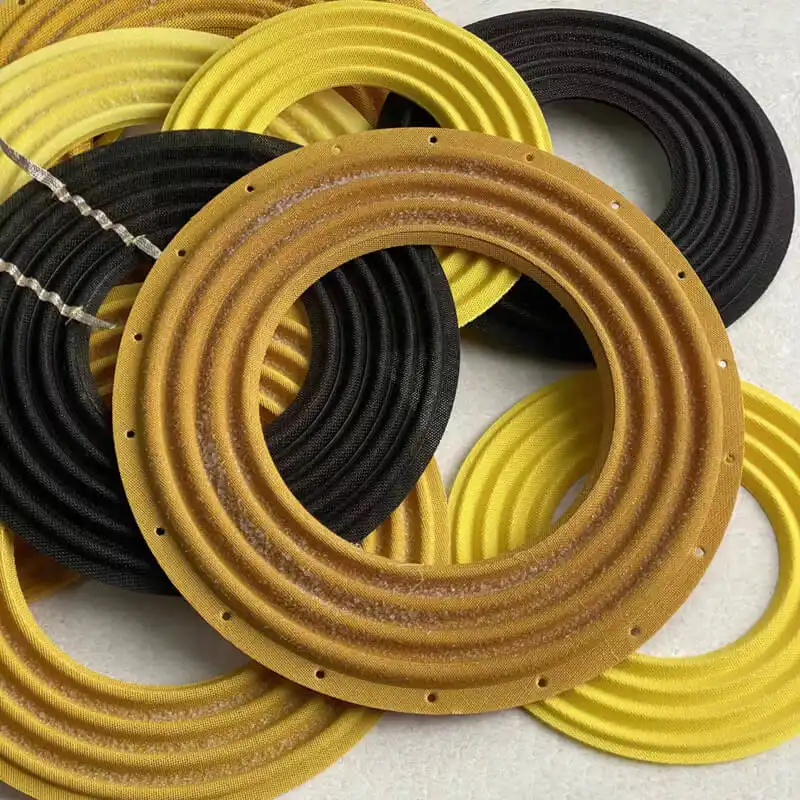
How to Prepare an RFQ for Speaker Spiders and Dampers for OEM or Replacement Orders
A practical RFQ guide for speaker spiders and dampers, covering dimensions, materials, corrugation, samples, QC expectations, and delivery planning.
A complete speaker spider RFQ helps a factory understand not only the part shape, but also the acoustic, mechanical, and production requirements behind the order. For OEM loudspeaker projects, the spider or damper must match the voice coil, cone assembly, frame, and target compliance. For replacement orders, it must match the original component closely enough to restore centering, travel, and suspension behavior.
Many quotation delays happen because the inquiry only says “need speaker spider” or includes a photo without dimensions. A clear RFQ reduces back-and-forth, improves sample accuracy, and gives buyers a more reliable basis for comparing price, tooling, lead time, and batch production options.
The following RFQ structure is designed for speaker OEM teams, woofer and subwoofer builders, component sourcing teams, and repair replacement channels that need a practical way to request speaker spiders, dampers, centering spiders, and related loudspeaker suspension components.
What a Speaker Spider RFQ Should Include
A speaker spider RFQ should identify the part, the application, the required dimensions, the material, the corrugation style, the voice-coil match, the sample requirement, and the expected production conditions. The more complete the RFQ, the easier it is for the factory to confirm feasibility, prepare samples, and quote accurately.
At minimum, prepare the following information:
- Part name: speaker spider, damper, centering spider, flat spider, progressive spider, or other type
- Application: woofer, subwoofer, midrange, full-range driver, compression-related assembly, repair replacement, or other use
- Key dimensions: OD, ID, SOD, FH, EH, thickness, and tolerance requirements where available
- Voice-coil group: voice coil diameter, former type, coil height, and related assembly details
- Material: cotton, Conex, Nomex-type aramid, blended fabric, phenolic-treated fabric, or existing material code if known
- Corrugation: wave count, wave depth, profile, spacing, and stiffness direction
- Compliance target: soft, medium, stiff, progressive, or measured compliance if available
- Quantity: sample quantity, pilot order, and batch order volume
- Compliance and documentation needs: RoHS, REACH, halogen-free, or internal material restrictions if applicable
- QC expectations: dimensional inspection, visual inspection, centering, bonding surface, and batch consistency
- Packaging and delivery: export carton, inner bag, anti-deformation packing, labeling, shipping term, and target schedule
For a custom spider inquiry, drawings and actual samples are especially useful. A drawing shows the intended geometry, while a physical sample helps the manufacturer check fabric treatment, corrugation feel, hardness, thickness, resin level, and forming quality.
Key Specification Checkpoints for Speaker Spiders and Dampers
The spider is a suspension and centering component. Small changes in diameter, wave geometry, fabric treatment, or stiffness can affect linear travel, resonance behavior, coil centering, and long-term reliability. A good RFQ should make these checkpoints clear before mold work or batch production begins.
OD, ID, SOD, FH, and EH
Dimensional clarity is the foundation of a speaker damper RFQ. Different teams may use different naming habits, so define each dimension clearly in the drawing or RFQ table.
Common checkpoints include:
- OD: outer diameter of the spider
- ID: inner hole diameter, usually matching the voice coil or former assembly
- SOD: spider outer seating diameter or effective mounting diameter, depending on the buyer’s drawing convention
- FH: free height or formed height, depending on the specification system used
- EH: effective height or edge height, depending on the assembly drawing
- Thickness: fabric and treated spider thickness at specified points
- Glue area: inner and outer bonding surfaces
- Tolerances: acceptable variation for production inspection
If your team uses FH and EH with a specific internal definition, include a marked drawing. These abbreviations are not always interpreted the same way across factories, design teams, and repair channels. A simple cross-section sketch can prevent expensive misunderstandings.
Voice-Coil Match
The spider must match the voice-coil group mechanically. The RFQ should not only list the ID; it should also describe the voice-coil diameter and assembly condition.
Useful voice-coil information includes:
- Nominal voice-coil diameter
- Former material and outer diameter
- Coil height and winding position
- Gap condition, if relevant
- Target excursion or driver type
- Whether the spider is bonded to the former, collar, or another intermediate part
For OEM loudspeaker sourcing, the spider is normally evaluated as part of the complete suspension system. For repair replacement orders, matching the original ID and bonding surface is critical because the repair technician may not be able to modify the assembly.
Material Code and Fabric Treatment
Material selection affects stiffness, durability, heat resistance, damping behavior, and forming consistency. If your company has an internal material code, include it. If not, describe the required performance and provide the original sample where possible.
Common RFQ material details include:
- Fabric type or material code
- Color, if important for identification or assembly inspection
- Resin or treatment requirement
- Target stiffness or compliance grade
- Heat or humidity expectations in the application
- Compliance restrictions such as RoHS or REACH, if required by your market or customer
When the exact material is unknown, ask the factory to inspect the sample and recommend a suitable match. A factory with spider and damper production experience can often compare fabric hand feel, corrugation recovery, thickness, and forming behavior, but the final selection should still be confirmed by sample testing in the speaker assembly.
Corrugation and Compliance
Corrugation design influences spider stiffness, linearity, centering force, and excursion capability. A flat-looking change in wave count or wave height can produce a noticeable difference in the loudspeaker.
Include these details when available:
- Number of corrugation waves
- Wave profile: shallow, deep, rounded, sharp, progressive, or custom
- Wave spacing and symmetry
- Inner and outer flat land width
- Required compliance direction or stiffness grade
- Whether the spider is for high-excursion subwoofer use, standard woofer use, or a lower-travel driver
If you have a target compliance value, include the test method and measurement condition. If you only have a reference sample, request sample matching and approval before confirming mass production.
RFQ Template for Speaker Spider and Damper Orders
A structured RFQ does not need to be complicated. The goal is to make the inquiry complete enough for engineering review, sample planning, quotation, and production scheduling.
1. Buyer and Project Information
Provide basic project context so the factory can understand the order type.
Recommended fields:
- Company name
- Contact person and role
- Email and phone
- Project name or part number
- Order type: OEM, replacement, repair channel, trial production, or repeat order
- Target market or internal customer requirement, if relevant
This information helps the factory distinguish between a one-time replacement order and a part that may require tooling, specification control, and recurring batch production.
2. Application and Speaker Type
The application tells the factory how the spider will be used.
Recommended fields:
- Speaker type: woofer, subwoofer, midrange, full-range, pro audio driver, car audio driver, home audio driver, or other
- Driver size
- Power level or general performance class, if relevant
- Target excursion or suspension requirement
- Assembly position and bonding method
- New design or replacement matching
For subwoofers and high-excursion drivers, corrugation depth, fabric treatment, and centering stability usually require closer review. For replacement spiders, dimensional matching and practical repair handling may be the priority.
3. Dimension Table
Use a table format in the RFQ so each dimension is easy to check.
Recommended fields:
| Item | Required Value | Tolerance | Notes |
|---|---:|---:|---|
| OD | | | Outer diameter |
| ID | | | Inner hole diameter |
| SOD | | | Define according to drawing |
| FH | | | Define measurement point |
| EH | | | Define measurement point |
| Thickness | | | Material and treated thickness |
| Inner glue land | | | Bonding area |
| Outer glue land | | | Frame or basket bonding area |
| Wave count | | | Corrugation count |
| Wave depth | | | If measurable |
Attach a 2D drawing, cross-section sketch, CAD file, or marked photo whenever possible. If the part is copied from an existing speaker, include the physical sample and state whether the sample is new, used, or removed from a repaired unit.
4. Material, Corrugation, and Performance Requirements
Describe the intended performance rather than only the appearance.
Recommended fields:
- Material code or fabric type
- Color
- Treatment or resin requirement
- Soft, medium, stiff, or progressive compliance target
- Heat or environmental requirement
- Corrugation shape and wave count
- Required centering behavior
- Any known noise, fatigue, or deformation concerns from previous versions
If the buyer is not sure which material is correct, the RFQ can request two or three sample options. For example, one sample may focus on close visual matching, while another may focus on stiffness and recovery. The final choice should be validated in the complete loudspeaker assembly.
5. Voice-Coil and Assembly Matching
The spider should be reviewed together with the voice-coil group. Include:
- Voice-coil diameter
- Former outer diameter
- Former material, if known
- Coil height and winding position, if relevant
- Target inner bonding diameter
- Glue type or bonding process, if controlled by the assembly line
- Whether the spider must match an existing cone, frame, or jig
For OEM loudspeaker sourcing, this information supports better centering and reduces the risk of assembly interference. For replacement spider orders, it helps confirm whether the spider can be used by repair teams without modifying the voice-coil assembly.
6. Quantity, Sampling, and Production Plan
Quantity affects price, tooling, production planning, and packaging. Separate the RFQ into sample, trial, and batch stages.
Recommended fields:
- Sample quantity required
- Pilot order quantity
- Estimated batch quantity
- Annual or repeat order estimate, if available
- Target sample date
- Target mass production date
- Required delivery schedule
If a new mold is needed, the factory must evaluate mold support, forming method, sample lead time, and revision possibility. If the order is based on an existing mold, confirm whether the dimensions and corrugation are close enough for your application.
7. Compliance, QC, and Inspection Expectations
A speaker parts quotation should also include quality expectations. This makes the quotation more meaningful and helps both sides define acceptance criteria before production.
Useful QC requirements include:
- Dimensional inspection for OD, ID, SOD, FH, EH, and thickness
- Visual inspection for cracks, stains, wrinkles, uneven resin, and deformation
- Corrugation consistency check
- Centering and flatness review
- Material and color consistency
- Packing inspection to prevent compression or warping
- Batch traceability or ERP-controlled production records, if required by the buyer’s quality system
If your company needs RoHS, REACH, or other compliance documentation, state this in the RFQ. Compliance expectations may affect material selection, documentation, and quotation.
8. Packaging, Labeling, and Delivery
Spiders and dampers can deform if packed poorly. RFQ packaging details help protect the part during export handling and warehouse storage.
Recommended fields:
- Inner packing method
- Quantity per bag or tray
- Carton size or weight limits, if required
- Anti-deformation packing requirement
- Part number and label format
- Shipping mark
- Delivery term and destination
- Preferred shipping method
For repair replacement channels, small pack labeling may be important. For OEM production, carton labels, batch numbers, and part codes usually matter more for warehouse receiving and line feeding.
Common RFQ Mistakes That Delay Quotation
Incomplete information is the most common reason a speaker spider RFQ takes longer than expected. The following issues often cause delays:
- Sending only a photo without OD, ID, or height dimensions
- Using FH, EH, or SOD without defining the measurement points
- Requesting “same as sample” without sending the physical sample
- Omitting the voice-coil diameter and bonding condition
- Asking for batch pricing without sample or tooling confirmation
- Not stating whether the order is OEM production or replacement matching
- Leaving out compliance requirements until after the quotation
- Ignoring packaging needs for export or warehouse handling
A better approach is to send a drawing, a filled RFQ table, and one or more physical samples. If the project is still early, state which parameters are fixed and which can be adjusted. This helps the factory recommend suitable material, mold options, and sample routes.
Practical RFQ Checklist Before Sending the Inquiry
Before submitting a speaker spider RFQ, review the inquiry against this checklist:
- Have OD, ID, SOD, FH, and EH been listed and defined?
- Is there a drawing, marked photo, or cross-section sketch?
- Is the voice-coil group information included?
- Is the application clearly stated?
- Is the material code or sample matching requirement included?
- Is corrugation wave count and profile described?
- Is the compliance target or stiffness expectation stated?
- Are sample quantity and batch quantity separated?
- Are compliance requirements such as RoHS or REACH included?
- Are QC, packaging, and delivery expectations listed?
A complete RFQ is not just an administrative document. It is the starting point for specification confirmation, sample matching, mold review, quality inspection planning, and production delivery. When buyers provide accurate dimensions, application context, and performance expectations, factories can respond with more useful quotations and better-matched samples.
For OEM speaker programs, the RFQ should support long-term production consistency. For repair and replacement orders, it should focus on matching the original part and making installation practical. In both cases, the best results come from treating the spider or damper as a functional suspension component, not a generic fabric ring.
FAQ
What information is needed for a speaker spider RFQ?
A complete speaker spider RFQ should include the application, OD, ID, SOD, FH, EH, thickness, material code, corrugation details, compliance target, voice-coil match, sample requirement, quantity, QC expectations, packaging needs, and delivery schedule.
Can a factory quote a speaker damper from a photo only?
A photo can help identify the general shape, but it is usually not enough for an accurate quotation. Buyers should provide key dimensions, a drawing or marked photo, application details, and preferably a physical sample for material and corrugation matching.
Why are voice-coil details important when ordering speaker spiders?
The spider must match the voice-coil group for centering, bonding, and suspension travel. Voice-coil diameter, former size, coil height, and bonding position help confirm the correct ID, glue area, and mechanical fit.
What is the difference between an OEM spider RFQ and a replacement spider RFQ?
An OEM RFQ usually focuses on design confirmation, material selection, mold support, sampling, and batch consistency. A replacement RFQ focuses more on matching the original spider’s dimensions, corrugation, stiffness, and installation conditions.
Should compliance requirements be included in the RFQ?
Yes. If the order requires RoHS, REACH, halogen-free materials, or internal customer restrictions, these should be stated early. Compliance requirements can affect material selection, documentation, and quotation.
Factory RFQ Next Step
Move from research to a specification shortlist with product examples that can be sent for factory quotation.