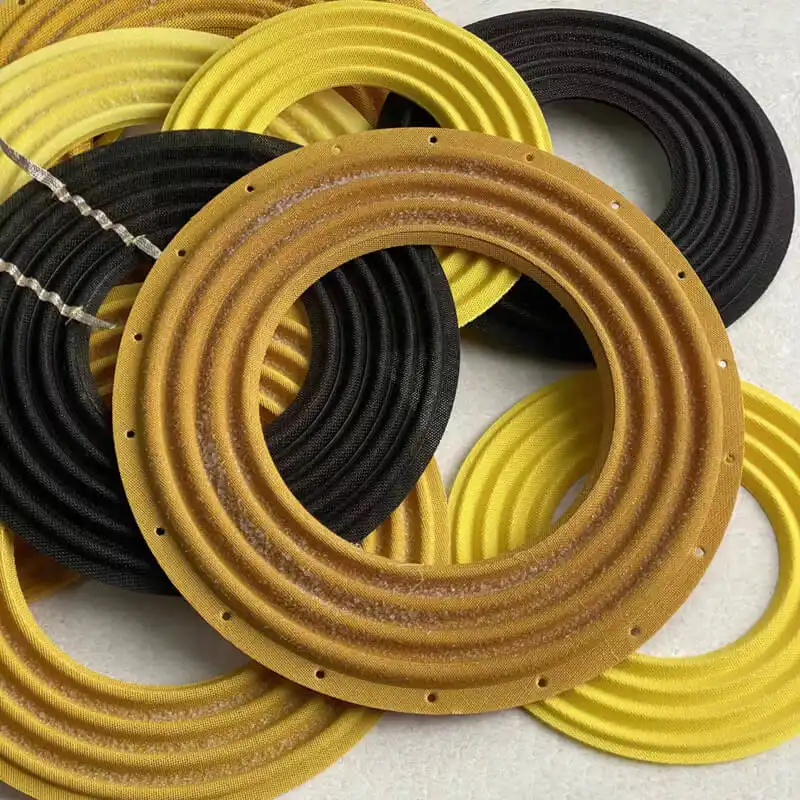
How to Specify Custom Speaker Spiders for OEM Loudspeaker Production
A practical buyer guide to turning drawings, samples, and driver requirements into clear custom speaker spider specifications for OEM production.
Turning a Speaker Spider Requirement Into a Production Specification
A custom speaker spider is not only a fabric disc with corrugations. In a loudspeaker motor system, it controls centering, restoring force, excursion behavior, and long-term stability around the voice coil. For OEM speaker projects, woofer and subwoofer builds, and repair replacement programs, the spider specification must be clear enough for a factory to sample, inspect, and repeat in batch production.
Many RFQs begin with a simple request such as “we need a 6.5-inch spider” or “please match this sample.” That is a useful starting point, but it is not enough for consistent production. A custom speaker spider manufacturer needs dimensional data, material direction, corrugation style, compliance target, voice-coil matching information, and batch requirements before the part can be quoted and sampled accurately.
For buyers, the goal is to reduce back-and-forth and avoid mismatched samples. A well-prepared specification helps the speaker damper factory understand what the spider must do in the driver, not just what it looks like on a table. It also helps sourcing, engineering, and quality teams compare suppliers on the same basis.
Define the Core Application Before Choosing the Spider
The best spider specification starts with the driver application. A small midrange driver, a home audio woofer, a professional audio driver, and a high-excursion subwoofer do not need the same suspension behavior. The spider must match the motor, cone assembly, voice coil, expected excursion, and reliability target.
Useful application details include:
- Driver type: tweeter, midrange, woofer, subwoofer, full-range unit, or repair replacement driver
- Nominal driver size and basket structure
- Voice coil diameter and former type
- Cone mass and moving assembly direction if available
- Expected excursion range and mechanical limit requirements
- Target compliance or stiffness behavior
- Operating environment, including heat, humidity, and intended duty cycle
- Required compliance or material restrictions for the market
For sourcing teams, this application information helps prevent one of the most common mistakes: specifying a spider only by outer diameter. Two spiders with similar OD and ID can behave very differently if the fabric, resin treatment, corrugation depth, and forming process are different. A replacement channel may focus on physical fit and basic performance recovery, while an OEM project usually needs tighter repeatability and a confirmed acoustic target.
Key Dimensions Every Custom Speaker Spider RFQ Should Include
Dimensional clarity is the foundation of a production-ready speaker spider RFQ. A drawing is ideal, but a well-measured sample sheet can also work if it captures the critical points.
OD, ID, and SOD
OD, or outer diameter, defines the outside edge of the spider. It must match the basket landing area or assembly design. ID, or inner diameter, must match the voice-coil former and attachment area. Both affect assembly fit and centering.
SOD is often used to describe the spider outside diameter at a specific effective or support-related position, depending on the buyer’s internal drawing practice. Because terminology can vary between companies, the RFQ should define exactly where SOD is measured. A simple annotated drawing or marked sample photo prevents confusion.
When sending dimensions, include the measurement unit, tolerance requirement, and whether the dimension is taken before or after forming. If the spider is impregnated or heat-formed, the finished condition matters most for assembly.
FH and EH
FH and EH are important height-related checkpoints for many spider designs. They can refer to formed height, effective height, edge height, or engineering-specific definitions used by the buyer. The key is not the abbreviation alone, but the measurement method.
For production communication, identify:
- Where the height is measured from
- Whether the spider is measured flat, free-standing, or installed
- Whether the value applies to the inner section, outer section, or corrugation peak
- Acceptable tolerance for the height
Height variation can affect centering, preload, and compliance. In high-excursion drivers, even small geometry differences may change how the spider behaves near its travel limit.
Voice-Coil Group and Assembly Fit
The voice-coil group should be specified with enough detail for the factory to confirm the inner hole, neck shape, and bonding area. Include voice coil diameter, former outer diameter where the spider attaches, and any collar or lead-out requirement.
If tinsel leads pass through or attach to the spider, provide lead position, hole location, reinforcement needs, and any special routing. A custom loudspeaker spider used in an OEM driver may also require a specific inner neck profile to support stable bonding and centering during assembly.
Tolerances and Inspection Method
Not every dimension needs an extremely tight tolerance, but critical assembly dimensions must be controlled. Typical RFQs should separate critical dimensions from reference dimensions. For example, ID, OD, formed height, and key corrugation measurements may require tighter confirmation than non-critical cosmetic areas.
Buyers should also specify the inspection condition:
- Finished part after forming and treatment
- Room-temperature inspection condition if relevant
- Sampling plan or incoming quality standard
- Measurement tools or fixture requirement for key dimensions
A clear inspection method reduces disputes during batch delivery and helps the supplier build the part into an ERP-controlled production route with stable process checkpoints.
Material, Corrugation, and Compliance Choices
A speaker spider’s performance depends heavily on material and forming. The visible shape is only one part of the specification. Fabric type, yarn structure, resin treatment, coating, and heat-forming all influence compliance, fatigue behavior, and centering.
Material Code and Fabric Direction
If the project already uses a material code, include it in the RFQ. If the code is internal and cannot be shared, provide a sample and performance target instead. A speaker damper factory can often match by appearance and stiffness direction, but the best results come from combining sample matching with functional requirements.
Material details may include:
- Cotton, poly-cotton, aramid blend, or other fabric direction if known
- Resin or impregnation level if specified
- Color requirement, such as black, yellow, or natural material tone
- Flame, RoHS, REACH, or other compliance targets where applicable
- Thickness and weight reference if available
The fabric’s warp and weft behavior can influence stiffness and centering. For OEM speaker spider projects, it is helpful to state whether the spider must match an existing driver design or whether the supplier may recommend a material based on compliance requirements.
Corrugation Profile
Corrugation determines how the spider flexes. Number of waves, wave height, wave width, spacing, and shape all matter. A spider with deeper corrugations may support larger movement, but the final behavior also depends on material and resin. A shallow-profile spider may suit tighter assembly spaces or smaller excursions.
A drawing should show the corrugation cross-section. If a drawing is not available, send clear photos from the top and side, plus sample quantities for measurement. For sample matching, include an approved original part and explain whether the priority is physical match, acoustic match, or production replacement.
Compliance and Centering Performance
Compliance describes how easily the spider moves under force. It is closely related to suspension stiffness and affects driver resonance, excursion, and distortion behavior. In many OEM projects, the buyer may define a target compliance, stiffness curve, or driver-level acoustic result rather than only a spider-level value.
If spider compliance data is available, include the test method and measurement condition. A value without a test method can create confusion because fixture design, displacement range, and preconditioning can change the result. If no compliance data is available, provide a known-good sample and driver performance target so the factory can support sample matching.
Centering is equally important. A spider that fits the drawing but does not hold the voice coil consistently can create rubbing, assembly scrap, or unstable performance. Centering depends on geometry, material balance, forming quality, and consistency across the batch.
Using Samples, Drawings, and Mold Support Effectively
Custom speaker spider development usually begins in one of three ways: a buyer provides a finished drawing, sends a physical sample, or shares driver requirements for a new design. Each route can work, but the communication requirements are different.
When You Have a Drawing
A drawing is the cleanest way to begin, especially for OEM loudspeaker production. It should include OD, ID, SOD, FH, EH, corrugation profile, material code, tolerance level, and any bonding or lead-out details. Add notes for compliance targets and inspection methods where possible.
If the drawing uses company-specific abbreviations, define them directly on the document. This prevents the factory engineering team from interpreting the dimensions incorrectly.
When You Have a Physical Sample
Sample matching is common for replacement channels and existing speaker models. Send enough samples for measurement, testing, and comparison. One used part may be deformed, fatigued, or contaminated with adhesive, so it may not represent the original production condition.
When sending a sample, clarify:
- Whether the sample is new, used, or removed from a driver
- Which features must be matched exactly
- Whether cosmetic color and surface finish are critical
- Whether the target is repair fit, acoustic match, or OEM continuation
- Expected order quantity and future production demand
A factory can measure and reproduce many physical features, but it should not be expected to infer all performance targets from a damaged or aged sample.
When You Need Mold Support
Custom corrugation and diameter requirements may need mold support. The buyer should confirm whether an existing mold can be used, whether a new mold is needed, and who approves the final mold output. For OEM projects, sample approval should be linked to both part inspection and driver-level testing.
Mold discussions should include expected production volume, sampling timeline, revision control, and whether the design may require future adjustments. If the driver is still under development, it may be wise to sample more than one compliance option before locking the mold and batch specification.
Preparing an RFQ for Batch Production
A complete speaker spider RFQ is more than a request for price. It should allow the manufacturer to evaluate feasibility, quote tooling or mold requirements, prepare samples, and plan batch production.
RFQ Checklist for Custom Speaker Spiders
A practical RFQ should include:
- Product name and application, such as OEM woofer spider or subwoofer damper
- Drawing or sample photos with OD, ID, SOD, FH, EH, and corrugation notes
- Voice-coil group details and bonding area requirements
- Material code or target material characteristics
- Compliance, stiffness, or known-good sample reference
- Centering and inspection requirements
- Color, coating, and compliance targets
- Quantity for samples and expected batch order volume
- Packaging, labeling, and delivery expectations
- Required documents, such as inspection report or material confirmation
This information helps the supplier provide a quote that reflects the real project. It also helps sourcing teams compare technical capability, not only unit price.
Quality Control and Process Repeatability
For batch production, repeatability is the main concern. Speaker spiders should be checked for key dimensions, forming stability, surface quality, material consistency, and centering-related features. Production control should cover incoming material, forming, treatment, inspection, packing, and shipment.
Factories with structured process control can record orders, specifications, materials, and inspection steps through an ERP or internal production system. For buyers, the important point is traceability: the approved sample, drawing revision, material code, mold, and inspection criteria should all connect to the production order.
Before approving mass production, confirm how the golden sample is stored and how changes are handled. If material, mold, process, or inspection criteria change, the buyer should be informed before shipment.
Sampling and Approval
Sampling should not stop at visual approval. For OEM loudspeaker production, test the spider inside the driver whenever possible. A part that measures correctly may still need acoustic and mechanical confirmation in the complete speaker system.
A useful sampling process includes:
- Dimensional inspection against drawing or sample reference
- Visual review for surface, corrugation, and edge quality
- Fit check with voice coil and basket
- Driver assembly test for centering and rubbing
- Performance comparison against the target driver or approved sample
- Written approval before batch production
For repair replacement channels, fit and consistency may be the main priorities. For OEM projects, performance verification is usually more demanding.
What Buyers Should Pay Attention To
A well-specified speaker spider reduces project risk. The most important change in many sourcing projects is moving from a size-only request to a functional production specification. That shift matters because the spider affects centering, excursion, resonance behavior, and assembly yield.
OEM teams should pay special attention to compliance, corrugation, and voice-coil matching. Component sourcing buyers should focus on drawing clarity, material confirmation, sample approval, and batch inspection. Woofer and subwoofer builders should verify excursion behavior and centering under real assembly conditions. Repair replacement channels should provide clean samples and define whether the goal is fit, appearance, or performance restoration.
A capable custom speaker spider manufacturer can support drawings, sample matching, mold discussions, specification confirmation, and batch production. The buyer’s strongest tool is a clear RFQ: one that connects dimensions, material, compliance, centering, and production requirements in a single package. When that information is complete, the factory can respond with more accurate pricing, more reliable samples, and a production plan that supports consistent loudspeaker performance.
FAQ
What information should be included in a custom speaker spider RFQ?
A strong RFQ should include the application, drawing or sample, OD, ID, SOD, FH, EH, corrugation details, voice-coil group information, material code or material target, compliance requirements, tolerance needs, sample quantity, batch volume, and inspection expectations.
Can a speaker damper factory make a spider from a physical sample only?
A factory can often start from a physical sample, but better results come from adding application details and performance targets. Used or removed samples may be deformed, so buyers should clarify whether the priority is physical fit, acoustic match, or OEM production repeatability.
Why are OD, ID, SOD, FH, and EH important for OEM speaker spiders?
These dimensions define how the spider fits the basket, voice-coil former, and suspension space. They also affect formed geometry, centering, preload, and assembly consistency. Each abbreviation should be clearly defined on the drawing because measurement practices can vary.
How does corrugation affect a custom loudspeaker spider?
Corrugation shape, depth, width, spacing, and number of waves influence how the spider flexes. The final behavior also depends on fabric, resin treatment, and forming process, so corrugation should be specified together with material and compliance targets.
Should OEM teams test speaker spiders before batch production?
Yes. Dimensional approval is important, but OEM teams should also test the spider in the complete driver to confirm centering, fit, rubbing risk, excursion behavior, and acoustic performance before approving mass production.
Factory RFQ Next Step
Move from research to a specification shortlist with product examples that can be sent for factory quotation.