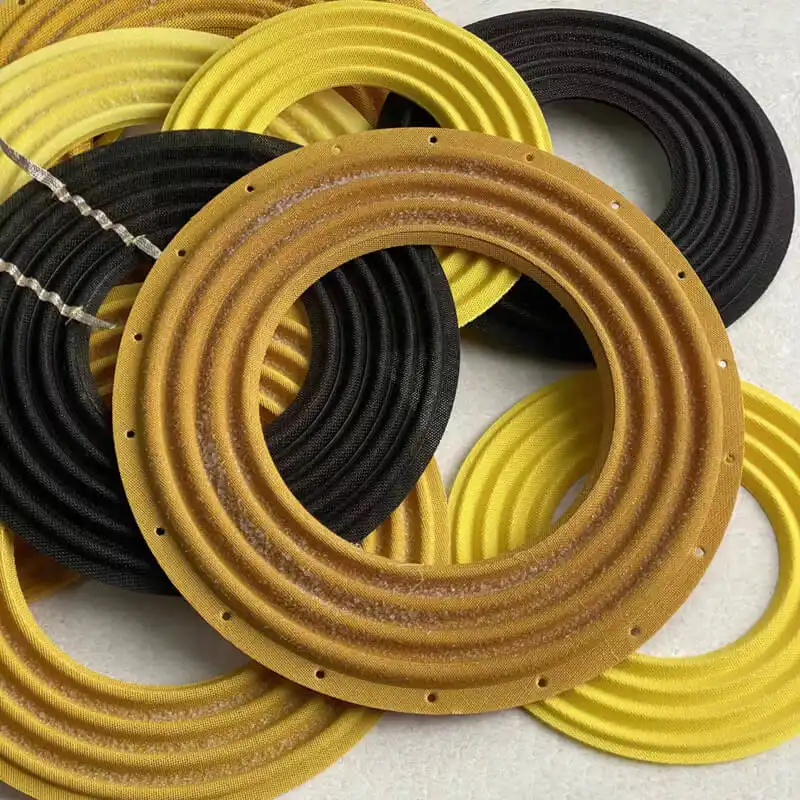
How to Choose a Speaker Spider Manufacturer for OEM Woofer and Subwoofer Production
A practical buyer guide for evaluating a speaker spider manufacturer, from tooling and material treatment to sample matching, QC, packing, and export support.
Choosing a speaker spider manufacturer is not only a purchasing decision. For woofer and subwoofer OEM production, the spider directly affects centering, excursion control, compliance, resonance behavior, durability, and assembly stability. A low-cost part that looks acceptable in a photo can still create voice-coil rubbing, inconsistent movement, poor glue bonding, or batch-to-batch variation after assembly.
For international speaker factories, OEM teams, sourcing buyers, woofer builders, and repair replacement channels, the best supplier is usually not the one with the longest online catalog. The more important question is whether the factory can understand the spider’s function inside the loudspeaker system and convert your required dimensions, materials, corrugation, and compliance target into repeatable production.
Qiao Tai, a speaker spider and damper factory in Guangzhou Panyu, China founded in 2006, works in this type of manufacturing environment: sample matching, mold support, specification confirmation, and batch production for loudspeaker suspension components. The following guide explains what buyers should verify before placing OEM woofer or subwoofer spider orders with any dedicated supplier.
Why the Speaker Spider Manufacturer Matters in OEM Production
The spider, also called a damper or centering spider, is one of the key suspension components in a loudspeaker. It supports the voice coil assembly, helps keep the coil centered in the magnetic gap, and contributes to the mechanical behavior of the moving system.
In woofer and subwoofer production, the spider is especially important because these drivers often require larger excursion, stronger suspension control, and stable performance under repeated movement. If the spider is too soft, too stiff, poorly centered, or inconsistent across batches, the finished speaker may show measurable and audible problems.
Common risks from poorly controlled spider production include:
- Voice-coil rubbing caused by poor centering or uneven compliance
- Unstable Fs or mechanical behavior from inconsistent fabric treatment
- Assembly rejection due to OD, ID, or SOD deviation
- Glue failure caused by surface treatment or material mismatch
- Different performance between pilot samples and mass production
- Deformation during packing or shipping
- Longer production delays due to unclear specifications or communication gaps
A qualified loudspeaker spider manufacturer should be able to discuss the part as a functional component, not only as a stamped fabric ring. For OEM projects, the buyer should expect support in specification confirmation, sample evaluation, mold selection or development, material control, inspection, packing, and export communication.
Key Factory Capabilities to Verify Before Sourcing
Production history and specialization
A general component trader may be able to quote a spider, but a dedicated speaker damper factory is usually better positioned to control tooling, fabric treatment, forming, sizing, and batch consistency. Production history matters because spider manufacturing is a process-driven category. Small changes in fabric, resin treatment, heat forming, corrugation, or storage conditions can affect the final behavior.
When evaluating a supplier, ask whether speaker spiders, dampers, and centering spiders are core products or only secondary catalog items. A specialist supplier should be familiar with woofer, subwoofer, midrange, and replacement requirements, and should be able to discuss common dimension points such as OD, ID, SOD, FH, and EH.
Qiao Tai’s background as a Guangzhou Panyu, China factory established in 2006 is relevant for buyers who prefer direct factory communication rather than purely marketplace-based sourcing. For international OEM teams, the value is not only price; it is the ability to confirm samples, support molds, manage production records, and keep specifications consistent across repeat orders.
Tooling and mold support
Tooling capability is one of the most important checkpoints when choosing a subwoofer spider manufacturer. Even when a supplier has many existing spider sizes, your project may need a specific outer diameter, inner diameter, corrugation profile, landing area, or height requirement.
Buyers should clarify:
- Whether existing molds match the required OD, ID, SOD, FH, and EH
- Whether a new mold is required for the project
- How mold dimensions are confirmed before production
- Whether the factory can support sample trials before batch manufacturing
- Whether the same mold and process can be reserved or repeated for future orders
Tooling decisions should be made early. If the OEM design is still flexible, an existing mold may reduce development time. If the loudspeaker structure is fixed, a custom mold may be necessary to match the frame, voice coil, cone, lead wire path, and assembly height.
Spider size range and application fit
A speaker spider is not selected by diameter alone. Two spiders with the same OD and ID may perform differently because of fabric material, corrugation count, corrugation depth, resin treatment, thickness, and forming height.
For woofer and subwoofer applications, confirm whether the supplier can support the size range and mechanical requirements of the driver. Larger subwoofers may need spiders designed for stronger movement control, while smaller woofers may prioritize precise centering and stable compliance in a compact assembly.
Useful application questions include:
- What driver size is the spider intended for?
- What voice-coil diameter and former type will it match?
- Is the spider used alone or in a dual-spider design?
- Does the design require high excursion or tighter centering?
- Is the spider for new OEM production or repair replacement?
A good woofer spider supplier will not rely on one generic part for all applications. The supplier should help narrow the specification based on the driver structure and the required manufacturing process.
Specification Checkpoints Buyers Should Confirm
Clear specifications reduce errors and make RFQ comparison more meaningful. Many sourcing problems happen because the buyer sends only a photo or approximate diameter, while the factory needs a complete set of functional and dimensional details.
Dimensional checkpoints: OD, ID, SOD, FH, and EH
For OEM orders, the following dimensions should be checked carefully:
- OD, outer diameter: The full outside size of the spider. It must fit the basket landing area and glue position.
- ID, inner diameter: The center opening. It must match the voice-coil former and assembly clearance.
- SOD, spider outside diameter or special outer diameter reference: Often used to describe the functional outer position required by the customer’s drawing or sample. Buyers should define how they use this term to avoid misunderstanding.
- FH, free height or forming height: The height condition of the spider before assembly, depending on how the supplier and buyer define it.
- EH, effective height or assembled height reference: The height relationship that affects cone, voice coil, and suspension geometry.
Because terminology can vary between factories and engineering teams, it is useful to attach drawings, photos with measurement marks, and physical samples where possible. If your team uses FH and EH in a specific way, define those values clearly in the RFQ.
Voice-coil group and assembly matching
The spider must match the voice-coil group. This includes voice-coil diameter, former material, winding height, adhesive process, and the required clearance in the magnetic gap. A spider that is too loose may not center the coil reliably. A spider that is too stiff or incorrectly formed can create assembly stress.
For OEM projects, provide the supplier with the voice-coil group information if available. Even basic details such as coil diameter, spider mounting position, and target application can help the factory recommend a more suitable spider construction.
Material code and fabric treatment
Material selection is a central part of spider manufacturing. Buyers should confirm the material code, fabric type, resin treatment, thickness, and any required performance characteristics. The same visual design can behave differently if the fabric treatment changes.
Fabric treatment affects stiffness, compliance, shape retention, heat behavior, and glue compatibility. For repair replacement channels, close matching to the original sample may be the priority. For OEM production, the spider should be selected to meet the driver’s design target and production stability.
Important questions include:
- What material code will be used for production?
- Is the sample made from the same material as the mass-production batch?
- Is the resin treatment controlled and repeatable?
- Are there any special requirements for stiffness, flexibility, or temperature exposure?
- Is the surface compatible with the buyer’s adhesive process?
Corrugation, compliance, and centering
Corrugation geometry influences movement and centering behavior. The number of waves, wave depth, wave spacing, and forming quality all affect the spider’s mechanical response. For subwoofers, corrugation design is especially important because the suspension must support larger movement without unstable deformation.
Compliance should be discussed as early as possible. If the buyer has a target value, it should be included in the RFQ. If not, a physical reference sample can help the manufacturer match the required feel and behavior more closely. However, sample matching should not stop at appearance. The supplier should compare dimensions, material, corrugation, height, and centering quality.
For OEM teams, pilot samples should be assembled into actual drivers and tested before mass production approval. A spider that passes visual inspection may still require adjustment after speaker-level testing.
Sampling, Quality Control, and Batch Consistency
Sample matching process
Sample matching is a practical way to begin when the buyer does not have a complete engineering drawing. The buyer sends an original spider, speaker sample, or detailed photos and measurements. The factory then checks whether an existing mold and material can match the sample or whether a new solution is needed.
A useful sample matching process should confirm:
- Dimensional match: OD, ID, SOD, FH, EH, and landing areas
- Material and treatment similarity
- Corrugation shape and wave count
- Center hole and voice-coil fit
- Flatness and forming condition
- Compliance feel or measured behavior where applicable
- Packing method for sample shipment
For repair replacement channels, visual and dimensional matching may be the main requirement. For OEM woofer and subwoofer production, the sample must also pass assembly and speaker performance checks before batch approval.
QC reports and inspection records
Quality control should be discussed before the purchase order is placed. A reliable OEM speaker parts supplier should be able to define what will be inspected and how inspection results are recorded.
Typical QC checkpoints for speaker spiders include:
- Incoming material confirmation
- Mold and process setup verification
- OD and ID measurement
- Height inspection for FH and EH references
- Corrugation appearance and forming consistency
- Center hole position and roundness
- Surface condition and contamination check
- Batch labeling and traceability support
- Final packing inspection
For international buyers, QC documentation is valuable because it reduces uncertainty before shipment. The report does not need to be complicated, but it should match the agreed specification and clearly identify the production batch.
ERP process control and repeat orders
For repeat OEM production, process control matters as much as the initial sample. A supplier that uses structured order records and production management can better maintain consistency between the approved sample and future batches.
ERP process control can help connect customer specifications, material codes, mold references, order quantities, production schedules, inspection status, and delivery records. For the buyer, this reduces the risk of specification drift when orders are repeated months later.
When discussing repeat orders, confirm whether the supplier can keep a clear record of:
- Approved sample version
- Drawing or measurement sheet
- Material code
- Mold reference
- Corrugation and height requirements
- Packing method
- QC criteria
- Order history
This is especially important for OEM teams that need the same spider across multiple production runs or across different factories in their supply chain.
RFQ Preparation, Packaging, and Export Communication
What to include in a speaker spider RFQ
A clear RFQ helps the manufacturer quote accurately and respond with useful technical feedback. If the RFQ is too vague, suppliers may quote different constructions, making price comparison unreliable.
For a speaker spider RFQ, include as many of the following details as possible:
- Product name: speaker spider, damper, centering spider, or loudspeaker suspension component
- Application: woofer, subwoofer, midrange, replacement, or OEM production
- Driver size and voice-coil diameter
- OD, ID, SOD, FH, EH, and any tolerance requirements
- Material code or reference material
- Corrugation count, shape, and height requirements
- Compliance or stiffness target if available
- Sample photos, drawings, or physical samples
- Quantity for sampling and batch production
- Required QC report or inspection format
- Packing requirements
- Destination country and preferred shipping method
- Expected timeline for sampling and production
If you are not sure about every specification, say so clearly. A capable speaker spider manufacturer can often help identify missing information by reviewing the sample, speaker structure, or drawing.
Packaging for export and production handling
Speaker spiders can deform if they are packed poorly. Even if the parts leave the factory within specification, pressure, moisture, or rough handling may affect their shape before they reach the assembly line.
Packaging should protect the corrugation, keep parts clean, and prevent unnecessary compression. For export orders, buyers should confirm carton strength, inner packing method, labeling, quantity per package, and whether batch information appears on the outer carton or packing list.
Repair channels may need smaller packing units for easier inventory control. OEM factories may prefer larger batch packing that matches production feeding requirements. The right packaging method depends on how the parts will be stored, transported, and used.
International sourcing communication and specification confirmation
International sourcing requires clear communication. The manufacturer should be able to confirm technical details in writing, respond to measurement questions, and avoid assumptions about unclear terms.
Before approving mass production, both sides should confirm:
- Final drawing or measurement sheet
- Approved sample status
- Material and treatment
- Mold or tooling reference
- Tolerances and inspection method
- Quantity and delivery schedule
- Packing and labeling requirements
- Shipping documents and contact details
This confirmation step is simple, but it prevents many avoidable problems. It also creates a shared reference if the buyer places repeat orders later.
Practical Takeaways for OEM Buyers
A strong speaker spider supplier should combine manufacturing experience with specification discipline. The buyer should look beyond the product photo and verify whether the factory can support the entire workflow: sample review, dimension confirmation, tooling, material selection, forming, QC, packing, and shipment.
For woofer and subwoofer production, pay close attention to OD, ID, SOD, FH, EH, voice-coil matching, material code, corrugation, compliance, and centering. These details determine whether the spider will fit the assembly and perform consistently after production begins.
For international OEM teams, the best result usually comes from treating the spider as an engineered suspension component rather than a commodity item. A direct factory such as Qiao Tai can be evaluated through the same practical checklist: production history, tooling support, sample matching ability, batch consistency, QC reporting, packaging control, and export communication. When those items are confirmed before ordering, the sourcing process becomes faster, more transparent, and less risky for woofer and subwoofer manufacturing.
FAQ
What should I check before choosing a speaker spider manufacturer?
Check the supplier’s production history, tooling capability, size range, material and fabric treatment control, sample matching process, QC reporting, packaging method, and export communication. For OEM production, also confirm whether the factory can manage repeat orders using the same material code, mold reference, and approved specification.
Which dimensions are most important when ordering speaker spiders?
The key dimensions are OD, ID, SOD, FH, and EH. Buyers should also confirm tolerance requirements, voice-coil fit, mounting position, corrugation profile, and height relationship inside the speaker assembly. Clear drawings or marked samples help prevent misunderstanding.
Can a factory match a speaker spider from a physical sample?
Yes, a dedicated speaker damper factory can often match a spider from a physical sample by checking dimensions, fabric, treatment, corrugation, height, and centering. However, OEM buyers should still test pilot samples in the actual woofer or subwoofer before approving batch production.
Why is fabric treatment important for woofer and subwoofer spiders?
Fabric treatment affects stiffness, compliance, shape retention, glue compatibility, and consistency during movement. Two spiders may look similar but behave differently if the material code or resin treatment is not the same.
What information should be included in an RFQ for speaker spiders?
Include the application, driver size, voice-coil diameter, OD, ID, SOD, FH, EH, material code, corrugation details, compliance target if available, sample photos or drawings, order quantity, QC requirements, packing needs, destination country, and expected sampling or production timeline.
Factory RFQ Next Step
Move from research to a specification shortlist with product examples that can be sent for factory quotation.