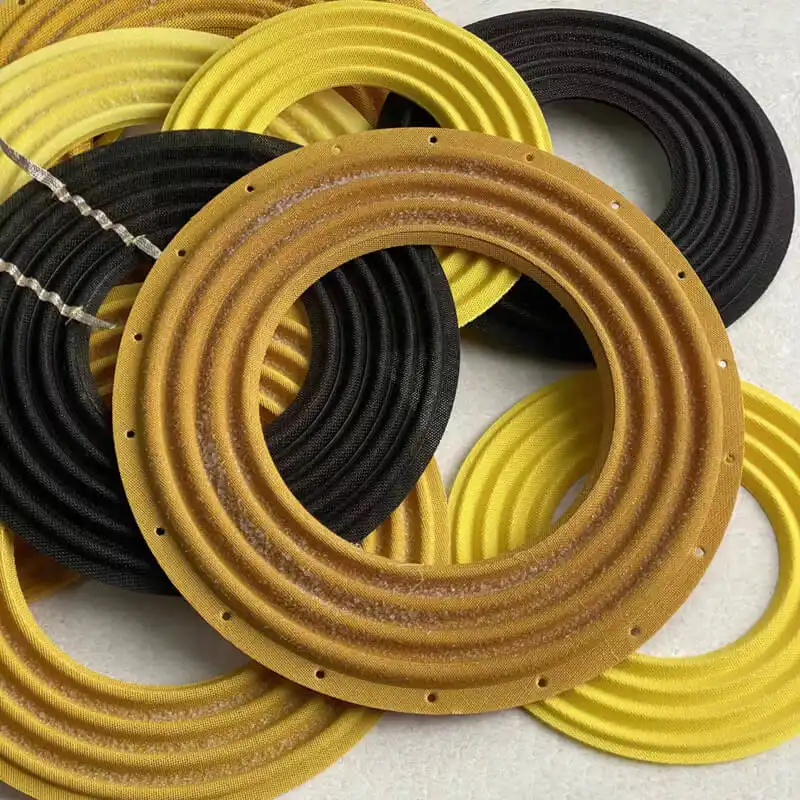
How to Choose a Speaker Spider Manufacturer for OEM Woofer and Subwoofer Projects
A buyer-focused checklist for qualifying a speaker spider manufacturer on materials, tooling, dimensions, sampling, QC, and batch consistency.
Why the speaker spider supplier matters
In woofer and subwoofer production, the spider does far more than hold a cone in place. It helps control centering, compliance, and long-term mechanical behavior around the voice coil. If the spider is unstable, inconsistent, or poorly matched to the rest of the driver, the result can show up in assembly problems, noisy operation, or uneven production yields.
That is why choosing a speaker spider manufacturer is a specification decision, not just a sourcing decision. Buyers evaluating OEM loudspeaker components need a partner that can work with the target suspension behavior, support custom dimensions, and keep batch production consistent after the sample is approved.
For OEM teams, replacement programs, and component sourcing buyers, the key question is simple: can the factory make a spider that fits the design, performs consistently, and can be supplied at scale without rework?
Start with the application, not just the part name
A speaker spider should be selected for the driver it will live in, not as a generic catalog item. Woofer spiders and subwoofer spiders often differ in compliance, corrugation profile, and load behavior. A replacement program may also require a closer match to an existing assembly than a new OEM build.
Before contacting a manufacturer, prepare the operating context:
- Driver size and power target
- Woofer or subwoofer application
- Cone and voice-coil group structure
- Required centering behavior
- Expected excursion and suspension stiffness
- Assembly method and bonding surface needs
This is where good RFQ preparation saves time. A serious supplier can respond more accurately when the request includes OD, ID, SOD, FH, EH, material code, and the intended voice-coil group. Without those details, sample matching often takes longer and production risk rises.
The dimensions that matter most
For spider sourcing, dimensional accuracy is not optional. Buyers should confirm:
- OD: outer diameter
- ID: inner diameter
- SOD: spring outer diameter or supporting outer reference, where applicable
- FH: folded or form height, depending on the design drawing
- EH: effective height or edge height, depending on internal specification use
Even when two spiders look similar, small differences can change centering behavior and assembly fit. A reliable speaker spider factory should be able to discuss these dimensions clearly and align them with the voice-coil group and cone geometry.
What a capable speaker spider manufacturer should be able to offer
A strong manufacturer is not only producing a part; it is managing a process. For OEM buyers, that process should include material selection, tooling support, sample confirmation, and stable batch output.
Material options and material control
Spider performance begins with the material system. Buyers should ask what material options are available for the required stiffness, heat resistance, and compliance range. Just as important, the factory should be able to identify the material code used for the approved sample.
Useful checkpoints include:
- Material type and code used for the build
- Resin or treatment system, if relevant to the design
- Fabric or composite consistency
- Cure or forming control
- Correlation between sample material and production material
If the sample and batch use different material lots or uncontrolled substitutions, consistency becomes difficult to maintain. For OEM projects, that risk is usually more expensive than taking time to lock the material specification early.
Tooling range and custom support
A good speaker spider manufacturer should support both standard tooling and custom tooling for special profiles. That matters for OEM woofer and subwoofer builds where the spider may need a unique diameter, compliance curve, or corrugation pattern.
Ask whether the factory can handle:
- Custom spider profiles
- Different corrugation shapes and counts
- Tooling for matched assemblies
- Development for replacement programs
- Mold support when a new design is required
Tooling capability is especially important when the spider must match an existing driver design. In that situation, the buyer is not just purchasing a part; the buyer is looking for dimensional replication with practical production support.
Corrugation, compliance, and centering
The corrugation design controls a large part of the spider’s mechanical behavior. For buyers, this means the pattern cannot be evaluated by appearance alone.
What to confirm:
- Corrugation height and spacing
- Compliance target for the driver
- How the spider centers the voice coil during movement
- Whether the design supports the required excursion range
- Whether the assembly remains stable under repeated use
A spider that is too stiff can affect sensitivity and movement. One that is too soft can reduce centering control and increase the chance of rubbing. The best supplier will treat corrugation as a functional parameter tied to the voice-coil group and the overall suspension design.
How to evaluate sample matching and RFQ communication
Sampling is where a buyer learns whether the supplier understands real production needs. A sample that looks acceptable but does not match the intended build can cost time on the production line.
What should be included in the sample request
A useful RFQ for a custom speaker spider should include:
- Drawing or sketch with all dimensions
- OD, ID, SOD, FH, and EH
- Voice-coil group information
- Material code or preferred material description
- Required quantity for test build
- Bonding or assembly notes
- Any replacement-match target sample
If you are working on a woofer spider supplier search for a replacement program, provide the existing part and explain what must stay unchanged. If the goal is a new OEM design, provide the performance target rather than only the shape.
What to look for in the sample process
A capable factory should respond with more than a price. Look for clear communication around:
- Dimensional confirmation before production
- Sample lead time expectations
- Process questions that identify risk early
- Feedback on feasibility or tolerance conflict
- Willingness to revise the sample if the first version needs adjustment
Good export communication matters here as much as the part itself. Buyers outside China often rely on drawings, photos, and written approvals to avoid misunderstanding. A clear supplier should be able to keep technical communication organized and traceable.
QC records and batch consistency are not optional
For OEM loudspeaker components, the sample is only the beginning. The real test is whether the factory can repeat the approved build in batch production.
Quality checkpoints buyers should ask about
A manufacturing partner should be able to describe its inspection process for each order. Useful questions include:
- Are incoming materials checked against the approved specification?
- Are critical dimensions verified before shipment?
- Is there a record for each batch?
- How is the approved sample referenced during production?
- What happens if a deviation appears during output?
You do not need a complicated quality story. You need a reliable one. The supplier should be able to show how QC records are linked to the approved sample and how production is controlled from order to shipment.
Why batch consistency matters
A speaker spider can pass one sample test and still create problems in volume production if the process is not stable. Small changes in material, forming, or curing can alter the behavior of the spider enough to affect centering and assembly.
For buyers, batch consistency affects:
- Assembly yield
- Rework rate
- Driver performance consistency
- Warranty risk in replacement channels
- Overall purchasing confidence
When evaluating a speaker spider factory, ask how they maintain repeatability across production runs. This is especially important for OEM projects that require ongoing supply, not just a one-time sample.
A practical buyer checklist before placing an order
Use this list to compare suppliers during RFQ and sample review:
- Can the factory make the required spider geometry, not only a standard catalog version?
- Are OD, ID, SOD, FH, and EH clearly confirmed?
- Is the material code documented and repeatable?
- Does the corrugation match the intended compliance and centering need?
- Can the supplier support voice-coil group matching?
- Is sample approval traceable to production output?
- Are QC records available for batch control?
- Is export communication clear, responsive, and technical?
- Can the factory support custom tooling or mold work if needed?
If several of these answers are vague, the risk usually appears later in production. A buyer should treat vague responses as a warning sign, especially for subwoofer spider manufacturer searches where suspension behavior is critical.
What this means for OEM woofer and subwoofer projects
The right speaker spider manufacturer should reduce uncertainty, not add it. For OEM drivers, that means the supplier must understand how the spider fits into the full suspension system. For replacement programs, it means the factory must be able to match existing specs with practical accuracy. For sourcing teams, it means technical clarity, stable batch output, and straightforward communication.
In short, the best partner is one that can:
- Understand the application
- Confirm the specification in measurable terms
- Support samples and revisions
- Control quality during production
- Deliver consistent batches for ongoing supply
That is the standard buyers should use when comparing speaker spider suppliers for woofer and subwoofer projects.
FAQ
What information should I send in a speaker spider RFQ?
Send the drawing, OD, ID, SOD, FH, EH, material code, voice-coil group details, target quantity, and any sample for matching.
How do I know if a spider is suitable for a woofer or subwoofer?
Check its compliance, corrugation, centering behavior, and whether it matches the voice-coil and cone structure of the driver.
Why is sample matching so important?
Because a spider can look correct but still affect centering, excursion, or assembly fit. Sample approval helps reduce production risk.
What should buyers ask about QC?
Ask how the factory checks material, dimensions, and batch consistency, and whether production records are tied to the approved sample.
Can a spider manufacturer support custom dimensions?
A capable factory should be able to support custom tooling and custom dimensions when the project requires a non-standard fit or a replacement match.
FAQ
What information should I send in a speaker spider RFQ?
Send the drawing, OD, ID, SOD, FH, EH, material code, voice-coil group details, target quantity, and any sample for matching.
How do I know if a spider is suitable for a woofer or subwoofer?
Check its compliance, corrugation, centering behavior, and whether it matches the voice-coil and cone structure of the driver.
Why is sample matching so important?
Because a spider can look correct but still affect centering, excursion, or assembly fit. Sample approval helps reduce production risk.
What should buyers ask about QC?
Ask how the factory checks material, dimensions, and batch consistency, and whether production records are tied to the approved sample.
Can a spider manufacturer support custom dimensions?
A capable factory should be able to support custom tooling and custom dimensions when the project requires a non-standard fit or a replacement match.
Factory RFQ Next Step
Move from research to a specification shortlist with product examples that can be sent for factory quotation.