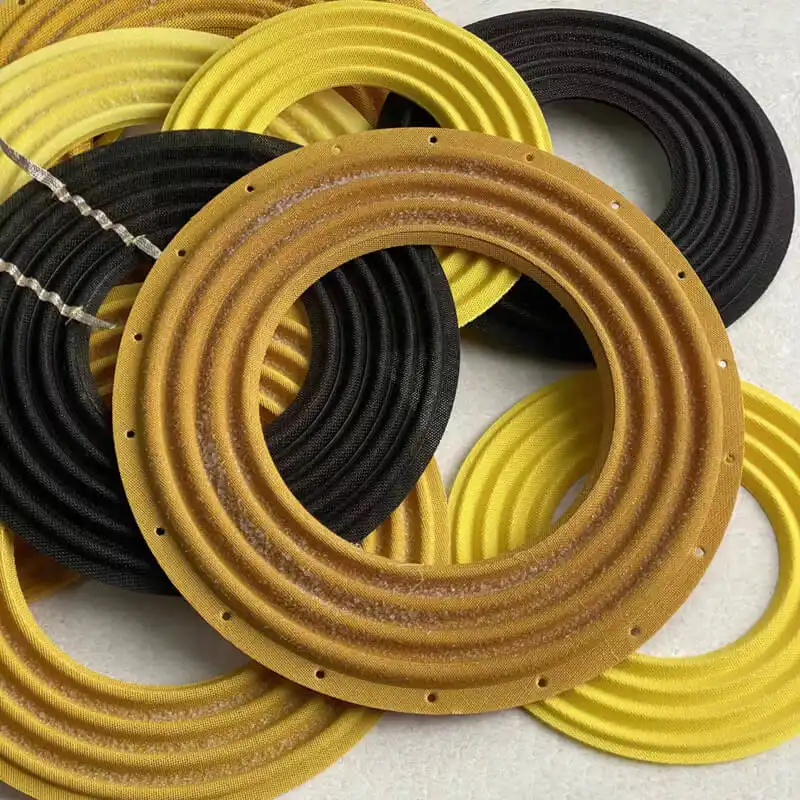
Subwoofer Spider Damper Selection for High Excursion, High Power and Batch Production
A practical buyer guide to choosing a subwoofer spider damper for high excursion, thermal stress, sample approval, and repeatable mass production.
Subwoofer performance depends heavily on the spider damper, especially in designs built for long excursion, high power handling, and stable batch output. For subwoofer builders, car audio OEM teams, and component sourcing buyers, spider selection is not only a suspension choice. It affects centering, sensitivity balance, glue security, thermal durability near the voice coil, and long-term fatigue behavior.
A generic replacement spider may work for repair, but production subwoofers need tighter control. High-excursion platforms often require dual spiders, progressive corrugation, larger ID layouts, and stiffness tuning that matches the moving system. If those details are missed during sourcing, the result can be coil rub, unstable excursion, glue failure, inconsistent units, or a sample that performs well but cannot be repeated in volume.
This guide explains what to check when selecting a subwoofer spider damper, why those details matter, and how to approve samples before moving to batch production.
Why the spider damper matters more in subwoofers
In a full-range or small woofer, the spider still plays a central mechanical role, but in a subwoofer the demands rise sharply. The suspension must control a heavier cone assembly, larger voice coil, stronger motor, and much greater stroke. That changes the buyer's checklist.
A subwoofer spider damper must help deliver:
- reliable centering of the voice-coil assembly
- controlled compliance across low-frequency excursion
- resistance to heat from the coil area
- stable bonding to cone neck, voice-coil former, and frame landing
- repeatable stiffness from sample stage to production lots
- fatigue life under repeated high-amplitude movement
For car subwoofer platforms and other high-output systems, the spider often becomes a key tuning part rather than a standard support component. Small changes in material, corrugation profile, or free height can alter the way the driver behaves at excursion limits.
Key selection points for high excursion and high power subwoofers
Dual spiders for better control
A dual spider subwoofer design is commonly considered when a single spider cannot provide enough stability or restoring force for the target excursion and moving mass. Dual spiders can improve centering and help manage tilt in demanding applications, especially when the coil is tall and the stroke window is wide.
For buyers, the question is not simply whether the product uses one spider or two. The practical points are:
- spacing between the spiders
- matching of stiffness between upper and lower spiders
- glue land width and bonding consistency
- alignment with the voice-coil former and frame structure
- assembly repeatability in production
A dual-spider system can improve mechanical control, but it also increases the need for dimensional accuracy and process discipline. If one spider differs too much from the other, the assembly may show uneven centering or inconsistent compliance.
Progressive rolls and corrugation design
A progressive spider for subwoofer applications is often used when builders want softer initial movement with stronger resistance as excursion increases. That behavior depends on corrugation geometry, fabric treatment, and overall forming profile.
Progressive roll selection matters because it influences:
- low-level linearity
- control near peak excursion
- bottoming resistance behavior
- perceived transient control in the finished driver
Corrugation should never be treated as a cosmetic detail. Buyers should confirm the number of rolls, roll depth, spacing, and whether the profile is intended for linear compliance or progressive loading. This is especially important when matching a new spider to an existing motor and cone assembly.
Larger ID designs and voice-coil matching
High-power subwoofers often use larger voice coils, and that changes spider geometry. A larger ID can be necessary to clear the coil former, adhesives, winding geometry, and venting features. The spider should fit the moving system without forcing compromises in glue line or assembly alignment.
Critical checkpoints include:
- ID: inside diameter, matched to voice-coil former and adhesive area
- OD: outer diameter, matched to basket landing and suspension layout
- SOD: seat or support outer diameter, depending on drawing convention used by the factory and buyer
- FH: free height of the spider before assembly
- EH: installed or effective height used to control the suspension position in assembly
- voice-coil group or coil size family
- cone neck and former bonding dimensions
Buyers should verify drawing conventions early. Different factories and engineering teams may use slightly different terminology for SOD, FH, or EH. The important point is that both sides confirm the same measuring method before mold work or sample approval begins.
Higher stiffness options and compliance control
High excursion does not always mean soft suspension. In many subwoofer builds, especially high-power car audio designs, higher stiffness is selected to control the moving system under heavy drive conditions.
The right stiffness depends on the whole driver concept:
- motor strength
- moving mass
- intended enclosure type
- target low-frequency behavior
- excursion limit strategy
- power level and thermal load
A spider that is too soft may allow excessive travel, poor centering control, and a higher risk of mechanical instability. A spider that is too stiff may reduce the intended low-frequency response or produce an unwanted mechanical character. The practical goal is controlled compliance that suits the voice-coil length, gap geometry, and target use case.
For repeatable sourcing, buyers should ask for a clear material code and stiffness-related sample reference rather than relying only on subjective terms like hard, soft, or heavy-duty.
Material, heat resistance, and glue bonding strength
Subwoofers run close to heat sources. The spider sits near the voice coil, where repeated high input can raise local temperature and challenge both the base material and the bonded joints.
Material selection near the coil
A suitable high excursion speaker spider needs material stability under mechanical cycling and thermal stress. Buyers should confirm:
- base fabric type
- resin or treatment system
- material code used for repeat production
- forming stability after curing
- stiffness retention after heat exposure
Material variation between lots can change the mechanical behavior enough to affect driver consistency. That is why sample approval should always lock the material code, not only the shape.
Glue line security
Glue failure is one of the most expensive avoidable problems in subwoofer production and repair. Even a well-designed spider can underperform if the bond to the former or frame is weak, contaminated, or too narrow.
Important bonding checkpoints include:
- bonding width at ID and OD
- adhesive compatibility with spider treatment
- glue penetration without oversaturation
- surface cleanliness before bonding
- curing conditions and assembly consistency
For high-power subwoofers, buyers should pay close attention to the heat zone near the inner bond area. The voice-coil side of the spider can face repeated thermal cycling, and that makes material-to-adhesive compatibility especially important.
Why thermal behavior matters in batch production
A spider sample may pass short listening tests and still fail in field use if it hardens, relaxes, or weakens after heat and fatigue. Production approval should therefore include checks that reflect real subwoofer conditions, not only dimensional inspection.
Factory specification checkpoints before sampling
A well-prepared RFQ shortens development time and reduces avoidable revisions. The best subwoofer spider sourcing projects start with a complete technical package rather than a simple request for a similar part.
Core dimensions to confirm
Before sampling, buyers should align on:
- OD
- ID
- SOD
- FH
- EH
- roll count and corrugation profile
- landing widths for ID and OD glue areas
- vent or clearance needs around the voice-coil group
If a replacement match is required, sending the physical original sample is often the fastest route. For new product development, drawings with tolerances are preferable.
Performance and construction details to define
Dimensional fit alone is not enough. Buyers should also specify:
- target compliance range
- stiffness preference or reference sample
- single or dual spider structure
- progressive or linear roll preference
- material code if already qualified
- expected power and excursion level
- frame type and assembly height reference
- voice-coil former material and diameter
RFQ details that improve quoting accuracy
A useful RFQ for a subwoofer spider manufacturer or woofer damper supplier should include:
- application: repair replacement, OEM, or new development
- annual or batch quantity
- sample quantity needed
- drawings or actual samples
- testing standard or approval method
- packaging requirements
- target production timeline
This helps the factory judge whether existing molds can be adapted, whether new tooling is required, and how to control repeatability once the part is approved.
How to approve samples before mass production
Sample approval is where many future production issues can be prevented. A spider that looks correct on the table still needs confirmation in the driver.
Check fit and assembly behavior
The first step is dimensional and assembly verification:
- Does the ID fit the former with the correct glue land?
- Does the OD sit cleanly on the basket landing?
- Is the FH suitable for the intended suspension geometry?
- Does the installed EH place the coil correctly in the magnetic gap?
- Is there enough clearance during excursion?
This stage should include actual assembly trials, not just loose part measurement.
Check centering and excursion stability
Once assembled, the focus shifts to mechanical behavior. Buyers should evaluate:
- centering of the voice coil at rest
- freedom from rub through intended stroke
- tilt resistance under high excursion
- consistency between units
- symmetry of movement in both directions
For dual-spider designs, the alignment process should be reviewed carefully because assembly error can mask or exaggerate the spider's real performance.
Check fatigue and heat response
A sample approved only by initial feel is not enough for high-power subwoofer production. A more practical approval process includes repeated drive or motion testing to observe:
- stiffness shift after cycling
- bond integrity after thermal exposure
- change in centering behavior
- visible cracking, separation, or deformation
- unit-to-unit consistency after stress
The exact test method may vary by factory and buyer, but the principle is constant: verify that the spider remains mechanically stable after the type of load the subwoofer is expected to face.
Lock the approved specification
Once the sample is approved, the production reference should be frozen clearly. That record should include:
- approved drawing
- material code
- key dimensions and tolerances
- corrugation form
- sample ID or retained golden sample
- glue area references if relevant to the part design
- packaging and inspection notes
This is essential for ERP-controlled production, incoming inspection, and later repeat orders. Without a locked specification, a buyer may receive a part that is visually similar but mechanically different.
What buyers should watch in mass production
The move from samples to production is where sourcing risk often appears. A strong first sample does not guarantee stable batches unless the process is controlled.
For batch production of a car subwoofer damper or other high-power woofer spider, buyers should pay attention to:
Dimensional consistency
OD, ID, FH, and EH variation can change assembly fit and coil position. Even small drift can affect centering or glue line quality.
Material consistency
Material substitutions or uncontrolled lot variation can change stiffness, fatigue life, and heat response. Material code control is critical.
Forming and corrugation repeatability
Inconsistent corrugation depth or shape can alter compliance and make one batch perform differently from the next.
Inspection discipline
A reliable factory process should include checks on dimensions, appearance, forming quality, and sample retention. For OEM programs, traceability becomes even more important.
Packaging and delivery condition
Spider dampers can deform if packed poorly. Buyers should confirm packaging that protects free height and prevents crushing during shipment and storage.
Practical takeaway for OEM teams, builders, and repair channels
A subwoofer spider damper should be selected as an engineered suspension part, not a generic accessory. In high-excursion and high-power drivers, the spider influences centering, durability, excursion control, and production yield.
For buyers, the safest path is straightforward:
- define OD, ID, SOD, FH, and EH clearly
- match the spider to the voice-coil group and assembly height
- confirm corrugation style, including progressive or linear behavior
- choose material and stiffness by tested sample, not description alone
- review glue bonding strength around the heat zone near the coil
- conduct fatigue and assembly validation before release
- freeze the approved sample and specification for batch production
That approach helps subwoofer builders and OEM sourcing teams avoid common failures while improving repeatability from prototype stage to volume orders.
FAQ
What is the main job of a subwoofer spider damper?
A subwoofer spider damper centers the voice-coil assembly and provides restoring force during cone movement. In high-excursion designs, it also helps control tilt, maintain alignment under load, and support long-term mechanical stability.
When should a dual spider subwoofer design be considered?
A dual spider design is often considered when the moving system is heavy, the excursion target is high, or additional centering control is needed. It can improve stability, but it also requires careful matching, spacing, and assembly control.
Which dimensions should buyers confirm before ordering spider samples?
Key checkpoints include OD, ID, SOD, FH, and EH, along with corrugation profile, glue land width, and the related voice-coil group. These dimensions affect fit, centering, installed height, and production repeatability.
Why does heat near the voice coil matter for spider selection?
The inner area of the spider is close to the voice coil, where repeated high power can create thermal stress. Buyers should check material stability, stiffness retention, and adhesive compatibility so the spider and bonded joints remain reliable over time.
How should a subwoofer spider sample be approved before mass production?
Approval should include dimensional checks, real assembly trials, centering evaluation, excursion testing, and fatigue or thermal verification. Once approved, the drawing, material code, corrugation form, and retained sample should be locked for production reference.
Factory RFQ Next Step
Move from research to a specification shortlist with product examples that can be sent for factory quotation.