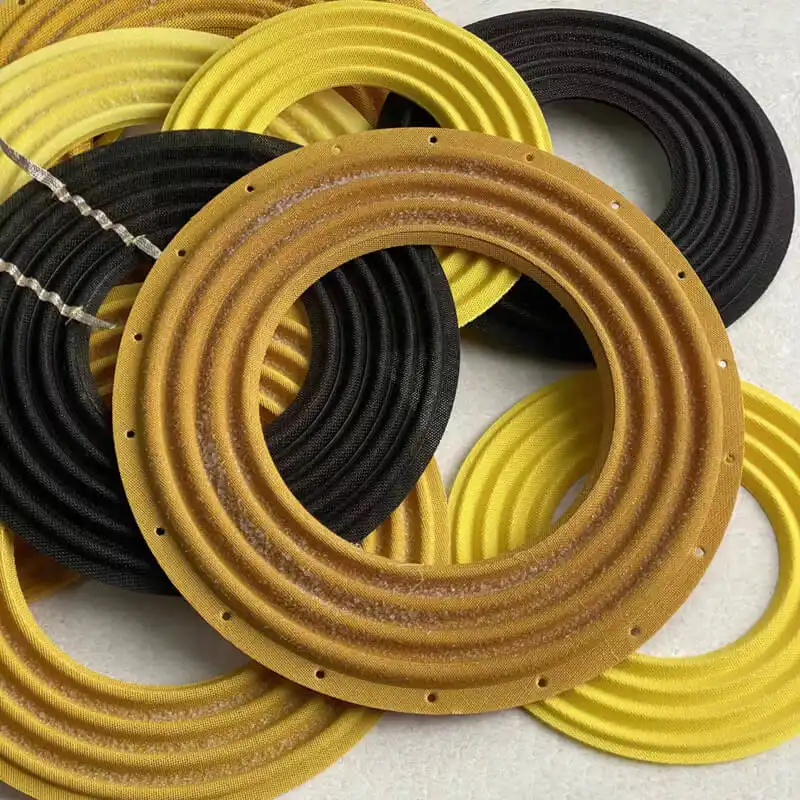
Speaker Spider Dimensions Explained: OD, ID, SOD, FH, EH and What to Include in an RFQ
A practical guide to speaker spider dimensions, RFQ checkpoints, sample matching, and specification details for OEM buyers and repair channels.
A speaker spider, also called a damper or centering spider, is a small part with a large influence on loudspeaker performance. It helps keep the voice coil centered in the magnetic gap, supports controlled axial movement, and works with the surround to define part of the suspension behavior. For purchasing engineers, OEM teams, woofer builders, subwoofer brands, and repair channels, the challenge is often not knowing that a spider is needed. The challenge is specifying it clearly enough for sample matching, quotation, tooling review, and batch production.
Many product lists describe spiders by nominal speaker size, such as 8 inch, 10 inch, 12 inch, or 15 inch. Others use simplified formats such as 190 x 75 x 25 mm. These labels may be useful for quick browsing, but they are not enough for procurement. A reliable RFQ should identify the key speaker spider dimensions: OD, ID, SOD, FH, EH, corrugation structure, wave count, material, color, lead-wire holes, tolerance, and target application.
Clear dimensions reduce back-and-forth communication, improve sample matching, and help the factory confirm whether an existing mold can be used or whether a new mold is required. They also help repair channels avoid parts that fit visually but fail in centering, clearance, or compliance after installation.
Why Speaker Spider Dimensions Matter
The spider is not only a textile or resin-treated component. It is part of the moving system. Its dimensions affect mechanical fit, voice-coil alignment, excursion behavior, and assembly efficiency. A spider with the wrong outer diameter may not sit correctly on the basket landing. A wrong inner diameter may interfere with the voice-coil former or leave too much adhesive gap. A wrong height can shift the rest position of the cone and voice coil.
For factories producing speaker spiders in batches, dimensions also affect mold selection, forming process, inspection method, and packaging. When the buyer provides accurate measurements and samples, the supplier can check:
- Whether the requested spider matches an existing mold
- Whether the seat and corrugation position suit the basket and cone assembly
- Whether the ID fits the voice-coil former and adhesive process
- Whether FH and EH support the required resting position
- Whether lead-wire holes or terminal passage points are needed
- Whether the material, resin treatment, and corrugation design are suitable for the application
A dimension-only request is still incomplete if it ignores the loudspeaker system. The same OD and ID may be used in different stiffness levels, materials, wave shapes, or heights. A woofer spider for general audio and a subwoofer spider for higher excursion may look similar in a photo, but their performance requirements can be very different.
Key Speaker Spider Dimensions: OD, ID, SOD, FH and EH
A good specification begins with a shared vocabulary. Buyers and suppliers should confirm how each dimension is measured before samples are quoted or mass production is arranged.
OD: Outer Diameter
OD means outer diameter. It is the full outside diameter of the speaker spider, measured across the widest edge. OD determines whether the spider fits the basket seat or spider landing area.
When measuring OD, check the spider in a relaxed state on a flat surface. If the part is flexible or slightly deformed from storage, avoid forcing it into a larger or smaller shape. For replacement work, measure both the old spider and the available seat area on the frame if possible.
OD is one of the first mold-related dimensions. If a factory has an existing mold with the same or close OD and matching inner structure, sampling may be faster. If the OD or corrugation layout is unique, mold support may need to be discussed.
ID: Inner Diameter
ID means inner diameter. It is the opening in the center of the spider, where the voice-coil former passes through and is usually bonded.
ID must match the voice-coil group, not just the cone size. Important voice-coil details include the former outside diameter, winding position, adhesive method, and available bonding width. If the ID is too small, assembly may be difficult or the spider may distort around the coil. If the ID is too large, the adhesive area may be insufficient, and centering accuracy can suffer.
For purchasing engineers, it is useful to provide the voice-coil former OD together with the spider ID. For repair channels, the best practice is to measure the former and the old spider opening, then confirm whether the replacement spider allows a proper glue joint.
SOD: Seat Outer Diameter
SOD usually refers to seat outer diameter, the diameter of the spider’s mounting or seating area. This is especially useful when the outer edge, flat seat, and corrugation area need to be distinguished.
In some spider designs, the full OD includes a flat outer flange. In others, the functional seating area may be more important than the absolute edge-to-edge size. If the spider has a defined flat ring for bonding to the basket, SOD helps the supplier understand where the adhesive seat should be located.
Buyers should not assume that OD and SOD are the same. When preparing drawings, mark both if the part has a visible seat or flange structure. For sample matching, clear top-view photos and section photos can help confirm the seat shape.
FH: Free Height
FH means free height. It describes the natural height of the spider when it is not installed and not compressed by assembly forces. FH is typically measured from a reference surface to a defined point on the spider profile, depending on the design.
Free height matters because it affects how the spider sits before assembly and how much preload or vertical offset may appear after bonding. Two spiders can share the same OD and ID but have different free heights, making them unsuitable substitutes.
When requesting a quote, define how FH is measured. If possible, include a side-view drawing or a measured sample. For formed spiders with corrugations, height should be checked consistently so that production inspection follows the same reference.
EH: Effective Height
EH means effective height. It is used to describe the working height or installed height that affects the suspension geometry after assembly. In practical communication, EH should be defined clearly because different teams may use the term differently.
For speaker OEM work, EH is useful when matching the spider to the cone, voice coil, frame, and magnetic gap. It helps the supplier understand the intended working position rather than only the loose part shape. For repair applications, EH helps prevent problems where the spider fits the diameter but places the cone or coil too high or too low.
A reliable RFQ should state whether EH is measured as an installed condition, a design target, or a reference height from an existing sample. If the buyer has a complete speaker assembly drawing, include the relevant vertical stack information.
Beyond Diameter: Corrugation, Wave Count, Material and Holes
Dimensions define the fit, but they do not fully define the spider. The structure and material determine how the part behaves in the loudspeaker suspension.
Corrugation and Wave Count
Corrugation refers to the raised and lowered wave structure of the spider. Wave count is the number of corrugation waves between the center and outer area. Corrugation shape, spacing, depth, and symmetry can influence compliance, movement control, and centering behavior.
When preparing a speaker spider RFQ, include wave count and corrugation type where possible. A photo may not be enough because lighting can hide shallow waves or make profiles appear different. A side-view drawing or sample is better for confirming the corrugation profile.
For woofer and subwoofer applications, the spider must support controlled movement under the expected excursion range. The supplier may need to know whether the part is for a small woofer, mid-bass driver, professional audio woofer, car subwoofer, or replacement repair kit. The target application helps determine whether the requested corrugation and material are reasonable.
Material Code and Treatment
Speaker spiders are commonly made from treated fabric materials, but the exact material and treatment should be confirmed by code, sample, or performance target. Buyers may specify material code, color, thickness, resin treatment, or stiffness requirements if these are already defined in their engineering documents.
Material selection affects compliance, durability, heat resistance, humidity behavior, and process stability. For sourcing teams, the safest approach is to send an approved sample together with the drawing. The factory can then match visual structure, material feel, color, thickness, and forming profile more accurately.
If the material code is unknown, describe the application and provide the old part for sample matching. For repair channels, this is especially important because many replacement spiders are selected by size alone, which can lead to incorrect suspension behavior after reconing.
Color and Visual Requirements
Color is not only a cosmetic issue. It can indicate material treatment or product family. Common spider colors may include yellow, brown, black, or other treated fabric appearances, depending on material and process.
If color consistency is important for visible assemblies or replacement kits, include the color requirement in the RFQ. If the part must match an existing component, provide a physical sample or clear photos under normal lighting. Color alone should not be used as proof of equivalent performance.
Lead-Wire Holes and Special Openings
Some spiders require lead-wire holes, tinsel-wire passage holes, slots, notches, or orientation marks. These features affect assembly speed and wire routing. Missing or misplaced holes can cause production delays even when the main dimensions are correct.
An RFQ should include:
- Number of lead-wire holes
- Hole diameter or slot size
- Position relative to the spider center
- Angle or orientation requirement
- Distance from ID, OD, or a reference point
- Whether holes are punched before or after forming, if relevant to the process
For OEM projects, hole position should be controlled by drawing. For repair replacement channels, it is helpful to send the old spider or a template showing wire routing.
How to Measure a Speaker Spider for Replacement or RFQ
Accurate measurement does not require a complex laboratory setup for the initial RFQ, but it does require consistency. A caliper, flat surface, height gauge or simple height reference, good lighting, and clear photos can make communication much easier.
Recommended Measurement Checklist
Before contacting a supplier, prepare the following information:
- OD: full outside diameter of the spider
- ID: center hole diameter for the voice-coil former
- SOD: seat outer diameter or bonding seat diameter, if different from OD
- FH: free height of the uninstalled spider, with measurement reference
- EH: effective or installed height, if known
- Wave count: number of corrugations
- Corrugation profile: shallow, deep, flat, progressive, or sample-based
- Material code: fabric type, treatment, thickness, or approved sample
- Color: required color or sample color
- Lead-wire holes: quantity, size, and position
- Tolerance: acceptable dimensional variation
- Voice-coil group: former OD, coil size, and bonding requirement
- Target application: woofer, subwoofer, full-range driver, repair kit, or OEM production
- Sample quantity: number of samples needed for testing and approval
- Batch quantity: estimated order quantity after approval
This information allows the factory to check mold availability, sampling feasibility, production process, and inspection points. It also helps avoid quoting a part that is dimensionally close but functionally unsuitable.
Common Measurement Mistakes
A frequent mistake is measuring only the outer diameter and center hole. OD and ID are important, but they do not confirm the spider height, seat, or working behavior. Another common mistake is using the nominal speaker size as the spider size. A 12-inch speaker does not always use the same spider OD or ID as another 12-inch speaker.
Buyers also sometimes measure deformed used parts without noting that the spider has sagged, hardened, or been damaged by removal. For repair applications, the old spider is still useful, but measurements should be supported by frame, cone, and voice-coil dimensions.
In OEM procurement, drawings may list dimensions but omit tolerance. Without tolerance, the supplier cannot know which dimensions are critical and which are flexible. ID, seat diameter, and height often require tighter control than purely visual features.
What to Include in a Speaker Spider RFQ
A strong RFQ is more than a request for price. It is a technical communication package that helps the factory confirm the product before quoting tooling, samples, and batch production.
RFQ Information for OEM Teams
For loudspeaker factories and OEM teams, the RFQ should include a drawing, target specification, approved sample if available, and expected production quantity. If the speaker is still under development, state whether the spider specification is fixed or open to adjustment.
Useful RFQ details include:
- Product name: speaker spider, damper, or centering spider
- Drawing with OD, ID, SOD, FH, EH, hole positions, and tolerances
- Voice-coil group information
- Cone and frame assembly relationship, if relevant
- Material code or sample requirement
- Corrugation and wave count
- Compliance or centering target, if already defined by engineering
- Required sample quantity and testing plan
- Batch forecast and delivery expectations
- Packaging or labeling requirements
With these details, a direct factory can evaluate mold support, specification confirmation, sample production, and ERP-controlled batch order handling more efficiently.
RFQ Information for Repair and Replacement Channels
Repair channels often work with incomplete data. In that case, the RFQ should focus on accurate sample matching and practical installation needs.
Provide:
- Old spider sample, even if damaged, when available
- Speaker model or application type
- OD, ID, height, and wave count measurements
- Voice-coil former diameter
- Photos of the basket seat and cone assembly
- Lead-wire routing details
- Desired quantity for repair kits or resale
For subwoofer spider replacement size selection, height and compliance are especially important. A replacement spider that simply fits the frame may still create rubbing, offset the cone, or change the suspension behavior.
Tolerance and Quality Inspection Points
Tolerance should be discussed early. It is not enough to state one size without an acceptable range. During production, the factory needs inspection standards for critical dimensions and appearance.
Common inspection points include OD, ID, seat size, height, hole position, corrugation forming, color, surface condition, and batch consistency. Depending on the application, centering performance and stiffness-related checks may also be part of the approval process.
For batch production, process control matters. Clear specifications support incoming material checks, forming control, in-process inspection, final inspection, labeling, and delivery management. When the RFQ is complete, the supplier can reduce uncertainty from sample stage to production shipment.
Practical Takeaways for Buyers
Speaker spider dimensions should be treated as a system specification, not a simple catalog size. OD, ID, SOD, FH, and EH define the physical fit, while corrugation, material, wave count, holes, tolerance, and voice-coil matching define whether the part will work in the speaker.
For purchasing engineers, the best RFQ combines a drawing, an approved sample, application details, and target production quantity. For repair teams, careful measurement and sample matching are the safest path when original drawings are not available.
A clear specification helps the factory confirm whether an existing mold can be used, whether a new mold is required, what samples should be made, and how batch production should be inspected. It also helps buyers compare quotations fairly, because every supplier is responding to the same technical requirements.
When preparing your next speaker spider RFQ, do not stop at “8 inch” or “15 inch.” Define the part by OD, ID, SOD, FH, EH, voice-coil group, material, corrugation, wave count, holes, tolerance, sample quantity, and target application. Those details make the difference between a part that only looks close and a spider that centers, fits, and performs correctly.
FAQ
What are the most important speaker spider dimensions to provide in an RFQ?
The key dimensions are OD outer diameter, ID inner diameter, SOD seat outer diameter, FH free height, and EH effective height. Buyers should also include wave count, corrugation profile, material, color, lead-wire hole details, tolerance, voice-coil group information, sample quantity, and target application.
Is speaker size enough to choose a replacement spider?
No. Nominal speaker size such as 10 inch, 12 inch, or 15 inch does not define the spider. Different speakers with the same nominal size may use different OD, ID, height, corrugation, material, and compliance. Replacement selection should be based on measurements, voice-coil matching, and application requirements.
What is the difference between OD and SOD on a speaker spider?
OD is the full outside diameter of the spider. SOD refers to the seat outer diameter or bonding seat area, when that area is different from the full outer edge. SOD is important for confirming how the spider mounts to the basket or spider landing.
Why do FH and EH matter for woofer and subwoofer spiders?
FH describes the free height of the uninstalled spider, while EH refers to the effective or installed working height when defined by the assembly. These height values affect cone position, voice-coil centering, preload, and clearance. A spider with correct OD and ID can still fail if its height is wrong.
What should repair channels send for sample matching?
Repair channels should provide the old spider if available, measurements for OD, ID, height, and wave count, voice-coil former diameter, photos of the basket seat and cone assembly, lead-wire routing details, and the target quantity. This helps the factory match fit and function more accurately.
Factory RFQ Next Step
Move from research to a specification shortlist with product examples that can be sent for factory quotation.