Speaker Spider Corrugation and Compliance: What Buyers Should Specify Before Production
A practical buyer guide to speaker spider corrugation, compliance, centering stability, resin treatment, and RFQ details before production.
Speaker Spider Corrugation and Compliance: What Buyers Should Specify Before Production
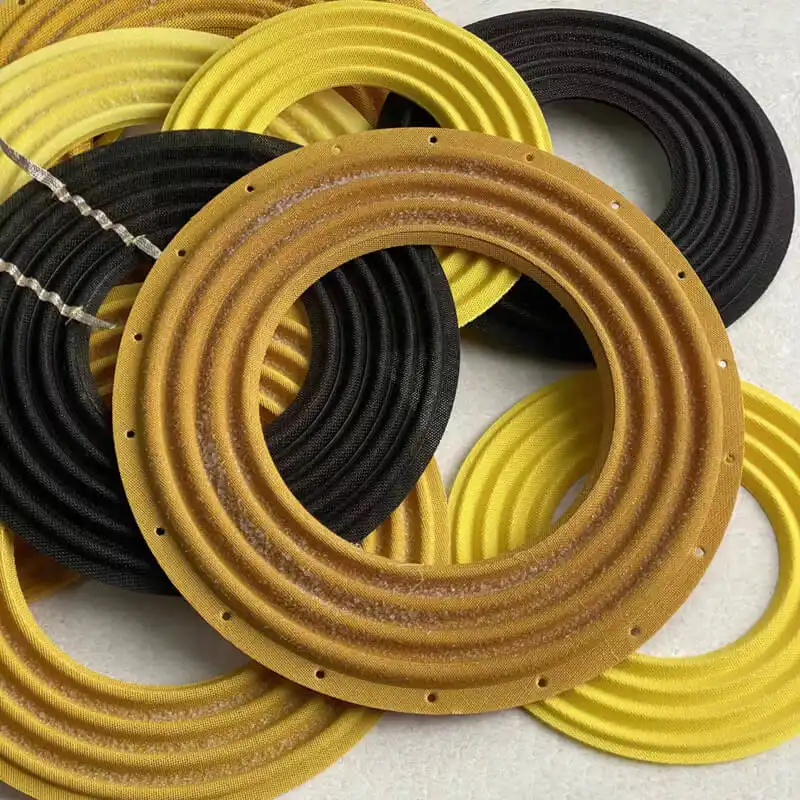
Speaker spider corrugation is one of the most important design details in a loudspeaker suspension system. It influences how the voice coil returns to center, how the cone moves under load, how the suspension behaves near its limits, and how consistently the speaker performs after production. For OEM teams, woofer and subwoofer builders, repair channels, and component sourcing buyers, the spider is not just a round fabric part with waves. It is a mechanical control component.
A speaker spider, also called a damper or centering spider, must balance several requirements at the same time: compliance, restoring force, centering accuracy, durability, and compatibility with the voice-coil group. Corrugation count, roll shape, profile depth, resin treatment, fabric structure, OD, ID, SOD, FH, and EH all affect the final behavior. If these details are not specified clearly before sampling and batch production, two spiders that look similar can perform very differently.
For buyers preparing a technical RFQ, the goal is not to overcomplicate the purchase. The goal is to define the spider well enough that the factory can match the required mechanical behavior, confirm the mold or tooling direction, inspect critical dimensions, and keep production consistent across batches.
Why Speaker Spider Corrugation Matters
Corrugation is the wave structure formed into the spider. These waves allow the fabric to flex while keeping the voice coil centered in the magnetic gap. The design of the corrugation directly affects spider compliance, which is the suspension’s resistance to movement. A more compliant spider allows easier movement. A stiffer spider provides stronger restoring force and tighter control.
In a loudspeaker, the spider works together with the surround, cone, voice coil, and motor system. If the spider is too soft, the moving assembly may lose centering stability, especially under high excursion or heavy cone load. If it is too stiff, sensitivity, low-frequency response, or intended tuning may be affected. In repair replacement channels, an incorrect spider can change the original sound and may cause rubbing if centering is not controlled.
Speaker spider corrugation also influences the type of suspension behavior:
- A more linear spider aims to provide a more even restoring force through its working range.
- A more progressive spider becomes increasingly resistant as excursion increases, helping control movement near the limits.
- A spider with deeper or wider rolls may move differently from one with shallow, narrow corrugations, even if OD and ID are the same.
This is why buyers should not approve a spider only by visual appearance. The corrugation profile, material construction, and treatment must be reviewed together.
Corrugation Variables That Affect Compliance and Stability
Corrugation count
Corrugation count refers to the number of waves or rolls formed into the spider. More corrugations can increase the available flexing area, but the result depends on roll shape, depth, material, and resin. A spider with many shallow corrugations may not behave the same as one with fewer deep corrugations.
For buyers, corrugation count should be specified with a drawing, sample, or clear photo when possible. If the required performance is known, the RFQ should also state whether the spider is intended for a woofer, subwoofer, midrange, professional driver, car audio driver, or repair replacement application. The intended excursion and centering demand help the factory judge whether the corrugation design is suitable.
Roll geometry and spacing
Roll geometry includes the shape, width, radius, and spacing of each corrugation. Two spiders may have the same number of corrugations but different roll geometry. Wider rolls usually provide a different flex pattern from narrow rolls. Smooth roll transitions can help reduce stress concentration, while sharper profiles may create different stiffness characteristics.
Spacing also matters. A spider with tightly packed corrugations may distribute movement differently from one with wider spacing. For high-excursion woofers and subwoofers, the roll geometry should be reviewed carefully because the spider must support movement without losing centering or creating unwanted mechanical resistance.
Profile depth
Profile depth is the height or depth of the corrugation profile. It is one of the most visible factors, but it should still be measured and confirmed rather than estimated. Deeper profiles can increase movement capacity and affect compliance, while shallow profiles may provide tighter control depending on material and treatment.
Profile depth should be considered together with FH and EH where these dimensions are used in the buyer’s drawing or production standard. In practical sourcing, buyers should provide the required height-related dimensions or send an original sample for measurement and matching. For replacement spiders, profile depth is especially important because a spider with the wrong formed height may not sit correctly in the assembly.
Inner and outer working areas
The spider’s inner and outer sections do different mechanical jobs. The ID must match the voice-coil group and assembly method. The OD must match the landing area on the basket or frame. SOD, when used, helps define the spider’s effective suspension diameter or related seating dimension.
A small change in ID, OD, or effective working diameter can change stress distribution and centering behavior. For example, a spider that fits physically but has a different active corrugation area may change the suspension response. Buyers should treat dimensional matching and compliance matching as connected issues, not separate checks.
Material, Resin Treatment, and Fabric Structure
Speaker spiders are commonly made from woven fabrics treated with resin or other stiffening systems. The fabric and treatment determine how the corrugation behaves after forming. A good spider design is not only a shape; it is a combination of material code, weave structure, impregnation, forming condition, and inspection control.
Fabric structure
Fabric structure affects flexibility, strength, fatigue resistance, and forming stability. Different fabric weights and weave patterns can produce different compliance values even with the same mold shape. The direction of the fabric, density, and base material selection also influence how the spider responds during repeated movement.
Buyers should include the material code if it is known. If not, an original sample can be supplied for matching. When a factory receives only OD, ID, and a photo, it may be possible to quote a general spider, but it is difficult to guarantee that the compliance and durability will match the original application.
Resin treatment
Resin treatment controls stiffness, heat resistance characteristics, shape retention, and fatigue behavior. A spider with heavier treatment may become stiffer and provide stronger restoring force. A lighter treatment may be more compliant, but it must still maintain centering and durability.
Treatment consistency is critical in batch production. If resin content or curing conditions vary, compliance can drift. This is why production control should include not only dimensional inspection but also process control for material preparation, forming, and curing. For buyers, it is useful to ask how the factory controls material codes, production lots, and inspection records.
Linear and progressive behavior
A linear spider is often requested when the design target is predictable suspension behavior within the working range. A progressive spider is used when stronger resistance is desired as travel increases. The difference is created through a combination of corrugation geometry, fabric, treatment, and the overall suspension layout.
Buyers should be cautious when using these terms without supporting details. Simply writing “linear spider” or “progressive spider” in an RFQ may not be enough. It is better to include the target application, sample reference, required compliance range if available, and any known performance issue that must be avoided, such as coil rub, early bottoming, insufficient centering, or excessive stiffness.
Key Specification Checkpoints Before Sampling
A reliable speaker damper corrugation specification should include both dimensional and mechanical information. The more complete the RFQ, the easier it is for the factory to recommend an existing mold, assess whether new mold support is needed, and prepare samples that are close to the target.
Dimensional checkpoints
Buyers should confirm these dimensions before sampling:
- OD: Outside diameter of the spider.
- ID: Inside diameter matched to the voice coil or former.
- SOD: Seating or suspension-related outside diameter if used in the drawing.
- FH: Formed height or related height dimension, depending on the buyer’s standard.
- EH: Effective height or edge-related height where applicable.
- Thickness: Material thickness or formed part thickness if measured.
- Corrugation count: Number of rolls or waves.
- Corrugation profile: Roll width, depth, spacing, and general shape.
- Glue area: Inner and outer bonding zones.
- Tolerance requirements: Critical dimensional tolerances for assembly fit.
If a buyer does not have a complete drawing, a clean original sample is often the best starting point. The sample should be representative of the approved production part, not a damaged or heavily aged part unless the purpose is repair matching and no new sample is available.
Voice-coil group compatibility
The spider must be matched to the voice-coil group. ID is only one part of the match. The spider also needs to support the coil former, maintain centering in the magnetic gap, and allow the intended stroke without creating unwanted mechanical stress.
Useful RFQ details include:
- Voice coil outside diameter and former material if known.
- Intended bonding method and glue area.
- Cone and dust cap assembly relationship.
- Target driver type, such as woofer, subwoofer, midrange, or professional driver.
- Expected excursion demand if available.
- Whether the spider is for new production or replacement repair.
For subwoofer suspension design, centering stability under larger movement is especially important. The spider should not only pass a static fit check. It should also maintain stable motion through the expected working range.
Compliance and performance information
If buyers have measured compliance data, it should be included. If not, practical performance requirements can still help the factory. For example, buyers can state whether the current spider is too stiff, too soft, unstable under excursion, difficult to center, or causing a change in low-frequency behavior.
Where available, include:
- Target compliance or stiffness reference.
- Sample comparison requirement.
- Original driver model or assembly context.
- Required centering stability.
- Durability expectations based on the application.
- Any known failure mode from previous production.
A spider supplier cannot fully define the speaker’s performance alone, because the final result depends on the full driver system. However, better spider information improves the chance of producing a component that supports the buyer’s acoustic and mechanical target.
Quality Control for Corrugated Speaker Spiders
Quality control for speaker spiders should cover dimensions, material identity, forming consistency, visual condition, and batch traceability. Corrugation accuracy is important because small changes in roll depth or formed height can affect compliance and centering behavior.
Incoming and process control
Before forming, material selection must be controlled. The factory should confirm the fabric type, material code, and treatment plan. During production, process control helps maintain consistent forming, curing, and trimming.
For organized batch production, ERP process control can help manage orders, material lots, production status, and inspection records. For buyers, this matters because repeat orders should match the approved sample as closely as possible. Consistency is often more valuable than a one-time sample that cannot be reproduced reliably.
Inspection points
Common inspection checkpoints include:
- OD, ID, SOD, FH, EH, and other drawing dimensions.
- Corrugation count and profile consistency.
- Inner and outer glue area condition.
- Surface defects, deformation, cracks, contamination, or uneven treatment.
- Flatness or formed shape stability where applicable.
- Packaging protection to prevent deformation during delivery.
For critical applications, buyers may request pre-shipment sample confirmation or inspection records. The required inspection level should match the risk and value of the project. A standard replacement spider may not need the same documentation as a custom high-excursion driver component.
Sampling before batch production
Sampling is the best stage to correct spider compliance and corrugation details. Buyers should evaluate not only whether the spider fits the frame and voice coil, but also whether it performs properly in the assembled driver.
A practical sample review should include:
- Assembly fit on the intended frame and voice-coil group.
- Centering during gluing and after curing.
- Movement feel compared with the target sample.
- Clearance through the expected stroke.
- Listening or measurement checks where relevant.
- Comparison against original or approved reference parts.
If adjustments are needed, describe the issue clearly. Instead of only saying “too hard” or “not good,” state whether the spider needs higher compliance, stronger centering, different height, a revised ID, a changed corrugation profile, or another material treatment.
What to Include in a Technical RFQ
A strong RFQ reduces trial-and-error. It helps the factory determine whether an existing mold can be used, whether a new mold is required, and what sample route is most realistic. For Qiao Tai and other direct spider and damper manufacturers, complete RFQ information supports faster specification confirmation and more stable batch production.
A practical speaker spider RFQ should include:
- Product name: Speaker spider, damper, centering spider, or replacement spider.
- Application: Woofer, subwoofer, midrange, full-range driver, professional speaker, car audio, or repair channel.
- Dimensions: OD, ID, SOD, FH, EH, thickness, and required tolerances.
- Corrugation: Count, profile depth, roll geometry, spacing, and photos or drawing.
- Material: Material code, fabric type, treatment requirement, or original sample for matching.
- Compliance: Target value if available, or comparison requirement against an approved sample.
- Voice-coil group: Coil diameter, former details if known, and bonding area.
- Quantity: Sample quantity and estimated batch quantity.
- Quality expectations: Inspection needs, packaging requirements, and approval process.
- Delivery needs: Sample timing, production schedule, and shipping preferences.
For repair replacement channels, original samples and accurate dimensions are especially useful. For OEM projects, drawings, performance targets, and assembly context are more important. For sourcing teams comparing multiple suppliers, keeping the same RFQ format across suppliers makes the evaluation more meaningful.
The best results come when buyers treat speaker spider corrugation as a defined engineering requirement, not a decorative shape. Corrugation count, roll geometry, profile depth, resin treatment, and fabric structure all influence compliance, restoring force, centering stability, and durability. Clear specifications at the RFQ stage make sampling more efficient and help batch production stay aligned with the approved part.
FAQ
How does speaker spider corrugation affect compliance?
Corrugation changes how the spider flexes during cone movement. Corrugation count, roll shape, spacing, and profile depth all influence compliance, restoring force, and centering behavior. The final result also depends on fabric structure and resin treatment.
What is the difference between a linear spider and a progressive spider?
A linear spider is designed to provide more consistent resistance through its working range, while a progressive spider increases resistance as excursion rises. The behavior is controlled by corrugation geometry, fabric, treatment, and the overall loudspeaker suspension design.
What dimensions should be included in a speaker spider RFQ?
A technical RFQ should include OD, ID, SOD if applicable, FH, EH, thickness, corrugation count, profile depth, glue areas, and tolerances. Buyers should also provide the voice-coil group details, material code if known, and an original sample or drawing when available.
Why can two spiders with the same OD and ID perform differently?
OD and ID only confirm basic fit. Compliance and centering stability can change because of different corrugation profiles, roll depths, fabric structures, resin treatment levels, formed heights, and effective working areas.
Should buyers send an original sample before production?
An original sample is very useful when drawings, material codes, or compliance values are not available. It allows the factory to check dimensions, corrugation shape, fabric structure, treatment, and assembly fit before recommending sampling or mold support.
Factory RFQ Next Step
Move from research to a specification shortlist with product examples that can be sent for factory quotation.