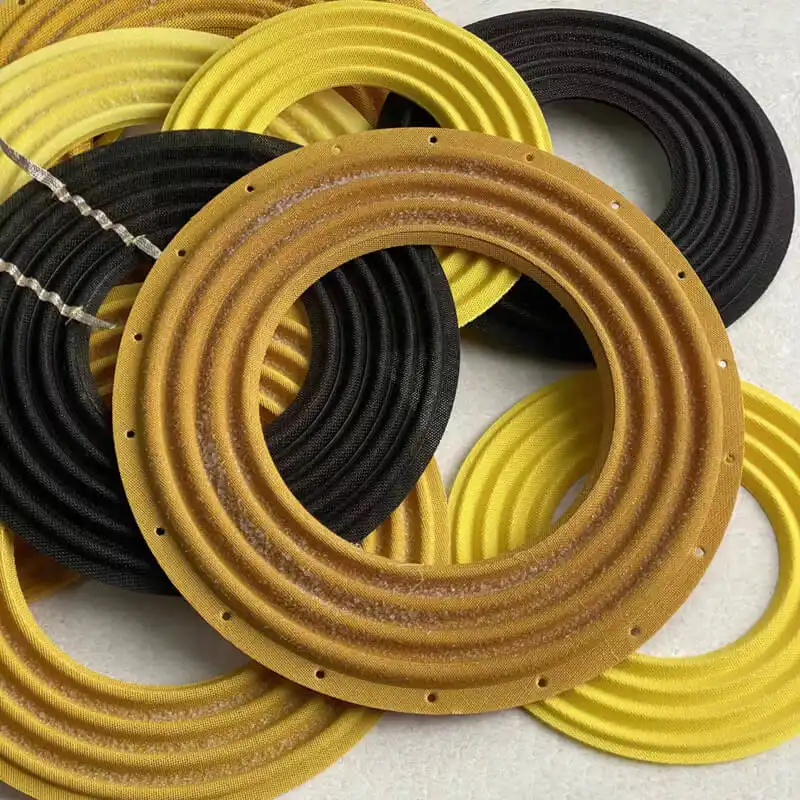
How Speaker Spider Compliance Affects Bass, Xmax, Centering and Voice Coil Reliability
Speaker spider compliance shapes bass output, excursion control, centering, and coil life. Learn how buyers should specify, sample, and verify the right stiffness.
Speaker spider compliance is one of the most important suspension parameters in a woofer or subwoofer, yet it is often discussed too vaguely during sourcing. Buyers may focus on OD, ID, height, and voice coil size, but the actual stiffness of the spider has a direct effect on bass behavior, usable Xmax, centering accuracy, distortion risk, and long-term voice coil reliability.
For OEM teams, component buyers, woofer builders, and repair channels, compliance should be treated as a working specification, not just a descriptive term. A spider can match the drawing and still perform incorrectly if the stiffness curve is wrong. That mismatch can lead to weak low-frequency output, unstable excursion, coil rub, poor assembly yield, or inconsistent batch-to-batch performance.
What speaker spider compliance means in practical terms
In simple sourcing language, speaker spider compliance describes how easily the spider moves under force. A more compliant spider moves more easily. A stiffer spider resists movement more strongly.
That sounds straightforward, but in loudspeaker manufacturing the real concern is not only whether a spider is soft or stiff. Buyers also need to consider how the force changes throughout the stroke. This is where force-deflection behavior becomes critical.
Compliance is tied to suspension control
The spider is part of the suspension system that keeps the voice coil centered while allowing controlled excursion. Its job is to:
- support the moving assembly
- help restore the cone and coil to neutral position
- resist rocking or tilt
- influence resonance and low-frequency behavior
- control movement at larger excursions
A spider that is too soft may allow excessive motion, poor centering, or unstable behavior at higher input levels. A spider that is too stiff may limit bass extension, reduce sensitivity in the low end, and restrict usable excursion.
Why buyers should think beyond a single stiffness number
Two spiders can have similar nominal dimensions and even similar initial feel, but behave differently once excursion increases. That difference often comes from corrugation geometry, fabric treatment, resin distribution, and forming consistency.
When reviewing samples, buyers should ask whether the spider behaves in a more linear or more progressive way across its working travel.
- Linear behavior means restoring force increases more evenly through the stroke.
- Progressive behavior means resistance rises more sharply as excursion increases.
This distinction matters because the right choice depends on the driver design target.
How compliance affects bass response and resonance
Spider compliance plays a direct role in the mechanical compliance of the suspension system, which influences resonance and low-frequency output. In practical terms, this affects how easily the cone moves at bass frequencies and how the driver behaves near its intended operating range.
Softer compliance can support deeper bass behavior
A more compliant spider generally allows easier movement, which can help a woofer or subwoofer achieve the intended low-frequency character. In many designs, this supports freer cone motion and can contribute to stronger bass extension when matched properly with the surround, cone mass, and motor.
But softness alone is not a performance advantage. If compliance is too high for the motor and moving system, the result can be:
- poor excursion control
- increased rocking tendency
- inconsistent centering
- greater risk of bottoming or overtravel
- unstable low-frequency output at higher power
Stiffer compliance improves control but can limit low-end freedom
A stiffer spider adds restraint to the moving assembly. That can be beneficial where tighter control is required, especially in systems designed for high power handling or stronger mechanical stability.
However, excessive stiffness may:
- raise effective suspension resistance
- reduce low-frequency responsiveness
- make bass sound less extended or less full
- reduce achievable excursion before the system becomes overly restricted
For buyers, the key point is that bass performance is not determined by spider compliance alone, but the spider can easily push the driver away from its target if the stiffness is wrong.
Why compliance matters for Xmax, centering, and coil reliability
A loudspeaker can only use its designed excursion range if the suspension keeps the moving parts aligned and controlled throughout the stroke. This is where spider compliance becomes a reliability issue, not just an acoustic one.
Xmax depends on controlled, symmetrical movement
In sourcing discussions, buyers often use Xmax as a headline requirement. But a spider does not increase usable excursion simply by being softer. Usable excursion depends on whether the suspension remains centered, stable, and repeatable as the cone moves forward and backward.
If compliance is too soft or uneven, the moving system may reach a point where motion is no longer well controlled. That can reduce practical Xmax even if the geometry appears suitable on paper.
If compliance is too stiff, the driver may resist motion early and fail to deliver the intended output over the required excursion range.
Poor compliance matching can cause coil rub
Voice coil rub is one of the most common failure concerns tied to suspension mismatch. When the spider does not hold the coil group in stable alignment, the coil can shift off-center during assembly or under dynamic operation.
Common causes include:
- spider stiffness that does not suit the cone mass and motor force
- uneven corrugation forming
- asymmetrical resin treatment
- dimensional mismatch in ID, OD, SOD, FH, or EH
- poor glue seating or inconsistent assembly preload
- batch inconsistency between approved sample and production lot
Even a small centering issue can become serious once the speaker is driven at higher excursion. What begins as slight rubbing may develop into heat buildup, distortion, scraping noise, or early field failure.
Progressive spiders are often important in subwoofer applications
Subwoofers and high-excursion woofers often need a suspension that remains compliant enough for low-frequency motion but adds stronger control as excursion increases. This is where progressive force-deflection behavior becomes valuable.
A progressive spider can help:
- maintain better control near excursion limits
- reduce the chance of overtravel damage
- support centering under large movement
- improve mechanical stability under heavy bass load
That does not mean every subwoofer needs the same stiffness profile. The target depends on the driver design, cone mass, surround contribution, coil length, gap geometry, and intended use.
Linear vs progressive behavior: what sourcing teams should check
For many buyers, compliance is still specified too loosely. Terms like soft, hard, or medium are not enough for a dependable RFQ or production approval process.
A more useful approach is to define both dimensional and performance checkpoints.
Critical specification points to confirm
When discussing a speaker spider or damper with a factory, buyers should verify:
- OD: outer diameter
- ID: inner diameter
- SOD: seating or support outer diameter as used in the project drawing
- FH: free height
- EH: installed or effective height, depending on project definition
- voice-coil group: coil diameter and moving assembly match
- material code: base fabric and treatment identification
- corrugation: number, shape, pitch, depth, and profile style
- compliance target: required stiffness or force-deflection range
- centering requirement: tolerance for coil alignment and rocking control
These checkpoints matter because dimensions alone do not guarantee functional equivalence. A spider with the same OD and ID but different material treatment or corrugation geometry may behave very differently in the driver.
Sample approval should include dynamic fit, not just dimensional fit
A common mistake in procurement is approving a spider sample because it fits the basket and voice coil assembly, while skipping deeper evaluation of movement behavior.
Sample matching should include:
- assembly fit with the intended voice-coil group
- centering stability during gluing and curing
- low-stroke and higher-stroke motion checks
- listening or measurement checks for rub, buzz, or asymmetry
- comparison with target low-frequency output behavior
- consistency across multiple sample pieces, not just one
For repair replacement channels, this is especially important. A replacement spider may look interchangeable, but incorrect compliance can change the driver's low-end behavior or create reliability problems after installation.
What to include in an RFQ for speaker spider compliance
An RFQ that only includes nominal dimensions often creates delays during sampling. It also increases the chance of receiving a spider that is manufacturable but not suitable for the application.
RFQ details that help avoid mismatch
A practical RFQ should include as many of the following as possible:
- application type: woofer, subwoofer, mid-bass, or repair replacement
- target voice coil diameter and coil group construction
- OD, ID, SOD, FH, and EH
- required material code or reference sample
- corrugation structure and profile preference
- target compliance or stiffness range
- whether linear or progressive behavior is preferred
- expected excursion range and control needs
- centering sensitivity or anti-rocking priority
- sample quantity needed for verification
- approval standard for batch production
If the buyer already has an approved original sample, sending that sample for matching often speeds up development. This is particularly useful when exact project drawings are incomplete or when the key requirement is to reproduce the behavior of an existing driver.
Why process control matters in batch production
Once a spider is approved, production consistency becomes the next concern. Compliance can drift if material lots, resin treatment, forming pressure, drying conditions, or mold wear are not controlled carefully.
For sourcing teams, that means batch reliability depends on more than mold dimensions. The manufacturing process needs to keep the approved force-deflection behavior stable from sample stage to mass production.
Buyers should pay attention to whether the factory can control:
- material traceability
- mold matching and maintenance
- forming repeatability
- dimensional inspection
- sample retention and approval records
- batch identification and process tracking
This is where ERP-linked process control and disciplined inspection routines can help reduce variation between lots.
How to judge whether compliance is wrong for your project
In many projects, the signs of incorrect speaker spider compliance appear before full production if the sample review is handled properly.
Typical warning signs during testing or pilot builds
Watch for these issues during sample assembly and evaluation:
- voice coil rub during manual excursion or powered test
- bass output that feels weaker or less extended than target
- excessive movement with poor control at low frequency
- distortion rising early at moderate excursion
- unstable centering during gluing
- inconsistent free height or installed height effect
- visible rocking or tilt under stroke
- noticeable variation from one sample piece to another
Each of these can point to stiffness mismatch, poor force symmetry, or inadequate process consistency.
What matters most for different buyer groups
Speaker OEM teams should focus on compliance as part of the full suspension design, not as an isolated spider attribute.
Component sourcing buyers should make sure RFQs include behavior requirements, not only dimensions.
Woofer and subwoofer builders should prioritize stroke control, centering, and progressive behavior where large excursion is expected.
Repair replacement channels should check that the replacement spider not only fits physically but also preserves the driver's original movement characteristics as closely as possible.
A practical takeaway for speaker buyers
Speaker spider compliance affects more than feel or mechanical stiffness. It shapes how the driver starts moving, how it behaves at bass frequencies, how well it stays centered through excursion, and how safely the voice coil operates over time.
The right spider is not simply soft or stiff. It must match the driver's voice-coil group, suspension target, corrugation design, and excursion demands. For sourcing teams, the safest approach is to confirm dimensions, material, and height data together with compliance behavior, sample matching, and batch control requirements.
When compliance is specified clearly and verified early, buyers are more likely to get stable bass performance, usable Xmax, better centering, and fewer voice coil reliability problems in production and in the field.
FAQ
What is speaker spider compliance?
Speaker spider compliance describes how easily the spider moves under force. In practical terms, it reflects suspension stiffness and how the spider controls cone and voice coil movement during operation.
How does spider compliance affect bass performance?
A more compliant spider can allow freer low-frequency movement, while a stiffer spider adds more control. If compliance is not matched to the driver design, bass can become weak, unstable, or less extended than intended.
Can wrong spider compliance cause voice coil rub?
Yes. If the spider does not center the moving assembly correctly or if its force-deflection behavior is unsuitable, the voice coil can shift off-axis during assembly or excursion, leading to rub, distortion, and early failure.
What should buyers include in an RFQ for speaker spiders?
A good RFQ should include OD, ID, SOD, FH, EH, voice-coil group, material code, corrugation details, target compliance, centering requirements, sample quantity, and approval standards for production.
Why are progressive spiders common in subwoofers?
Progressive spiders can stay compliant enough for bass movement while adding stronger resistance at larger excursions. This helps control high stroke, support centering, and reduce the risk of overtravel in subwoofer applications.
Factory RFQ Next Step
Move from research to a specification shortlist with product examples that can be sent for factory quotation.