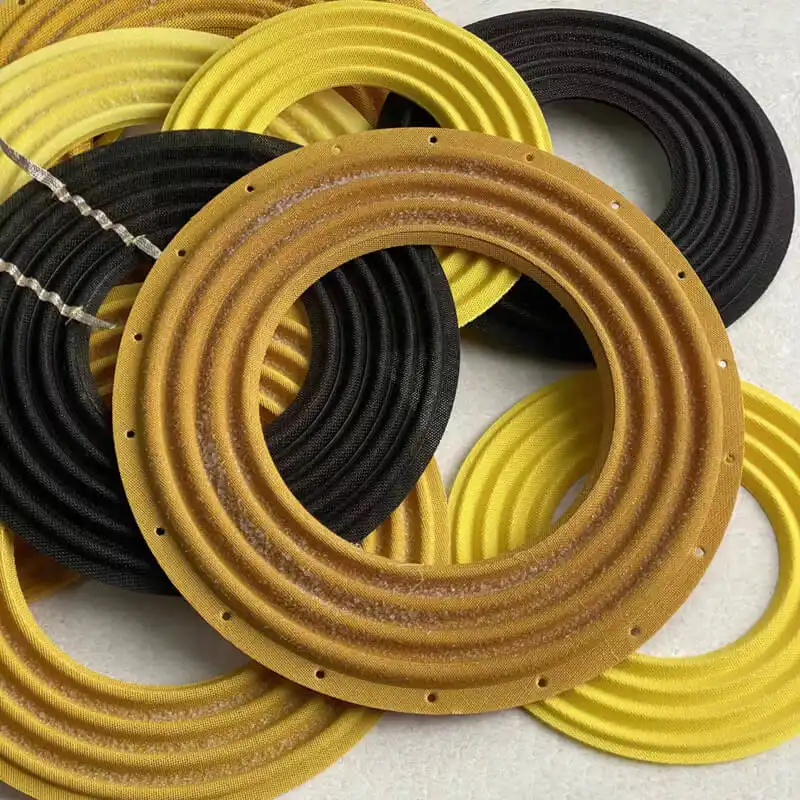
Speaker Spider Compliance: How Stiffness Affects Fs, Excursion, Centering, and Bass Performance
A practical guide to speaker spider compliance, Cms, Kms, stiffness, centering, and sourcing checks for woofer and subwoofer production.
Why Speaker Spider Compliance Matters in Real Products
Speaker spider compliance is one of the quiet specifications that can change the way a woofer or subwoofer behaves more than many buyers expect. A spider may look like a simple corrugated fabric part, but its stiffness, geometry, material treatment, and dimensional fit help define the moving system of the loudspeaker. When compliance is wrong, the result can appear as a changed Fs, limited excursion, rubbing voice coil, unstable centering, or bass that does not match the approved sample.
For engineering teams, compliance is often discussed through Cms and Kms. For sourcing teams, it becomes a production question: can the factory match the approved sample, control the corrugation and resin treatment, confirm OD, ID, SOD, FH, and EH, and keep batch production consistent? Both sides are describing the same risk from different angles.
A well-specified speaker spider should support the design target of the driver. It should center the voice coil, contribute the right suspension force, allow controlled excursion, and remain consistent across production. For woofer and subwoofer programs, especially where low-frequency response and high excursion are important, spider compliance deserves the same attention as cone mass, surround shape, voice-coil diameter, and magnetic gap.
Cms, Kms, and Stiffness in Loudspeaker Suspension
Compliance describes how easily the suspension moves when force is applied. In loudspeaker engineering, Cms is the mechanical compliance of the suspension. A higher Cms means the suspension is softer and moves more easily. A lower Cms means the suspension is stiffer.
Kms is the mechanical stiffness, which is the inverse of compliance. A higher Kms indicates a stiffer suspension. A lower Kms indicates a softer suspension. In practical factory discussion, buyers may simply say the spider is too hard, too soft, too loose, or too tight. Behind those words are measurable suspension behaviors that influence the driver.
The spider is not the only suspension element. The surround also contributes to total suspension compliance, and the moving system includes the cone, dust cap, voice coil, former, lead wires, adhesive, and related parts. Still, the spider plays a central role because it sits close to the voice coil and helps maintain axial movement through the gap.
What a softer spider can do
A more compliant spider can help lower the driver resonance frequency, depending on the full suspension and moving mass. It can support deeper low-frequency movement when the motor and enclosure are designed for it. In some woofer and subwoofer designs, a softer suspension is part of the target sound.
However, a spider that is too soft may reduce centering stability. The voice coil may become more sensitive to assembly variation, shipping stress, or high-power movement. If the spider does not provide enough restoring force, the moving assembly may rock, sag, or shift more easily. In production terms, this can increase the chance of coil rub, asymmetrical travel, or inconsistent bass between units.
What a stiffer spider can do
A stiffer spider can improve centering support and mechanical control, especially where the moving assembly is heavy or the voice-coil group needs firm guidance. It may help stabilize motion under demanding operating conditions.
The tradeoff is that excessive stiffness can raise Fs, restrict excursion, reduce low-frequency output, or make the driver sound less extended than intended. A spider that is too stiff may also create a mismatch between the engineering sample and the final production batch, even if the dimensions look correct on paper.
This is why speaker spider compliance should not be treated as a generic material choice. It is part of the acoustic and mechanical design of the driver.
How Compliance Affects Fs, Excursion, Centering, and Bass
Speaker spider compliance affects several areas that buyers and engineers usually evaluate during sampling and production approval.
Resonance frequency and bass response
Fs, the free-air resonance frequency of the driver, is influenced by moving mass and suspension compliance. When the total suspension becomes softer, Fs generally moves lower. When the suspension becomes stiffer, Fs generally moves higher. The spider contributes to this total suspension behavior together with the surround.
For a woofer or subwoofer, a shift in Fs can affect how the driver integrates with the enclosure and crossover target. A replacement spider that is stiffer than the original may make the repaired speaker less capable of the intended low-frequency response. A production spider that is softer than the approved sample may change the system alignment and lead to a driver that measures differently from the design target.
For sourcing teams, this means compliance should be confirmed during sample matching, not left to visual comparison alone. Two spiders may share the same OD, ID, and corrugation count while still having different stiffness because of fabric, impregnation, resin content, thickness, heat treatment, or forming process.
Excursion and mechanical travel
Excursion is not only about how far the cone can move. It is about whether the moving assembly can travel in a controlled and centered way within the designed range. The spider contributes restoring force during forward and backward motion.
A softer spider may allow more movement at lower force, but it must still maintain centering and resist unwanted rocking. A stiffer spider may keep the coil better controlled but can limit the useful travel if the restoring force becomes too high.
For high-excursion woofers and subwoofers, progressive behavior becomes important. A spider may be relatively compliant near the rest position but become stiffer as it moves farther. This progressive stiffness can help protect the driver from uncontrolled travel. The corrugation profile, fabric treatment, forming depth, and overall spider geometry all influence this behavior.
Voice-coil centering
The spider is often called a centering spider for a reason. Its job is not only to flex; it also helps keep the voice coil aligned in the magnetic gap. Good compliance without good centering is not enough.
Centering performance depends on dimensional fit and mechanical symmetry. Important checkpoints include OD, ID, SOD, FH, EH, the voice-coil group, corrugation shape, and bonding surfaces. If the inner diameter does not match the former correctly, or if the outer diameter does not seat consistently in the frame, the spider may introduce centering errors even when its stiffness is acceptable.
The spider must also match the assembly process. Adhesive selection, glue line width, curing conditions, and fixture control can all influence the final centering result. A sourcing decision based only on loose parts can miss what happens after the spider is bonded into the speaker.
Unit-to-unit consistency
Bass performance is not only a design target; it is also a production consistency issue. A batch with uneven compliance can create measurable and audible variation. Some units may test close to the approved sample, while others may show shifted Fs, altered impedance behavior, or rubbing under excursion.
For batch production, the buyer should look for controlled material selection, stable forming, consistent treatment, and inspection records. ERP process control can also support order traceability, material confirmation, and production coordination, especially when multiple spider specifications are similar in appearance but different in performance.
Specification Checkpoints for Buying Speaker Spiders
A clear RFQ reduces the risk of receiving a spider that looks similar but behaves differently. Speaker spider compliance should be specified together with dimensional and material details so the factory can evaluate whether the part can be matched, molded, sampled, and produced consistently.
Key dimensions to confirm
The basic drawing should include the dimensions that affect fit, centering, and assembly. Common checkpoints include:
- OD: outer diameter of the spider
- ID: inner diameter for voice-coil former fit
- SOD: suspension outer diameter or seat-related outer dimension, depending on the drawing convention
- FH: free height or forming height, as defined in the buyer's specification
- EH: effective height or edge height, depending on the part drawing
- Corrugation count, pitch, width, and depth
- Inner and outer landing width for bonding
- Voice-coil group diameter and former material
- Frame or basket seat dimension
Because naming conventions can vary between factories and customers, drawings should define each dimension clearly. A short note on measurement position can prevent costly misunderstanding.
Material and treatment details
Spider stiffness is strongly affected by material construction and treatment. A useful RFQ should identify the material code if available, or provide an approved physical sample for matching. Buyers should also confirm whether the spider uses cotton, blended fabric, synthetic fiber, aramid-related material, or another structure, when such details are part of the design requirement.
The impregnation or resin treatment can be just as important as the base fabric. Treatment level affects stiffness, damping, heat resistance, forming stability, and long-term behavior. If an existing driver is being repaired or duplicated, sample matching is often more reliable than relying on a verbal description such as medium stiffness or high compliance.
Compliance target and test method
If the engineering team has Cms, Kms, or force-displacement targets, include them in the technical file. The target should specify the measurement condition where possible. Compliance can vary with preload, displacement range, temperature, humidity, and break-in condition. A part that appears acceptable under one test condition may not match under another.
For many procurement cases, especially replacement and repair channels, a full engineering specification may not be available. In that case, the original spider sample, driver model details, voice-coil dimensions, and application notes become important. A factory can often evaluate the sample, compare dimensions, review material and corrugation, and suggest a practical matching route.
Progressive behavior and excursion range
A flat stiffness value does not always describe how a spider behaves during large movement. For woofer and subwoofer applications, the force curve across displacement may matter more than a single number near the rest position.
Buyers should state whether the driver is a low-excursion woofer, high-excursion subwoofer, PA driver, car audio speaker, home audio woofer, repair replacement, or OEM production part. The spider design should match the application load. A spider that works for a mid-power woofer may not be suitable for a long-throw subwoofer even if the ID and OD are similar.
Sampling and Quality Control for Batch Production
Speaker spider sourcing usually moves through sample confirmation, trial assembly, performance testing, and production approval. This process is especially important when compliance affects driver tuning.
Sample matching should go beyond appearance
Visual similarity is useful but incomplete. The sample should be checked for dimensions, corrugation profile, material structure, treatment level, forming height, centering performance, and stiffness feel. When possible, the spider should be assembled into the driver and tested against the approved benchmark.
For an OEM project, the engineering team may compare Fs, impedance curve, excursion behavior, rub and buzz performance, and acoustic output. For repair replacement, the goal may be practical compatibility with the original driver rather than redesigning the suspension from zero.
Mold support and forming control
If the spider profile is not a standard item, mold support may be needed. The forming tool affects corrugation shape, height, symmetry, and repeatability. A small change in corrugation depth can affect stiffness and progressive behavior.
Before batch production, buyers should confirm whether the factory is using an existing mold, modifying a mold, or developing a new one. The drawing and sample should be aligned so that the approved sample can be repeated in production.
Inspection points for production lots
Quality inspection should cover both fit and function. Useful checks may include:
- OD, ID, SOD, FH, EH, and bonding land dimensions
- Corrugation shape and forming consistency
- Material code and treatment confirmation
- Surface condition, cracks, deformation, and contamination
- Compliance or stiffness check where required
- Centering and flatness inspection
- Lot traceability and packing protection
ERP process control can help keep orders, material codes, production steps, and delivery status aligned. For buyers managing several similar speaker spider models, traceability reduces the risk of mixing parts that look alike but perform differently.
Practical RFQ Guidance for Speaker Spider Compliance
A strong RFQ gives the factory enough information to evaluate feasibility and avoid assumptions. For speaker spider compliance, the most useful RFQ package combines drawings, samples, application data, and performance targets.
Include these items when available:
- Product type: woofer, subwoofer, midbass, PA driver, car audio driver, home audio driver, or repair replacement
- Spider drawing with OD, ID, SOD, FH, EH, corrugation details, and tolerances
- Voice-coil group details, including former diameter and assembly relationship
- Material code or original sample for matching
- Compliance, stiffness, Cms, Kms, or force-displacement target if available
- Required centering performance and excursion range
- Expected sample quantity and batch production quantity
- Any test results from the approved driver sample
- Packing and delivery requirements
For Qiao Tai, a Guangzhou Panyu factory founded in 2006, this kind of RFQ detail helps connect engineering intent with manufacturing steps such as material selection, sample matching, mold review, specification confirmation, quality inspection, ERP process control, and batch delivery. The goal is not to make the spider more complex than necessary. The goal is to make sure the selected component supports the driver design instead of changing it after production begins.
When buyers treat speaker spider compliance as a measurable and repeatable specification, sourcing becomes more predictable. The engineering team gets a suspension part that supports the intended Fs, excursion, centering, and bass performance. The procurement team gets clearer comparison criteria between samples and suppliers. The production team gets a better chance of repeating the approved result at scale.
FAQ
What is speaker spider compliance?
Speaker spider compliance describes how easily the spider flexes under force. In engineering terms it is related to Cms, while stiffness is related to Kms. A more compliant spider is softer, while a less compliant spider is stiffer.
How does spider stiffness affect Fs?
Spider stiffness contributes to the total suspension stiffness of the driver. A softer suspension generally lowers Fs, while a stiffer suspension generally raises Fs, depending on the surround, moving mass, and full driver design.
Can two spiders with the same dimensions have different compliance?
Yes. OD, ID, SOD, FH, EH, and corrugation shape are important, but compliance can also change with fabric type, material code, resin treatment, thickness, forming process, and heat treatment.
What should be included in an RFQ for a compliant speaker spider?
A good RFQ should include drawings, OD, ID, SOD, FH, EH, corrugation details, voice-coil group information, material code or sample, compliance or stiffness target if available, application type, sample quantity, and expected batch quantity.
Why is centering important when choosing spider compliance?
The spider must flex and keep the voice coil centered in the magnetic gap. If it is too soft, too stiff, poorly matched to the voice-coil group, or dimensionally unstable, the driver may develop coil rub, uneven excursion, or inconsistent bass performance.
Factory RFQ Next Step
Move from research to a specification shortlist with product examples that can be sent for factory quotation.