How Woofer and Subwoofer Spider Design Affects Power Handling, Excursion and Centering
A practical buyer guide to woofer spider for subwoofer design, covering single vs double spiders, excursion, centering, coil alignment and sourcing checks.
How Woofer and Subwoofer Spider Design Affects Power Handling, Excursion and Centering
A woofer spider for subwoofer applications does far more than hold the voice coil in place. It controls how the moving system returns to center, how much linear excursion the driver can use, and how consistently the coil stays aligned inside the magnetic gap under high-power, low-frequency operation.
For OEM woofer teams, subwoofer builders and component sourcing buyers, spider selection is not a simple matter of choosing a diameter and fabric color. The correct design depends on the voice-coil group, cone mass, surround compliance, expected stroke, cabinet application, thermal load and production tolerance targets. A spider that is too soft may allow excessive rocking or bottoming. A spider that is too stiff may restrict excursion, raise resonance and reduce low-frequency output. A spider with the wrong geometry may pass a visual inspection but create rubbing, offset or premature fatigue after assembly.
This guide explains how single and double spider setups affect woofer and subwoofer performance, which specification checkpoints matter during RFQ preparation, and how buyers can reduce risk during sample matching and batch production.
What the Spider Does in a Woofer Suspension System
The spider, also called the damper or centering spider, is the lower suspension component of a loudspeaker. It is usually installed between the voice-coil former and the frame or basket. Together with the surround, it forms the suspension system that guides the cone and voice coil during movement.
In a woofer or subwoofer, the spider has several critical functions:
- Centering: It keeps the voice coil concentric with the magnetic gap.
- Restoring force: It pulls the moving assembly back toward its neutral position.
- Excursion control: It helps define how far the cone can travel in a controlled manner.
- Rocking resistance: It reduces side-to-side movement that can lead to coil rub.
- Durability support: It must survive repeated low-frequency movement, heat exposure and mechanical stress.
The term woofer suspension often includes both the surround and spider, but the spider is especially important for coil alignment. The surround controls the outer cone edge, while the spider controls the inner moving system near the voice coil. If the spider is inconsistent or incorrectly matched, the driver may show poor centering even when the surround appears normal.
For subwoofers, the challenge is greater because the moving system is heavier and the excursion requirement is higher. Low-frequency signals demand large cone movement. During high-power use, the suspension must remain stable across forward and backward travel, not only at the rest position.
Single Spider vs Double Spider Woofer Designs
One of the most common sourcing questions is whether a driver should use a single spider or a double spider. The answer depends on the driver design target rather than a universal rule.
Single Spider Designs
A single spider is widely used in woofers, mid-woofers and many standard subwoofer designs. It offers a simpler structure and can be suitable when the voice coil, cone mass and excursion target are within a moderate range.
A well-designed single spider can provide:
- Lower part count and simpler assembly
- Adequate centering for many woofer applications
- Tunable compliance through material, resin, corrugation and geometry
- Cost and production advantages for stable models
For OEM teams, the key is not whether the spider is single, but whether it matches the moving system. A single spider with correct OD, ID, SOD, free height and compliance can perform better than a poorly specified double spider. It must be evaluated with the actual voice-coil group, cone, surround and frame, not as an isolated part.
Double Spider Woofer Designs
A double spider woofer uses two spiders, often stacked with a spacer or separated by a controlled distance depending on basket and motor design. This setup is common in high-excursion subwoofers, large woofers and heavy-duty drivers where coil stability is a priority.
A double spider design can help with:
- Improved voice-coil centering under long stroke
- Better resistance to rocking motion
- More stable movement in heavy cone assemblies
- Higher mechanical control for high-power bass use
- Reduced risk of coil rub when properly aligned
The benefit comes from increased guiding support. When two spiders are positioned correctly, they can help keep the voice-coil former straighter during excursion. This is especially useful when the voice coil is long, the cone is heavy, or the driver is expected to handle strong low-frequency input.
However, double spiders are not automatically better. They add stiffness, weight, assembly complexity and more tolerance points. If the two spiders are not matched in compliance and installed concentrically, they may fight each other, creating offset force or uneven travel. For this reason, double spider sourcing should include sample verification, not only drawing confirmation.
When to Consider a Double Spider
A double spider setup is worth evaluating when the product has one or more of these requirements:
- High excursion subwoofer design
- Large voice-coil diameter or long voice-coil former
- Heavy cone, dust cap or moving assembly
- High power input and strong low-frequency operation
- Need for improved lateral stability
- Previous failures involving coil rub, rocking or off-center movement
For replacement channels, a double spider should not be substituted casually for a single spider unless the repair target supports the added stiffness and installation height. Replacement work must respect the original suspension balance, otherwise bass response and mechanical clearance can change.
High-Excursion Spider Requirements for Subwoofers
A high excursion spider must support large displacement without losing control, cracking, deforming or creating nonlinear resistance too early. Subwoofer buyers often focus on cone travel, but the spider must be designed to survive that travel repeatedly.
Important design factors include material, corrugation, stiffness, free height, effective height and compatibility with the voice-coil group.
Corrugation Geometry
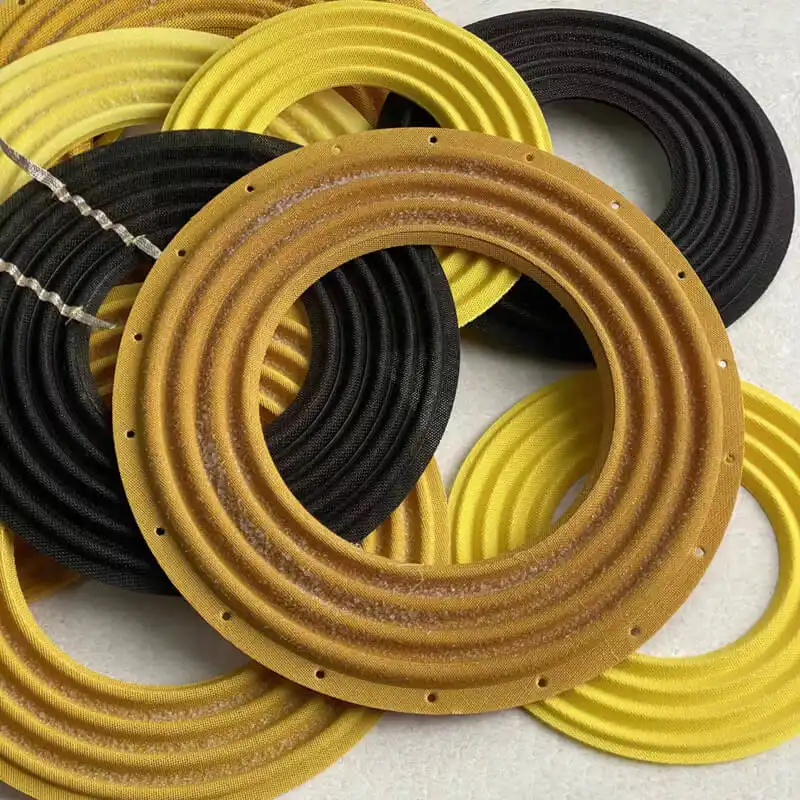
Corrugation is one of the most visible features of a speaker spider. The number, shape and depth of waves affect compliance, travel behavior and stress distribution.
A deeper or more open corrugation may allow greater movement, while a tighter structure may increase control. The best choice depends on the driver target. In subwoofer applications, the spider should provide sufficient linear movement before the suspension becomes too restrictive or unstable.
During specification review, buyers should confirm:
- Corrugation count and profile
- Inner and outer working area
- Symmetry of wave shape
- Compatibility with frame landing surface
- Clearance during forward and backward excursion
A spider may match OD and ID dimensions but still be unsuitable if the corrugation profile interferes with the basket, lead wire path or voice-coil movement.
Compliance and Stiffness Balance
Compliance refers to how easily the suspension moves. In practical sourcing language, buyers often discuss whether a spider is soft, medium or stiff. For production, this should be translated into a confirmed compliance or stiffness target where possible.
The spider must work with the surround, not against it. If the spider is too stiff, it can limit excursion and reduce low-frequency efficiency. If it is too soft, the coil may shift, rock or bottom under power. In a subwoofer, the suspension balance must support both output and control.
This balance affects several performance areas:
- Resonance behavior
- Cone return speed
- Linear excursion range
- Mechanical power handling
- Long-term durability
- Centering consistency during assembly
For OEM development, spider samples should be tested in the complete driver assembly. A loose part may feel correct by hand but behave differently once bonded to the former and frame.
Material Selection and Resin Treatment
Spider materials commonly involve treated fabric structures. The material code, weave, thickness and resin treatment influence stiffness, heat resistance and fatigue life. For buyers, the exact formulation may be factory-controlled, but the functional requirement should be clear.
An RFQ should specify or request confirmation of:
- Material code or approved equivalent
- Fabric type and thickness target
- Resin treatment level or stiffness grade
- Color if relevant for inspection or model consistency
- Heat and fatigue expectations based on application
High-power subwoofers expose the spider to heat from the voice-coil area and repeated mechanical cycling. A suitable material must keep its shape and centering function through normal operating stress. For repair replacement channels, material matching is especially important because a spider with the same size but different stiffness can change the driver behavior.
Centering, Voice-Coil Matching and Power Handling
Power handling is often discussed in electrical terms, but the spider affects mechanical power handling. A driver may have a capable motor and voice coil, yet fail mechanically if the suspension cannot control the moving assembly.
Why Coil Alignment Matters
The voice coil must stay centered in the magnetic gap. If the coil leans, shifts or rocks, it can rub against the pole or top plate. This creates noise, heat, damage and eventual failure.
The spider helps control this alignment, especially near the coil former. In high-excursion subwoofers, centering must remain reliable at high displacement, not only when the driver is idle. A spider with uneven stiffness, poor concentricity or inaccurate ID can introduce alignment problems during assembly.
Practical centering checkpoints include:
- ID fit to voice-coil former
- OD fit to frame landing position
- SOD, if the spider has a stepped or specified support outer diameter
- Free height and assembled height
- Even corrugation without distortion
- Flatness and concentricity before assembly
- Stable bonding surface at both inner and outer edges
The voice-coil group should be treated as a key matching reference. This includes former diameter, winding height, former material, lead wire route and intended coil position in the magnetic gap. A spider that fits the former dimensionally may still be unsuitable if the height or stiffness shifts the rest position.
FH and EH in Spider Specification
Two practical dimensions that buyers should confirm are FH and EH. These terms can vary by drawing style, but they are commonly used to describe height-related spider conditions such as free height and effective height.
- FH: Often used for free height or natural height before assembly.
- EH: Often used for effective or assembled height in the driver structure.
Because terminology may differ between engineering teams and suppliers, buyers should define these terms on the drawing or RFQ. Height affects the neutral position of the cone and coil. If the spider height is wrong, the coil may sit too high or too low in the gap, reducing usable excursion in one direction.
For subwoofers, where long stroke is expected, height accuracy is critical. Even a spider with the right stiffness can cause problems if its installed geometry shifts the moving system away from the intended center point.
Spider Design and Mechanical Durability
A power handling spider must maintain shape and function under repeated motion. Durability issues may appear as sagging, permanent deformation, torn corrugations, bond failure or loss of centering.
Buyers should pay attention to:
- Fatigue behavior after repeated excursion
- Resistance to deformation near the inner neck
- Bonding compatibility with adhesives used in assembly
- Consistency between samples and production batches
- Lead wire clearance and risk of slap or fatigue
- Dimensional stability after storage and handling
Heavy low-frequency use creates stress at the corrugation peaks, inner collar and outer bonding area. For double spider designs, consistency between the upper and lower spider also matters. Differences in stiffness or height may create uneven load sharing.
Specification Checkpoints for OEM Sourcing and RFQ Preparation
A clear RFQ reduces sampling cycles and avoids confusion between visually similar spiders. For a woofer spider for subwoofer development, the buyer should provide enough information for accurate sample matching and mold review.
Core Dimensions to Confirm
The most important dimensions include:
- OD: Outer diameter of the spider
- ID: Inner diameter for voice-coil former fit
- SOD: Specified support or step outer diameter, if applicable
- FH: Free height or defined height before assembly
- EH: Effective or assembled height, clearly defined on the drawing
- Corrugation width and count: Working suspension geometry
- Inner neck shape: Fit and bonding area near the voice coil
- Outer landing area: Fit to frame or basket support
For repair and replacement channels, physical sample matching is often necessary because original drawings may not be available. In that case, buyers should send a clean sample, photos with measurement references and details about the driver model or voice-coil group.
Performance and Material Requirements
Beyond dimensions, the RFQ should include performance expectations. Useful information includes:
- Target application: woofer, subwoofer, car audio, home audio, professional audio or repair
- Single or double spider structure
- Required stiffness or compliance target
- Material code or sample to match
- Expected excursion range, if available
- Voice-coil diameter and former details
- Frame landing dimensions
- Cone and surround information for suspension balance
- Testing method used by the buyer, if already defined
If the buyer has experienced failures, the RFQ should describe them clearly: coil rub, spider tearing, sagging, excessive stiffness, bottoming, lead wire interference or assembly offset. This helps the factory evaluate whether the issue is dimensional, material-related or caused by overall suspension balance.
Sampling and Batch Production Control
Sampling should confirm both fit and function. A spider sample may pass a dimension check but fail after driver assembly. Practical sample review should include:
- Loose-part dimensional inspection
- Visual check for corrugation uniformity and flatness
- Trial assembly with the intended voice-coil group
- Cone movement check for rubbing or offset
- Listening or signal test under controlled conditions
- Comparison against the approved reference sample
For batch production, consistency is as important as the approved design. Buyers should ask how key dimensions, material codes and production steps are controlled. In a factory environment, ERP process control, incoming material checks, mold management and final inspection all help keep production aligned with the approved sample.
Qiao Tai, founded in 2006 in Guangzhou Panyu, China, manufactures speaker spiders, dampers and related loudspeaker suspension components for OEM and replacement applications. In a sourcing workflow, the practical value of factory support is not only making the part, but also confirming drawings, matching samples, supporting mold decisions and keeping batch production consistent with the approved specification.
Practical Selection Guide for Woofer and Subwoofer Buyers
Spider selection should begin with the driver goal. A compact woofer, a long-stroke subwoofer and a repair replacement part may all need different suspension behavior even if the visible dimensions seem close.
For OEM Woofer Development
OEM teams should treat the spider as part of the full moving system. During development, compare different stiffness grades or corrugation options only after confirming the same voice-coil group, cone, surround and frame. Small changes can shift resonance, sensitivity and mechanical clearance.
A useful development approach is to build sample sets around controlled variables:
- Same dimensions with different stiffness levels
- Same material with different corrugation profiles
- Single spider compared with double spider structure
- Different FH or EH values for coil position validation
This allows the engineering team to evaluate performance without confusing multiple changes at once.
For High-Excursion Subwoofer Programs
High-excursion subwoofers require careful attention to centering and durability. Double spider structures may be appropriate, but the design must be checked for assembled height, stiffness balance and clearance.
Key questions to resolve before production include:
- Does the spider allow the required stroke without deformation?
- Is the voice coil centered at rest and during movement?
- Does the suspension become too stiff before the desired excursion?
- Are the two spiders matched if a double spider is used?
- Is there enough clearance for lead wires during full movement?
Testing should include the actual production-intent assembly, not only prototype parts from different material lots.
For Repair and Replacement Channels
Replacement buyers often need sample matching because drawings are unavailable. The safest approach is to match both geometry and stiffness as closely as possible. A replacement spider that fits the basket and coil but has different compliance can change bass output or create centering problems.
When requesting a replacement spider, provide:
- Original spider sample if possible
- OD, ID, height and corrugation measurements
- Photos from top, side and bonding areas
- Voice-coil former diameter
- Driver type and intended use
- Any symptoms from the original failure
Repair work is especially sensitive to height and centering. Even a small mismatch can shift the coil position and reduce mechanical clearance.
Key Takeaways for Sourcing a Woofer Spider for Subwoofer Use
The spider is a small component with a major effect on subwoofer performance. It influences excursion, centering, mechanical power handling and long-term reliability. A single spider can be effective when properly matched, while a double spider can improve stability in demanding designs if stiffness and alignment are controlled.
For buyers, the strongest sourcing results come from clear specifications and complete sample validation. OD, ID, SOD, FH, EH, material code, corrugation, compliance and voice-coil group details should be confirmed before batch production. The approved sample should become the reference for both inspection and production control.
A well-matched subwoofer spider supports controlled bass movement, protects coil alignment and helps the driver perform consistently under heavy low-frequency use. For OEM teams and component sourcing buyers, that makes spider design a practical engineering decision, not just a purchasing line item.
FAQ
What does a woofer spider do in a subwoofer?
A woofer spider centers the voice coil, controls cone return movement and helps manage excursion. In a subwoofer, it must support heavy low-frequency motion while keeping the coil aligned in the magnetic gap.
Is a double spider better than a single spider for subwoofers?
A double spider can improve centering and rocking resistance in high-excursion or heavy-duty subwoofers, but it is not always better. It adds stiffness and assembly complexity, so the design must match the voice-coil group, cone mass, surround and target excursion.
Which spider specifications should be included in an RFQ?
An RFQ should include OD, ID, SOD if applicable, FH, EH, corrugation details, material code, stiffness or compliance target, voice-coil group information, frame landing dimensions and whether the design is single or double spider.
How does spider stiffness affect power handling?
Spider stiffness affects mechanical power handling by controlling how the moving assembly behaves under power. Too soft may allow rocking, bottoming or coil rub. Too stiff may restrict excursion and change low-frequency performance.
Can a replacement spider be selected by size only?
Size alone is not enough. A replacement spider should also match height, corrugation, material and stiffness. A part with the same OD and ID but different compliance can change bass response or cause centering issues.
Factory RFQ Next Step
Move from research to a specification shortlist with product examples that can be sent for factory quotation.