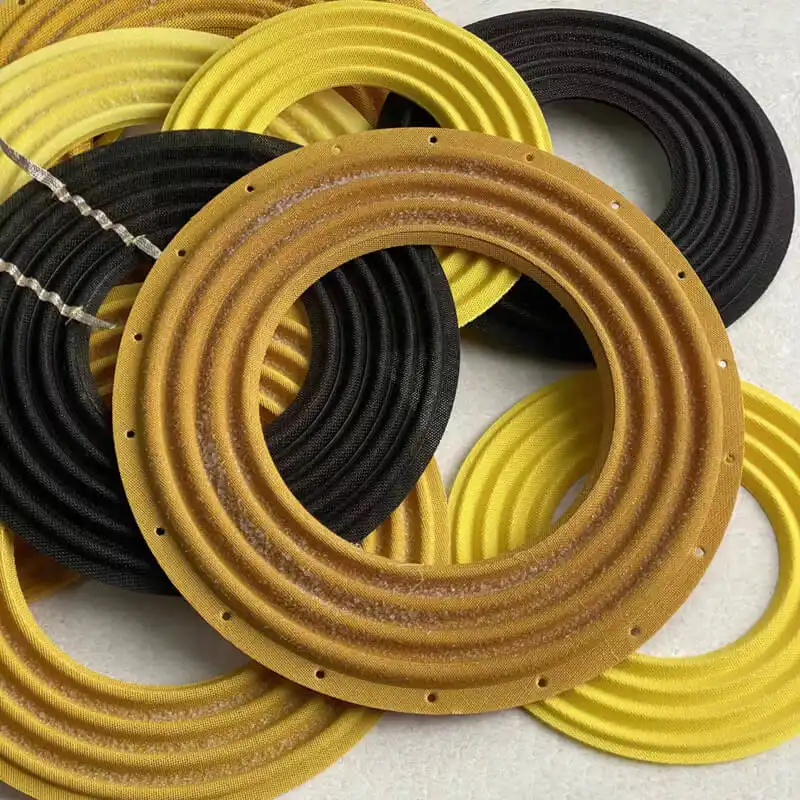
How to Match a Speaker Spider to Voice Coil Diameter, Height and Excursion
A practical buyer guide to speaker spider and voice coil matching, including ID, collar fit, winding height, excursion, samples, and RFQ checks.
How to Match a Speaker Spider to Voice Coil Diameter, Height and Excursion
Speaker spider and voice coil matching is one of the most important suspension decisions in a woofer or subwoofer build. The spider must center the voice coil accurately in the magnetic gap, support the moving assembly, and allow the intended excursion without adding unwanted rocking, noise, or early fatigue. A spider that looks correct by outside diameter can still fail if the inner diameter, collar shape, compliance, or effective height does not match the coil former and motor structure.
For OEM engineering teams, component sourcing buyers, repair replacement channels, and woofer builders, the matching process should not be treated as a simple size lookup. It is a specification exercise that connects the spider ID, collar fit, coil former diameter, winding height, top plate gap, cone neck, frame landing, and target excursion. When these points are confirmed before sampling and mass production, buyers reduce the risk of rubbing, offset centering, inconsistent compliance, and assembly rework.
Why Voice Coil and Spider Matching Matters
The spider, also called a damper or centering spider, controls the axial movement and centering of the voice coil. It works together with the surround to keep the moving parts aligned as the cone travels forward and backward. In low-frequency drivers, especially woofers and subwoofers, the spider often carries a large share of the mechanical control.
A mismatch can create several common problems:
- The coil former does not pass cleanly through the spider ID.
- The spider collar grips too tightly and distorts during assembly.
- The ID is too loose, causing poor concentricity or adhesive gaps.
- The spider height does not place the voice coil correctly in the magnetic gap.
- Compliance is too stiff or too soft for the intended excursion.
- Corrugation geometry reaches stress limits during large movement.
- The voice coil rubs at high drive levels because centering is unstable.
In production, these issues are expensive because they may not appear during visual inspection. A driver can pass basic assembly checks and still show scraping, offset movement, abnormal resonance, or performance drift after testing. That is why a practical matching process should start with dimensions, then move to fit, movement, and batch verification.
Core Dimensions: ID, OD, SOD, FH and EH
A speaker spider drawing normally includes several dimensions that affect voice coil matching. Different factories and engineering teams may use slightly different drawing formats, so every RFQ should define the terms clearly. The most important checkpoints are OD, ID, SOD, FH, and EH.
Spider ID and coil former fit
The spider ID is the opening at the center of the spider. It must match the outside diameter of the voice coil former or the coil assembly area where the spider will be bonded. The ID is not selected only by nominal voice coil size. A “2-inch voice coil” may refer to a category rather than the exact outside diameter of the former after material thickness, winding, coating, and tolerance are included.
For accurate speaker spider and voice coil matching, buyers should confirm:
- Coil former outside diameter at the spider bonding position
- Former material and surface condition
- Whether the spider bonds to the former, coil collar, sleeve, or cone neck area
- Required glue clearance
- ID tolerance and roundness requirement
- Whether a flat ID, raised collar, or formed neck is required
A tight ID can improve positioning during assembly, but if it is too tight, it may deform the spider or scrape adhesive from the bonding surface. A loose ID gives the assembly team more installation space, but it requires better jigs and adhesive control to maintain concentricity. The correct choice depends on the assembly method and the tolerance control of the voice-coil group.
OD and frame landing
The spider OD is the outer diameter that fits the basket or frame landing. OD is less directly related to the coil former, but it affects the available corrugation width, compliance, and mechanical stability. If the OD is too small for the frame landing, bonding strength and centering control may suffer. If the OD is too large, the spider can buckle, wrinkle, or interfere with frame features.
When confirming OD, the buyer should check the frame landing width, adhesive area, clamp or fixture method, and whether the spider needs trimming, notches, or special outer-edge treatment.
SOD and usable corrugation area
SOD is often used to describe a step, seat, or specific outer diameter related to the corrugation or spider seating design. Because terminology can vary, SOD should always be marked on the drawing or confirmed with a physical sample. In practical matching, SOD helps define how much of the spider is available for active movement and how much is used for bonding or positioning.
For high-excursion woofers and subwoofers, the usable corrugation area is critical. A spider with the correct ID and OD may still be unsuitable if its corrugation layout cannot support the required stroke.
FH and EH in assembly height control
FH and EH are height-related checkpoints used to control how the spider sits in the assembly. The exact meaning should be aligned between buyer and factory, but in speaker suspension specification work they typically relate to formed height, effective height, or the distance between key seating planes. These values influence the rest position of the cone and voice coil.
Height control matters because the voice coil must sit correctly relative to the top plate gap. If the spider height forces the coil too high or too low, the driver may lose symmetrical travel. In severe cases, the coil can bottom, leave the magnetic gap unevenly, or rub under excursion.
For a new build, FH and EH should be reviewed together with:
- Top plate thickness and gap position
- Voice coil winding height
- Former length
- Cone neck height
- Surround height and roll geometry
- Frame depth and spider landing height
- Target rest position of the moving assembly
Matching the Spider ID to the Voice-Coil Group
The voice-coil group is more than the winding diameter. It may include the former, winding, lead wire routing, collar, cone neck, dust cap interface, and adhesive build-up. The spider often bonds to a specific point in this group, so the real fit should be checked at the bonding zone instead of relying only on nominal coil diameter.
Coil former diameter and tolerance
The coil former diameter determines the minimum practical spider ID. Buyers should measure actual samples, not only catalog size. Former materials and production methods can affect dimensional consistency. Any coating or adhesive layer can also change the final outside diameter.
For replacement or repair channels, this is especially important. A repair spider may be selected for a common voice coil size, but the repaired unit may use a different former thickness or a replacement coil with different tolerances. A small mismatch can make assembly difficult or cause off-center bonding.
Collar fit and bonding control
Some spiders are flat around the ID, while others include a collar or raised inner structure. The collar can increase bonding area and help position the spider on the former. It may also improve mechanical connection between the voice coil and suspension. However, collar geometry must match the coil group and cone geometry.
A collar that is too high may interfere with the cone neck, lead wires, or winding area. A collar that is too narrow may not provide enough adhesive surface. A collar angle that does not match the assembly can create stress after curing.
Before mass production, buyers should check:
- Collar inside diameter and height
- Bonding surface width
- Clearance to winding and lead-out wires
- Glue type and glue line thickness
- Assembly jig method
- Whether the collar changes the resting height of the spider
Winding height and top plate gap
Voice coil winding height and top plate gap determine how the coil operates in the magnetic field. The spider does not set magnetic geometry by itself, but it helps locate the coil at rest and controls movement during excursion.
For many woofer and subwoofer designs, the intended excursion depends on the relationship between winding height and top plate thickness. The spider must allow the moving assembly to travel through the intended range while keeping the former centered. If the spider is too stiff, the driver may not reach the desired excursion efficiently. If it is too soft or poorly centered, the coil may tilt or rub.
The buyer should confirm the target rest position using a complete motor and moving assembly layout, not only spider dimensions. The best practice is to review the voice coil, top plate, cone, surround, and spider as one suspension and motor system.
Excursion, Corrugation and Compliance for Woofer and Subwoofer Builds
Excursion control is where spider selection becomes more than a dimensional task. Two spiders can share the same OD and ID while behaving very differently because of material, resin treatment, corrugation count, corrugation height, thickness, and forming profile.
Woofer applications
In woofer applications, the spider must balance centering stability, sensitivity, and durability. A woofer that needs clean mid-bass response may require controlled compliance without excessive mechanical looseness. The spider should support the voice-coil group and cone while avoiding asymmetrical motion.
Important woofer checkpoints include:
- Stable centering through normal operating travel
- Suitable compliance for the cone mass and surround
- Corrugation design that avoids early mechanical noise
- Good bonding strength at both ID and OD
- Consistent height so the coil stays aligned in the gap
For speaker OEM teams, a woofer spider should be evaluated with the final cone, surround, coil, and frame, because each part affects the moving system.
Subwoofer applications
Subwoofer suspension matching usually places greater demand on excursion, fatigue resistance, and centering at high travel. The spider may need deeper or multiple corrugations, a stronger material specification, or a design that maintains force symmetry across a wider stroke.
Subwoofer builders should pay close attention to:
- Maximum intended linear and mechanical travel
- Corrugation clearance at forward and backward movement
- Lead wire path and tinsel wire slap risk
- Spider pack design when multiple spiders are used
- Heat exposure near the voice coil
- Long-term fatigue under repeated large movement
In high-excursion designs, the spider can become a limiting component if the corrugation reaches its stress limit before the motor or surround. Sample testing should include movement checks, not just static fit.
Compliance and material code
Material code is a key part of spider specification. It may describe the fabric type, resin treatment, hardness, thickness, or other manufacturing variables. The same visual shape can perform differently if the material code changes.
For repeat purchasing, material code should be locked after sample approval. A clear RFQ should include the required compliance target or approved reference sample. If a buyer cannot provide a numeric compliance target, the factory can often work from a physical sample, drawing, and application description, then produce trial samples for comparison.
Compliance should not be selected in isolation. It must match cone mass, surround stiffness, motor strength, intended tuning, and excursion requirement. A spider that works in a light woofer may not work in a heavy subwoofer even if the voice coil diameter is the same.
Sample Verification Before Mass Production
Sampling is the bridge between specification and production. For speaker spiders, a drawing is essential, but physical sample verification is still important because fit, compliance, forming, and assembly behavior are difficult to judge from dimensions alone.
Step 1: Prepare a complete RFQ package
A useful RFQ should give the factory enough information to evaluate both fit and function. Buyers should include:
- Spider OD, ID, SOD, FH, EH, and tolerance requirements
- Voice coil former outside diameter at the spider bonding area
- Voice coil winding height and former length
- Top plate gap information or motor drawing when available
- Cone neck diameter and bonding position
- Frame landing size and seating height
- Material code or approved reference sample
- Corrugation profile, count, and height if known
- Target application: woofer, subwoofer, mid-bass, repair replacement, or OEM production
- Intended excursion or movement requirement
- Quantity range and batch delivery expectations
For sample matching, send the original spider when possible. If the original part is unavailable, provide the complete moving assembly or clear measurements from the driver.
Step 2: Check static fit
The first sample check should confirm whether the spider physically fits the voice-coil group and frame. The coil former should pass through the ID or collar as intended, without forced deformation. The OD should sit correctly on the frame landing. FH and EH should place the spider at the expected height.
Static fit checks should include:
- ID-to-former clearance
- Collar seating and glue area
- OD seating on frame
- Flatness and visible forming consistency
- Alignment with cone neck and surround height
- Clearance from lead wires and winding area
If the sample requires excessive pressure to assemble, the design may create production variation even if one hand-built unit can be completed.
Step 3: Check centering and movement
After the spider is assembled with the voice coil and cone, the moving system should travel smoothly through the expected range. This is where many hidden mismatches appear. A spider may fit statically but pull the coil off-center when moving.
Movement checks should look for rubbing, twisting, rocking, asymmetrical resistance, and corrugation interference. For subwoofer applications, the test should reflect the intended excursion as closely as practical before approving the part for batch production.
Step 4: Confirm compliance and production consistency
Once the sample works mechanically, the buyer should confirm whether its compliance and material feel match the design target or approved reference. If the project depends on a known acoustic result, the spider should be tested in a complete driver build.
For mass production, consistency matters as much as the first approved sample. Specification confirmation should cover material code, forming mold, dimensional tolerance, inspection method, packaging requirements, and batch traceability. Factory ERP process control can support order tracking, material control, production scheduling, and delivery coordination, but the buyer still needs a clear approved specification to prevent ambiguity.
Practical Buying Notes for OEM, Repair and Sourcing Teams
A good speaker spider is not simply the closest available size. The correct part is the one that matches the voice-coil group, frame, cone, motor height, and movement requirement in the complete loudspeaker system.
For OEM development, start with the design target and confirm the spider with drawings, voice coil dimensions, and assembled samples. For replacement and repair channels, compare the original spider with the replacement coil and actual frame, because older drivers may have non-standard dimensions or changed repair parts. For component sourcing teams, keep an approved sample and a controlled specification sheet so repeat orders do not depend on visual matching alone.
Qiao Tai, a Guangzhou Panyu speaker spider and damper factory founded in 2006, typically approaches these projects through sample matching, mold support, specification confirmation, and batch production. The same workflow is useful for any buyer working with suspension components: define the dimensions, verify the voice-coil fit, test the movement, approve the material and corrugation, then control the specification during production.
The strongest purchasing decisions are made before the first production batch. When OD, ID, SOD, FH, EH, material code, corrugation, compliance, and voice-coil group details are confirmed early, the spider becomes a controlled part of the loudspeaker design rather than a source of assembly risk.
FAQ
How do I choose the correct speaker spider ID for a voice coil?
Measure the actual outside diameter of the voice coil former at the spider bonding position, not only the nominal coil size. Confirm whether the spider uses a flat ID or collar, then allow suitable clearance for adhesive, assembly jigs, and tolerance control.
Why do FH and EH matter in speaker spider matching?
FH and EH are height-related checkpoints that affect where the spider sits in the loudspeaker assembly. They help control the resting position of the cone and voice coil relative to the magnetic gap, top plate, surround, and frame landing.
What should be included in an RFQ for a woofer voice coil spider?
A practical RFQ should include OD, ID, SOD, FH, EH, material code, corrugation details, voice coil former diameter, winding height, cone neck size, frame landing dimensions, target application, excursion requirement, sample references, and expected batch quantity.
Is subwoofer suspension matching different from woofer spider matching?
Yes. Subwoofer spiders usually face higher excursion and fatigue demands. Buyers should check corrugation clearance, compliance, centering stability, lead wire clearance, material strength, and movement behavior under the intended travel range.
Why is sample verification necessary before mass production?
A drawing can confirm dimensions, but samples reveal real assembly fit, collar behavior, centering, compliance, and excursion performance. Sample approval helps prevent rubbing, off-center bonding, height mismatch, and inconsistent batch production.
Factory RFQ Next Step
Move from research to a specification shortlist with product examples that can be sent for factory quotation.