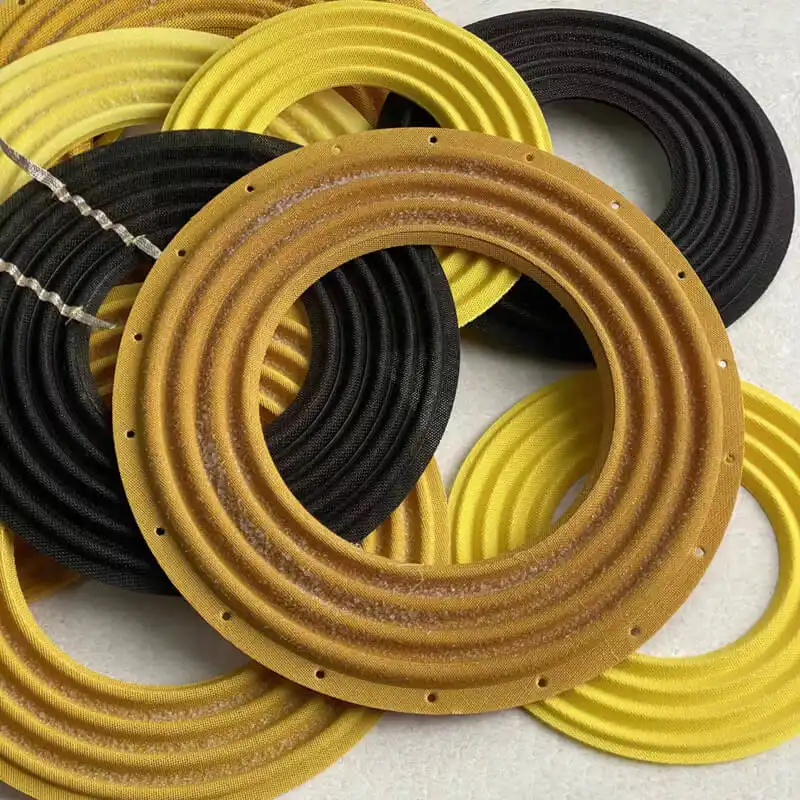
Sample Matching for Speaker Spiders: How to Send the Right Reference for Fast OEM Development
A practical guide to speaker spider sample matching, including reference samples, drawings, coil data, dimensions, performance targets, and RFQ preparation.
Why Speaker Spider Sample Matching Matters
Speaker spider sample matching is often the fastest path when a loudspeaker factory, OEM team, repair channel, or woofer builder needs a replacement suspension part or a new component based on an existing design. Instead of starting from a blank drawing, the buyer provides a physical reference, technical data, photos, application notes, and target requirements so the factory can evaluate the part and develop a suitable sample.
A speaker spider looks simple from the outside, but small changes in material, corrugation, inner diameter, outer diameter, resin treatment, and forming height can affect centering, compliance, moving system control, voice-coil alignment, and long-term stability. For woofers and subwoofers, the spider is especially important because it helps control excursion and keeps the voice coil moving correctly in the magnetic gap.
Good sample matching reduces back-and-forth communication, shortens development time, and lowers the risk of remake delays. Poor input can lead to incorrect ID fit, wrong stiffness, unstable centering, unsuitable corrugation shape, or pilot samples that cannot be assembled into the driver. The goal is not only to copy the visible shape. The goal is to confirm a manufacturable speaker spider that fits the voice-coil group, frame, cone assembly, and performance target.
For buyers preparing an RFQ, the most useful approach is to send enough information for the factory to answer three questions:
- What physical dimensions must be matched?
- What functional behavior must be maintained or adjusted?
- What production conditions must be considered for batch supply?
What to Send for Accurate Speaker Spider Sample Matching
The best reference package includes a physical sample, a dimension drawing, clear photos, voice-coil data, application information, and target performance notes. Not every project starts with a complete file, but the more accurate the input, the easier it is to develop a practical OEM sample.
Physical speaker spider sample
A physical speaker spider sample is the most valuable reference when available. It allows the factory to inspect the actual material, resin treatment, corrugation profile, forming height, inner and outer edges, glue contact areas, and deformation condition.
When sending a sample, try to provide:
- At least one unused or undamaged spider if available
- Several pieces from the same batch if consistency is a concern
- One assembled driver sample if the spider cannot be removed cleanly
- Notes about whether the sample is new, aged, used, repaired, or taken from production
Used spiders can be helpful for size and structure reference, but they may not represent original compliance because aging, heat, humidity, mechanical fatigue, and glue removal can change the part. If the sample comes from a failed speaker, explain the failure mode. A spider removed from a burnt voice coil assembly may show thermal deformation that should not be copied.
Dimension drawing or measurement sheet
A speaker component drawing does not need to be complex at the RFQ stage, but it should define the key checkpoints clearly. For speaker spiders, important dimensions usually include:
- OD: outside diameter
- ID: inside diameter for voice-coil or former fit
- SOD: sewing outside diameter or effective assembly reference diameter when applicable
- FH: free height or forming height
- EH: effective height or installed/equivalent height depending on the buyer's drawing standard
- Corrugation count and corrugation spacing
- Inner and outer flat land width
- Thickness or material stack reference when measurable
- Center hole shape and edge condition
- Tolerance requirements for critical fit points
If your team uses different naming standards for FH, EH, or SOD, define them on the drawing. These abbreviations are common in speaker suspension discussions, but different factories and engineering teams may use them in slightly different ways. A simple sketch with arrows is often better than a table with unclear labels.
Photos with calipers can also help, but they should not replace a proper measurement sheet for production confirmation. Caliper photos are useful for communication; drawings are better for quality control.
Clear photos from multiple angles
Photos help the factory understand details before the physical sample arrives. Use good lighting and include a scale or ruler. Useful photo angles include:
- Top view showing OD, ID, corrugation shape, and hole position
- Side view showing FH, wave height, and profile
- Close-up of inner edge and outer edge
- Close-up of material texture and resin treatment
- View of the spider assembled in the speaker, if available
- Photos of glue areas and contact surfaces after disassembly
Avoid compressed, dark, or heavily filtered images. A spider that appears black, yellow, brown, or grey in a photo may have a different material or treatment in reality. Photos help the discussion, but material selection should be confirmed through sample review and specification agreement.
Voice-coil group and assembly data
The spider does not work alone. It must match the voice-coil group, cone, surround, frame, and magnetic structure. For fast OEM sample development, include the voice-coil and assembly details that affect fit and movement.
Useful voice-coil group information includes:
- Voice-coil former outside diameter and related ID fit requirement
- Former material when relevant to bonding or heat resistance
- Winding height and expected excursion range
- Glue position on the former
- Spider landing position in the assembled driver
- Number of spiders if the driver uses a dual-spider structure
- Gap and centering sensitivity if known
For woofer sample matching and subwoofer part development, excursion demand and spider stiffness are especially important. A spider that fits mechanically may still fail to deliver the right control if compliance is too soft, too stiff, or inconsistent across production.
Application notes and performance targets
A factory can inspect and reproduce many physical features, but buyers should still provide the intended use of the part. A spider for a small midrange, a car woofer, a high-excursion subwoofer, and a replacement repair unit may require different priorities.
Helpful application notes include:
- Driver type: woofer, subwoofer, full-range, midrange, professional audio, car audio, repair replacement, or other use
- Nominal speaker size and frame type
- Power and excursion expectations if available
- Target compliance or stiffness direction if known
- Whether the goal is to match the original exactly or improve durability, centering, or assembly stability
- Operating environment, such as high temperature, humidity exposure, or heavy mechanical loading
- Batch quantity estimate and expected production schedule
Do not assume the factory will know whether you want a copy of the existing spider or a tuned replacement. In many projects, buyers want the same fit but a slightly adjusted compliance, better centering, or more stable batch consistency. That requirement should be stated early.
What a Factory Can Reverse-Engineer From a Speaker Spider Sample
A capable speaker spider and damper manufacturer can evaluate many features from the sample, then convert them into a manufacturable specification. Sample matching usually combines physical inspection, dimension measurement, material selection, tooling review, and pilot sample testing.
Dimensions and structure
The factory can measure OD, ID, FH, EH, corrugation profile, land width, and other visible geometry. If the sample is complete and not distorted, these dimensions can be used to prepare an initial drawing or confirm a buyer's drawing.
However, some dimensions are affected by handling, storage, aging, or disassembly. A spider pulled from an old driver may not return to its original free height. Glue residue may affect ID or outer edge measurement. For this reason, dimension confirmation should include both the sample and the actual assembly requirements.
Material and treatment reference
Speaker spiders are commonly made with selected textile materials and resin treatments designed to achieve specific stiffness, recovery, heat behavior, and durability. From the sample, the factory can evaluate the material appearance, weave, thickness, treatment level, and forming condition. In some cases, the exact original material code may not be identifiable unless the buyer provides it.
This is why material code and performance target should be discussed together. If the original material code is known, include it. If not, the factory can propose a comparable material based on the sample, application, and required behavior. The buyer should then confirm the pilot sample through assembly and acoustic or mechanical checks.
Corrugation design
Corrugation strongly affects compliance, restoring force, and centering behavior. A sample provides direct reference for corrugation count, wave shape, wave height, spacing, and forming direction. For OEM sample development, this is one of the most important areas to check.
Even a small change in corrugation depth or pitch can change the way the moving system behaves. If the project requires a strict replacement, the corrugation should be matched closely. If the project is an improved version, the buyer should explain whether the target is softer movement, stronger control, higher excursion support, or better centering.
Mold and tooling feasibility
Some spider designs can be matched with existing mold resources; others require new tooling or mold adjustment. Tooling decisions depend on OD, ID, corrugation shape, height, and production requirements.
For buyers, the important point is to confirm tooling feasibility before expecting batch production. A sample may look standard, but the exact wave profile or height may require a dedicated mold. If the part is urgent, ask the factory whether existing tooling can support a close sample and what differences may remain. If the part must be exact, allow time for mold confirmation and sample approval.
What should not be left to reverse engineering alone
Reverse engineering speaker parts is useful, but it should not replace engineering confirmation. The factory can inspect the part and propose a matching route, but the buyer should confirm the requirements that depend on the complete speaker design.
Do not leave these items unclear:
- Final ID fit on the voice-coil former
- Installed height in the assembled driver
- Required compliance or acceptable stiffness range
- Centering requirement under excursion
- Adhesive contact area and assembly process
- Environmental or heat resistance requirement
- Batch tolerance for critical dimensions
- Whether the sample is a strict copy or a functional alternative
Pilot Samples: What Buyers Should Confirm Before Batch Production
Pilot samples are the bridge between sample matching and stable production. They should be checked not only as loose parts but also in the actual speaker assembly whenever possible.
Dimensional fit
Start with the measurable items. Confirm OD, ID, SOD, FH, EH, corrugation shape, inner land, outer land, and any special cutting or edge requirement. Check whether the ID fits the voice-coil group without forcing, looseness, or glue gap problems. Confirm whether the outer diameter sits correctly on the frame or spider landing.
If the design uses tight tolerances, define them clearly before batch production. A sample that is acceptable by hand inspection may still create assembly variation if tolerances are not documented.
Centering and assembly behavior
The spider's main job is to help center the voice coil. During pilot assembly, check whether the voice coil remains stable in the gap, whether rubbing occurs, and whether the spider pulls the coil off-center after glue curing.
Important observations include:
- Is the spider flat and symmetrical before assembly?
- Does the ID align cleanly with the former?
- Does the outer edge sit evenly on the frame landing?
- Does the moving system return smoothly after displacement?
- Does glue application change the height or shape?
For high-excursion woofer and subwoofer projects, centering should be checked through the expected movement range, not only at rest.
Compliance and stiffness direction
If laboratory test data is available, use it. If not, practical assembly and listening checks can still reveal whether the spider is too stiff, too soft, or inconsistent. The buyer should compare the pilot sample against the reference part and the final speaker target.
Compliance is not determined by one visible feature. It is affected by material, resin treatment, thickness, corrugation geometry, forming process, and part size. When requesting adjustment, describe the direction clearly: for example, slightly softer movement, stronger restoring force, improved high-excursion support, or closer match to original sample behavior.
Material and batch consistency
Once the pilot sample is approved, the material code, treatment direction, dimensions, and inspection standard should be locked for batch production. This is where factory process control becomes important. A manufacturer using structured production management and ERP process control can keep orders, material batches, inspection checkpoints, and delivery details more traceable.
For buyers, the practical requirement is simple: approved samples and production specifications should match. Ask how critical dimensions and appearance are inspected, how nonconforming parts are handled, and what information will be shown on production documents or shipment labels.
How to Avoid Remake Delays in OEM Sample Development
Most remake delays happen because the first sample was developed from incomplete or unclear input. The part may be physically close, but not correct for assembly or performance. A better RFQ package prevents avoidable revisions.
Prepare an RFQ checklist
Before sending a request, organize the key information in one file or email thread. A useful RFQ for speaker spider sample matching should include:
- Project name or speaker model reference
- Required quantity for sample and estimated batch order
- Physical sample availability and condition
- Drawing or measurement sheet with OD, ID, SOD, FH, EH, and tolerances
- Photos from top, side, edge, and assembly views
- Voice-coil former OD and assembly position
- Material code if known
- Corrugation details or reference photos
- Application: woofer, subwoofer, OEM speaker, repair replacement, or other use
- Target performance notes: compliance, centering, excursion, durability, or replacement match
- Special packaging, labeling, or delivery requirements
This checklist gives the factory a clear basis for quoting, sampling, and confirming production feasibility.
Define whether the target is a copy, match, or improvement
The word "match" can mean different things. For a repair channel, it may mean the replacement spider must fit an existing speaker and behave close to the original. For an OEM project, it may mean the spider is based on an old design but adjusted for a new voice-coil group or performance target. For a subwoofer builder, it may mean the same OD and ID but higher mechanical control.
State the target clearly:
- Exact physical copy where possible
- Functional match for replacement assembly
- Same fit with adjusted compliance
- New OEM sample based on an existing reference
- Alternative material or corrugation for improved stability
This prevents the factory from copying features that the buyer actually wants to change.
Confirm installed conditions, not only loose-part dimensions
A loose spider can measure correctly but behave differently after assembly. Glue thickness, curing process, former material, cone weight, surround stiffness, and frame landing position all influence final performance. If the buyer can provide installed height and assembly notes, the factory can better understand how the spider will work in the finished loudspeaker.
For dual-spider systems, provide details for both spiders. The upper and lower spiders may have different dimensions, stiffness, or centering roles. Sending only one part without explaining the full suspension structure can cause incorrect development.
Approve changes in writing before batch production
During sample development, small adjustments are common. A factory may suggest changes to material, FH, corrugation, or tolerances to improve manufacturability or consistency. These changes should be recorded before mass production.
A practical approval record may include:
- Final drawing revision
- Approved sample photos
- Material code or agreed material description
- Critical dimension table
- Pilot sample approval comments
- Batch quantity and delivery schedule
- Inspection points for OD, ID, FH, EH, appearance, and forming quality
Clear approval records reduce disputes and help the production team manufacture the correct version.
Practical Takeaways for Faster Speaker Spider Development
Speaker spider sample matching works best when buyers treat the reference part as the starting point, not the entire specification. A factory can reverse-engineer dimensions, corrugation, material direction, and tooling feasibility, but the buyer must confirm how the part fits the voice-coil group and what performance the final speaker requires.
For fast OEM sample development, send a physical sample when possible, supported by a speaker component drawing, photos, coil data, application notes, and target requirements. Confirm OD, ID, SOD, FH, EH, material code, corrugation, compliance, and centering before batch production. Use pilot samples to test assembly behavior, not just appearance.
Qiao Tai, a speaker spider and damper factory in Guangzhou Panyu founded in 2006, works with sample matching, mold support, specification confirmation, and batch production for loudspeaker suspension components. For buyers, the most efficient inquiry is one that clearly connects the sample to the finished speaker requirement. Better input leads to better samples, fewer remakes, and a smoother path from RFQ to production delivery.
FAQ
What is speaker spider sample matching?
Speaker spider sample matching is the process of developing a new or replacement spider based on an existing physical part, drawing, photos, voice-coil data, and performance requirements. The factory measures and evaluates the reference, then prepares pilot samples for fit, compliance, centering, and production confirmation.
What dimensions should be included in a speaker spider RFQ?
Key dimensions include OD, ID, SOD when applicable, FH, EH, corrugation count and profile, inner and outer land width, thickness reference, and any critical tolerances. Buyers should define abbreviations clearly because drawing standards may differ between engineering teams.
Can a factory reverse-engineer a speaker spider from a used sample?
A used sample can provide useful reference for size, corrugation, material direction, and assembly style, but aging, glue residue, heat, and mechanical fatigue may change height and compliance. It is best to explain the sample condition and confirm the pilot sample in the actual speaker assembly.
Why are voice-coil details important for speaker spider development?
The spider must fit and center the voice-coil group. Former diameter, glue position, winding height, installed height, excursion demand, and dual-spider structure can all affect ID fit, centering, stiffness selection, and final assembly behavior.
How can buyers avoid remake delays during OEM sample development?
Provide a complete RFQ package with a physical sample, drawing, photos, coil data, application notes, target compliance or stiffness direction, and batch requirements. Confirm pilot samples for dimensions, assembly fit, centering, and performance before approving batch production.
Factory RFQ Next Step
Move from research to a specification shortlist with product examples that can be sent for factory quotation.