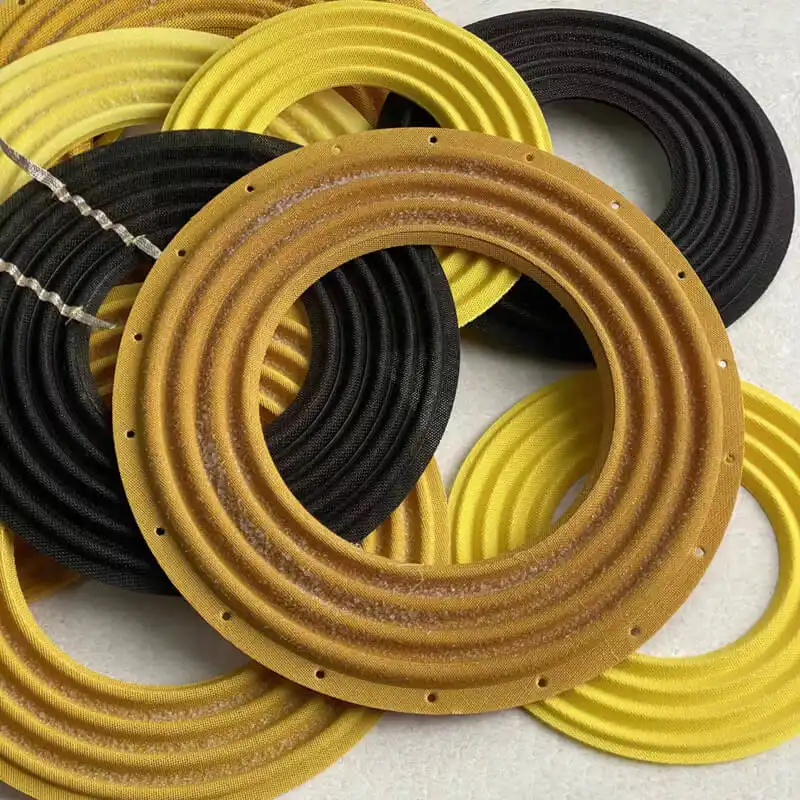
How to Match a Speaker Spider with the Voice Coil, Cone, Basket and Magnetic Gap
A practical guide to voice coil spider matching, covering ID fit, free height, cone neck, basket landing, lead-wire routing, and rub-free assembly.
Speaker performance can be lost long before final testing if the spider is matched only by outer diameter or a rough sample check. In real production, voice coil spider matching is a system decision. The spider has to work with the voice coil former, cone neck, basket spider landing, surround geometry, and magnetic gap at the same time.
For buyers, OEM teams, repair channels, and woofer or subwoofer builders, this matters because many common failures trace back to poor matching rather than poor material alone. Voice coil rub, unstable rest position, glue squeeze into the moving path, tilted travel, uneven compliance, and lead-wire interference often start with a spider that looks close on paper but does not fit the full moving assembly.
A practical matching process should confirm the key dimensions, the working height, the centering behavior, and the assembly method before batch production. The main checkpoints are usually OD, ID, SOD, FH, EH, voice-coil group, material code, corrugation profile, glue area, and lead-wire path.
Why voice coil spider matching affects the whole moving system
A speaker spider is not only a suspension part. It is also a centering element that helps keep the voice coil moving axially inside the magnetic gap. If the spider does not match the rest of the moving system, the problem is not limited to the spider itself.
Typical downstream effects include:
- voice coil rubbing in the gap
- off-center rest position
- reduced linear travel
- inconsistent left and right channel behavior
- assembly difficulty and lower yield
- rework during sampling or pilot production
- early fatigue around the glue joints or lead-wire area
For sourcing teams, this means the spider should not be approved as a stand-alone component. It should be evaluated as part of the voice-coil group and suspension stack.
Core dimensions to confirm before sampling
A matching discussion usually begins with dimensions, but a good RFQ goes beyond OD and ID. The most useful specification set includes:
- OD: outside diameter of the spider
- ID: inside diameter, usually matching the voice coil former area
- SOD: support or seating diameter used for basket landing reference, depending on drawing standard
- FH: free height of the spider before assembly
- EH: installed or effective height in the assembled condition
- voice-coil group: former diameter, former wall thickness, winding height, and related fit details
- material code: cloth type, resin treatment, and stiffness category
- corrugation: number of waves, wave shape, pitch, and depth
Different factories may define some drawing points differently, so buyers should confirm the measurement method, not only the number. A spider listed as the same nominal size can still behave differently if the free height reference or landing diameter definition is different.
ID fit to the voice coil former
The spider ID should match the voice coil former in a way that gives stable glue bonding without distorting the moving assembly. If the ID is too tight, the former can be forced out of alignment during assembly. If it is too loose, glue control becomes difficult and the centering point can drift.
The practical questions are:
- What is the actual former outer diameter?
- What glue type and glue line thickness are planned?
- How much bonding length is available at the neck?
- Is the former paper, aluminum, Kapton, or another material with different stiffness and thermal behavior?
A proper fit needs enough glue area for strength, but not so much excess adhesive that it creeps toward the coil winding or adds uneven mass. For buyers comparing suppliers, the important point is not just nominal ID. It is the real assembled fit with the chosen glue process.
Glue area and bond stability
The glue area between spider and former should be wide enough for production reliability and repair durability. Small bond areas may pass a sample but fail under heat, excursion, or repeated stress. Overly large glue spread can also create problems by stiffening the wrong zone or pulling the spider off center during curing.
Good matching reviews should confirm:
- former bonding width
- cone neck bonding width
- basket landing bonding width
- glue viscosity and application method
- curing conditions that may affect final shape
This is especially important for higher-excursion woofer and subwoofer builds, where the spider sees larger cyclic loads.
Matching free height, effective height, and rest position
Many voice coil rub problems come from height mismatch rather than diameter mismatch. A spider can fit the former and cone, yet still place the voice coil too high or too low in the magnetic gap.
Free height versus effective height
Free height (FH) describes the spider shape before assembly. Effective height (EH) reflects the installed working height after it is glued into the system. Both matter.
If FH is wrong, the spider may need to be forced into position during assembly. That can preload the suspension, shift the neutral point, and create uneven excursion. If EH is wrong, the voice coil may sit outside the intended rest position in the magnetic gap, reducing usable stroke and increasing rub risk.
Buyers should check whether the supplier is matching the spider to:
- gap height and top plate geometry
- voice coil winding height
- cone depth and neck position
- surround roll geometry
- basket spider landing depth
Rest position in the magnetic gap
The correct rest position keeps the voice coil centered where the design expects it to operate. In practical assembly, this means the moving system should sit in the intended neutral position with no forced tilt from the spider, cone, or surround.
If the spider pushes the assembly upward or downward, several issues can appear:
- reduced linearity around the intended operating range
- mechanical noise at high excursion
- asymmetric travel limits
- increased chance of coil contact with the pole or top plate
A sample should be checked not only statically but also through full excursion movement. A build that looks centered at rest can still rub when travel increases if the spider geometry is unstable or the corrugation is not balanced.
Magnetic gap clearance and rub prevention
Magnetic gap clearance is a strict checkpoint, especially on tighter motor designs. Even a small tilt in the voice coil can cause contact. Spider selection affects this because it controls centering stiffness and guides axial motion.
To reduce rub risk, confirm:
- the voice coil sits concentrically in the gap during assembly
- the spider corrugation supports even travel
- glue squeeze-out does not enter the moving path
- the former is not distorted by an undersized ID fit
- basket landing is flat and aligned
- lead wires do not pull the cone or spider sideways
In production, shimming may help during assembly, but shims cannot correct a fundamentally mismatched spider. If the geometry is wrong, the unit may still fail after curing or after a short period of use.
Matching the spider to the cone neck and basket landing
The spider has to connect two major structural points: inward to the voice coil former and outward to the basket. At the same time, it has to cooperate with the cone neck geometry.
Cone neck size and neck angle
The cone neck size affects how the spider and voice coil group meet the cone. If the cone neck is too narrow, too wide, too steep, or positioned at the wrong height for the selected spider, the assembly can become stressed or misaligned.
Practical checkpoints include:
- cone neck inner and outer diameter
- neck depth and angle
- cone material stiffness near the neck
- available glue land between cone and former or cone and spider contact area
The spider should not force the cone into an unnatural position. If the cone and spider are fighting each other, the final neutral axis will be unstable. This often shows up as rocking motion, uneven compliance, or a rub that appears only under dynamic movement.
Basket spider landing
The basket landing is often treated as a simple OD match, but it deserves more attention. The landing must support the spider evenly around the circumference. A mismatch here can warp the spider during bonding.
Check these points:
- actual landing diameter, not only nominal basket size
- landing width available for glue
- landing flatness or contour
- depth relative to the top plate and surround mounting level
- venting features or frame shapes that may affect glue spread
If the spider OD or SOD does not match the basket landing correctly, the result can be partial bonding, edge lift, or built-in stress. In batch production, that means inconsistent centering from unit to unit.
Corrugation, compliance, and centering behavior
Two spiders with the same OD, ID, and height can behave very differently because of material and corrugation design. This is where many substitutions fail.
Material code and stiffness selection
Material selection influences compliance, fatigue life, and thermal stability. Buyers should request the material code or an equivalent internal specification so future repeat orders stay consistent.
Useful items to confirm include:
- base fabric type
- resin treatment level
- target stiffness or compliance range
- environmental stability expectations
- whether the spider is intended for low-frequency, high-excursion, or general-purpose use
If replacement sourcing is done only by dimensions, the resulting assembly may center differently or change the system response.
Corrugation profile
Corrugation determines how the spider flexes and returns to center. Wave count, wave depth, pitch, and profile all influence centering force and travel behavior.
What buyers should pay attention to:
- whether the corrugation supports the required excursion
- whether it introduces excessive stiffness for the intended cone mass
- whether it provides stable axial movement without rocking
- whether the lead-wire path interferes with the wave shape
For woofer and subwoofer applications, corrugation choice is closely tied to excursion control. For repair channels, matching the original corrugation style is often important to avoid changing the speaker’s behavior.
Lead-wire routing, assembly control, and sample approval
A spider may be dimensionally correct and still create production issues if lead-wire routing and assembly control are not addressed.
Lead-wire routing through or over the spider
Lead wires should move freely without slapping, pulling, or rubbing adjacent parts. The routing path must be compatible with the spider geometry and excursion range.
Common checkpoints are:
- lead-wire hole or path location
- reinforcement around the wire area if needed
- slack length under full excursion
- avoidance of tension that shifts the voice coil off center
- clearance from cone, spider waves, and basket features
Poor lead-wire routing can imitate a spider problem by introducing side force into the moving system.
Sample matching before batch production
Before approving volume production, a proper sample review should combine dimensional confirmation with assembly testing. This is more reliable than checking a loose spider only.
A practical sample process usually includes:
- confirming OD, ID, SOD, FH, and EH against the drawing
- matching the spider to the actual voice-coil group, cone, and basket
- assembling with the intended glue system
- checking rest position in the magnetic gap
- testing smooth excursion for rub, rocking, or wire interference
- reviewing consistency across multiple sample units
For OEM teams and sourcing buyers, this step reduces change risk later. It also improves RFQ quality because the approved sample can define the final production standard.
What to include in an RFQ for voice coil spider matching
A stronger RFQ saves time and reduces back-and-forth during development. Instead of requesting a spider by size only, include the full matching context.
Recommended RFQ details:
- speaker model or application
- voice coil former diameter and material
- OD, ID, SOD, FH, and target EH
- cone neck dimensions
- basket landing dimensions and photos or drawing
- magnetic gap and voice coil height relationship
- material code or performance target
- corrugation preference
- lead-wire routing requirement
- sample quantity needed for validation
- expected batch quantity and delivery window
When buyers provide a complete specification package, sample matching and mold support become much more efficient.
What buyers, OEM teams, and repair channels should focus on
The main change in how many teams approach spiders is moving from a simple replacement mindset to a system matching mindset. That shift matters because the spider controls centering, and centering affects the voice coil, magnetic gap clearance, assembly yield, and final reliability.
For OEM teams, the key issue is production consistency. A spider that looks acceptable in a single hand-built sample may still create variation in batch assembly if the height, landing fit, or glue area are not tightly controlled.
For component sourcing buyers, the key issue is specification discipline. Dimensions alone are not enough. The RFQ should connect the spider to the voice-coil group, cone, basket, and magnetic gap.
For repair and replacement channels, the key issue is functional compatibility. Matching OD and ID without checking free height, corrugation, and rest position can easily lead to voice coil rub after reassembly.
A well-matched spider supports smooth excursion, stable centering, and repeatable assembly. In practical terms, that means fewer rub complaints, better production yield, and a more reliable finished loudspeaker.
FAQ
What is the most important check in voice coil spider matching?
The most important check is whether the spider keeps the voice coil centered in the magnetic gap at the correct rest position. That depends on more than ID size. Buyers should confirm ID fit, free height, effective height, basket landing, cone neck geometry, and lead-wire routing together.
Can a speaker spider with the same OD and ID still cause voice coil rub?
Yes. Two spiders with the same OD and ID can still differ in free height, corrugation, material stiffness, and effective installed height. Any of these differences can shift the rest position or reduce centering stability, leading to rub during assembly or under excursion.
Why should an RFQ include cone, basket, and magnetic gap details?
A spider works as part of the full moving system, not as an isolated part. Cone neck size affects the inner assembly geometry, basket landing affects outer support and glue area, and magnetic gap position determines whether the voice coil sits correctly at rest. Including these details improves sample matching and reduces production risk.
How do lead wires affect spider matching?
Lead wires can pull the moving system sideways if routing, slack, or entry position is wrong. Even when the spider dimensions are correct, poor lead-wire routing can create off-center movement, noise, or rubbing during excursion.
What sample checks should be completed before batch production?
Sample approval should include dimensional checks for OD, ID, SOD, FH, and EH, plus actual assembly with the target voice coil, cone, and basket. Teams should verify rest position, smooth excursion, glue control, lead-wire clearance, and consistency across multiple units before releasing volume production.
Factory RFQ Next Step
Move from research to a specification shortlist with product examples that can be sent for factory quotation.