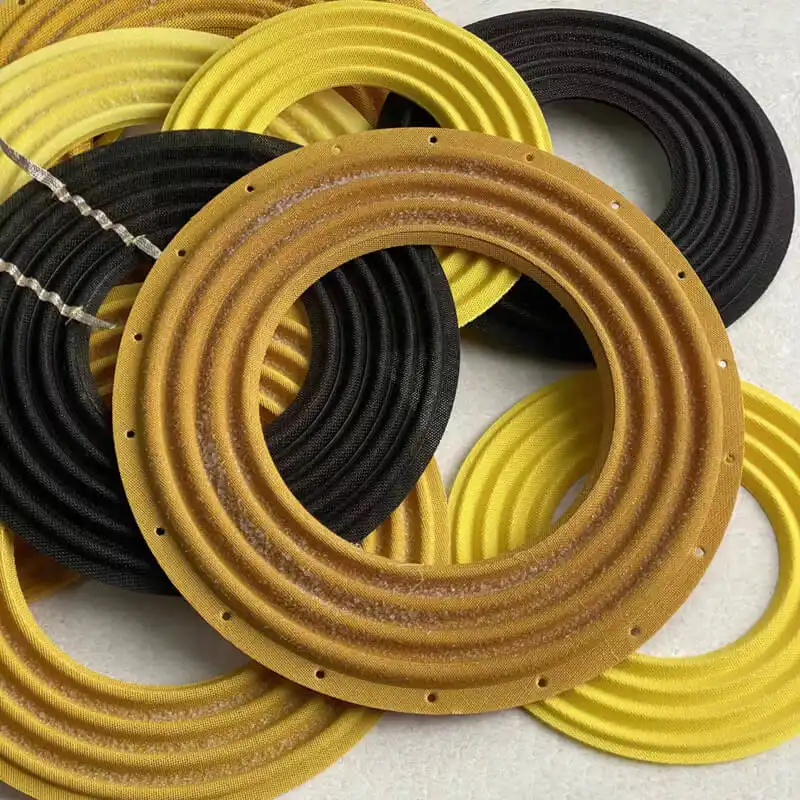
Speaker Spider Dimensions Explained: OD, ID, SOD, FH, and EH for Accurate Sourcing
A practical guide to speaker spider dimensions, covering OD, ID, SOD, FH, EH, voice-coil matching, centering, sampling, and RFQ preparation.
Why Speaker Spider Dimensions Matter
A speaker spider, also called a damper or centering spider, is a small suspension component with a large influence on loudspeaker assembly. It helps keep the voice coil centered in the magnetic gap, controls part of the suspension behavior, and connects the moving system to the basket or frame. When the dimensions are wrong, the result can be assembly interference, poor centering, voice-coil rub, inconsistent excursion, or a sample that looks close but fails during production.
For buyers, the challenge is that spider specifications are often reduced to a few shorthand terms: OD, ID, SOD, FH, and EH. These measurements are not interchangeable. Each one describes a different part of the spider geometry and affects how the spider fits with the basket, cone, voice-coil former, lead wire layout, and intended working height.
For speaker OEM teams, woofer and subwoofer builders, component sourcing buyers, and repair replacement channels, clear dimension control is one of the fastest ways to reduce sampling mistakes. A complete RFQ should not only ask for a “6.5-inch spider” or “subwoofer damper.” It should define the actual dimensions, material, corrugation profile, compliance target, voice-coil group, and assembly requirements.
Qiao Tai, a speaker spider and damper factory in Guangzhou Panyu founded in 2006, handles specification confirmation, sample matching, mold support, and batch production for loudspeaker suspension components. In practical sourcing work, dimension clarity is where a successful project often begins.
The Core Speaker Spider Dimensions: OD, ID, SOD, FH, and EH
Different factories and engineering teams may use slightly different drawing formats, so it is important to confirm definitions before approving a sample. The following terms are commonly used in speaker spider and damper sourcing.
OD: Outside Diameter
OD means outside diameter. It is the full outer diameter of the spider, measured across the widest outer edge.
The OD determines whether the spider can sit correctly on the basket landing area or frame support. If the OD is too large, the spider may not fit into the basket or may interfere with frame ribs, terminals, or lead wire routing. If the OD is too small, the bonding area may be insufficient, reducing glue strength or changing the effective suspension behavior.
For sourcing, OD should be checked against:
- Basket spider landing diameter
- Available glue area
- Frame rib clearance
- Lead wire path and solder terminal position
- Cone and surround assembly space
- Production tolerance requirements
A spider can have the correct material and compliance but still fail if the OD does not match the basket design. This is especially important for woofer and subwoofer assemblies, where larger excursion and heavier moving systems increase the load on the spider joint.
ID: Inner Diameter
ID means inner diameter. It is the central opening of the spider where the voice-coil former, neck joint, or cone assembly passes through or bonds.
ID is closely related to the voice-coil group. If the ID is too small, the spider may not fit over the former or may create stress during assembly. If the ID is too large, the bonding position may be weak, uneven, or difficult to center. A mismatch can also affect voice-coil alignment, especially when the glue joint between spider, cone neck, and voice-coil former must hold a precise position.
When specifying ID, buyers should confirm:
- Voice-coil former outer diameter
- Cone neck diameter
- Glue joint width
- Whether the spider bonds directly to the former or to another assembly part
- Required clearance for assembly tooling
- Final centering method used during production
ID is one of the most important checkpoints for avoiding voice-coil rub. Even a small dimensional mismatch can shift the moving system or create uneven stress after curing.
SOD: Spider Outer Diameter or Seat Outer Diameter
SOD can be used differently depending on the drawing or factory terminology. In many sourcing conversations, SOD refers to a specific spider seat outer diameter, stepped outer diameter, or functional outer seating diameter rather than the full visible OD. It may describe the diameter of the bonding shoulder, the usable clamping area, or a formed section that sits into a defined basket position.
Because SOD is not always defined the same way, it should never be assumed. Buyers should request a drawing or marked sample photo showing exactly where SOD is measured.
SOD can affect:
- How the spider seats in the basket
- Whether the corrugation starts too close to the glue area
- Glue width and bonding repeatability
- Clearance between the active corrugation and frame structure
- Consistency between sample approval and batch production
In RFQ communication, it is useful to state both OD and SOD if the part has a stepped or shaped outer zone. If the spider is flat and simple, OD may be enough. If the spider has a special edge shape, shoulder, trimming step, or positioning area, SOD becomes much more important.
FH: Free Height or Forming Height
FH commonly refers to free height or forming height, depending on the supplier’s drawing system. It describes the vertical height of the spider when not assembled, or the formed height created by the corrugation and profile.
FH matters because a speaker spider is not only a flat ring. Its corrugation profile and height influence the resting position of the moving assembly, the working geometry, and the centering behavior. If the free height is not suitable, the spider may force the voice coil too high or too low after assembly, changing the neutral position and reducing reliable excursion.
Buyers should evaluate FH together with:
- Basket depth
- Cone profile
- Voice-coil winding height and magnetic gap position
- Intended rest position of the moving system
- Assembly jig height
- Required excursion range
For replacement and repair channels, FH is often overlooked because buyers focus on OD and ID first. However, a spider with the same diameters but a different height can change how the reconed speaker sits and moves.
EH: Effective Height or Edge Height
EH may refer to effective height, edge height, or a related vertical reference depending on the engineering drawing. Like SOD, EH must be confirmed on a marked drawing because usage can vary.
In practical terms, EH is normally used to control a vertical relationship that affects fit and working position. It may indicate how high a certain edge, corrugation point, or seating area sits relative to a reference plane. This can influence whether the spider clears the basket, aligns with the cone neck, and supports the intended voice-coil position.
When reviewing EH, buyers should ask:
- What reference plane is used for the height measurement?
- Is EH measured before assembly or after assembly?
- Does EH refer to the outer edge, inner edge, or effective working profile?
- How does EH relate to FH on the same drawing?
- What tolerance is acceptable for production inspection?
EH is especially relevant when matching an existing spider sample. If the original part has a formed profile, simply measuring the diameter is not enough. The vertical geometry must also be captured.
How Dimensions Affect Fit, Centering, and Voice-Coil Alignment
Speaker spider dimensions are not isolated numbers. They work together as a system. A correct OD with the wrong ID can still create assembly problems. A correct ID with the wrong height can still produce voice-coil rub. A good-looking sample with an undefined SOD may fail when production baskets vary slightly.
Basket Assembly and Bonding Area
The spider must bond securely to the basket or frame. The OD and SOD define whether the outer edge has enough landing area for adhesive. If the active corrugation is too close to the glue zone, bonding can become inconsistent and the working corrugation may be restricted.
A good sourcing specification should identify the actual bonding area, not only the nominal outside diameter. For example, the drawing should show whether the outer edge is flat, raised, stepped, or trimmed. This helps the factory confirm whether the part can be made with an existing mold or needs mold support.
Voice-Coil Group Matching
The ID must match the voice-coil group, including former diameter and assembly clearance. In loudspeaker production, the spider often helps hold the voice coil in the magnetic gap while the adhesive cures. If the ID is not matched correctly, the spider can pull the coil off-center or create uneven glue thickness.
The voice-coil group should be described clearly in an RFQ. Useful details include:
- Former outside diameter
- Former material if relevant to bonding
- Winding height and position requirements
- Cone neck diameter
- Assembly method and centering jig information
- Target rest position in the magnetic gap
For woofer and subwoofer designs, where the moving system is heavier and excursion is larger, this matching becomes even more important.
Corrugation and Compliance
Corrugation shape affects mechanical behavior. A spider with the same OD and ID can perform differently if the corrugation number, wave depth, fabric, resin treatment, or forming height changes. Compliance, stiffness, and restoring force are influenced by both material and geometry.
Dimension discussion should therefore include the corrugation profile and material code. If buyers only provide OD and ID, the factory may be able to make a part that fits physically but does not meet the intended suspension behavior.
For specification confirmation, buyers should share:
- Corrugation count or profile reference
- Material code or original sample
- Desired stiffness or compliance target, if available
- Application type, such as woofer, midrange, subwoofer, or repair replacement
- Whether the spider needs special treatment or coating
Centering and Production Repeatability
A speaker spider is a centering component. Its geometry must be repeatable in batch production. Small variations in ID, height, or corrugation can affect how consistently the voice coil remains centered across units.
This is where quality inspection and process control matter. During batch production, inspection should confirm key dimensions and visual quality before parts move forward. For factory manufacturing, ERP process control can help manage order information, material selection, production steps, and delivery status so that approved specifications are not mixed with similar-looking parts.
Specification Checkpoints for Sampling and RFQ Preparation
Clear sourcing starts with a complete specification package. A physical sample is helpful, but a sample alone can leave room for interpretation. The best approach is to combine measurements, application context, and performance expectations.
Basic Dimension Checklist
Before requesting samples or pricing, prepare these measurements:
- OD: full outside diameter
- ID: inner opening diameter
- SOD: seat or functional outer diameter, if applicable
- FH: free height or forming height, with definition
- EH: effective height or edge height, with reference plane
- Thickness or material thickness, if measured
- Corrugation count and profile details
- Outer and inner bonding area width
- Tolerance requirements for critical dimensions
If the part is being matched from an existing spider, provide clear photos with caliper readings. Mark exactly where each dimension is taken. For formed height measurements, side-view photos are especially useful.
Material and Construction Details
Dimension accuracy does not replace material confirmation. Speaker spiders are commonly made with treated fabric materials, and different material codes or resin treatments can change stiffness, durability, and centering behavior.
A practical RFQ should include:
- Material code, if known
- Original sample for matching, if available
- Color and treatment requirements, if relevant
- Corrugation profile or mold reference
- Compliance or stiffness target, if known
- Application category and power/excursion expectations, if available
If the original material code is unknown, sample matching can help the factory compare hand feel, profile, thickness, and working behavior. For critical programs, buyers should confirm samples in the actual speaker assembly rather than approving by appearance only.
Application and Assembly Information
The same spider dimension may work differently in different speakers. A woofer, subwoofer, midrange unit, and repair recone kit may require different centering strength, compliance, and height relationships.
Useful application details include:
- Speaker size and type
- Basket model or landing dimensions
- Voice-coil diameter and former details
- Cone neck structure
- Expected excursion range
- Assembly sequence
- Whether the spider is used alone or with multiple spiders
- Packaging and delivery requirements for batch production
For OEM teams, this information helps reduce back-and-forth during sample development. For repair replacement channels, it helps avoid parts that fit the frame but change the speaker’s resting position or create rubbing after installation.
Quality Control Points Before Batch Production
A dimension-focused spider project should not move directly from sample approval to mass production without clear inspection standards. The approved sample should become the reference for production, but the measurable checkpoints must be documented.
Incoming and In-Process Checks
Quality inspection should cover both visual and dimensional items. For speaker spiders and dampers, typical checkpoints include:
- OD, ID, SOD, FH, and EH measurement
- Corrugation shape consistency
- Edge trimming condition
- Surface treatment and material consistency
- Flatness or formed profile stability
- Bonding area cleanliness
- Deformation, cracks, loose fibers, or contamination
The importance of each checkpoint depends on the speaker design. For a tight magnetic gap, ID and centering behavior may be highly critical. For a basket with limited landing space, OD and SOD may require tighter control.
Sample Approval in Real Assembly
A spider should be tested in the actual assembly or a representative fixture whenever possible. A loose part may seem correct on a table, but problems can appear after it is bonded into the basket and connected to the voice-coil and cone assembly.
During sample evaluation, buyers should check:
- Does the spider sit correctly on the basket landing?
- Is the voice coil centered after curing?
- Is there any coil rub at rest or during movement?
- Does the spider interfere with cone movement, frame ribs, or lead wires?
- Is the rest height correct for the magnetic gap?
- Does the compliance feel consistent with the target design?
For batch orders, approved dimensions, material code, sample reference, and inspection requirements should be locked before production. This helps avoid confusion when several similar spiders are being made at the same time.
Production Delivery and Specification Control
Speaker spider sourcing is not only about finding a part that can be made. It is about making the same part consistently across production lots. Clear drawings, sample references, and ERP-supported process records help keep material selection, mold usage, production routing, inspection, and delivery aligned with the approved specification.
For global sourcing teams and speaker manufacturers, this reduces the risk of receiving parts that look similar but behave differently. It also supports smoother reorder management when the same spider is needed again for future production.
Practical Takeaways for Accurate Speaker Spider Sourcing
The most reliable way to source a speaker spider is to treat dimensions as part of a full suspension specification, not as isolated measurements. OD, ID, SOD, FH, and EH should be confirmed with drawings, marked photos, or physical samples. Voice-coil group matching, corrugation, material code, compliance, and centering behavior should be reviewed before batch production.
A strong RFQ should answer these questions clearly:
- What are the exact OD, ID, SOD, FH, and EH values?
- How is each height or special diameter measured?
- What voice-coil group does the spider need to match?
- What basket landing and bonding area are available?
- What material code, corrugation, and compliance are required?
- Is there an original sample for matching?
- What inspection standards should apply to batch production?
For buyers working with new loudspeaker projects, early dimension confirmation helps prevent tooling and assembly delays. For repair and replacement channels, accurate measurement helps avoid recone problems and voice-coil rub. For OEM production, documented specifications support repeatability from sample approval through batch delivery.
Speaker spiders may be simple in appearance, but their dimensions define the mechanical relationship between the basket, cone, voice coil, and magnetic gap. Getting OD, ID, SOD, FH, and EH right is one of the most practical steps toward stable assembly and reliable loudspeaker performance.
FAQ
What does OD mean in speaker spider dimensions?
OD means outside diameter. It is the full outer diameter of the speaker spider and determines how the part fits on the basket landing area, how much bonding space is available, and whether the spider clears the frame structure.
Why is ID important for voice-coil alignment?
ID means inner diameter. It must match the voice-coil former, cone neck, and glue joint requirements. If the ID is too small or too large, the spider may pull the moving assembly off-center, create uneven bonding, or contribute to voice-coil rub.
Are SOD, FH, and EH always defined the same way?
No. SOD, FH, and EH can vary by drawing system or factory terminology. Buyers should confirm each term with a marked drawing, measurement reference, or sample photo before approving samples or placing a batch order.
What should be included in a speaker spider RFQ?
A complete RFQ should include OD, ID, SOD, FH, EH, material code, corrugation details, compliance or stiffness target if available, voice-coil group information, basket landing dimensions, sample reference, and inspection requirements.
Can a speaker spider with the correct OD and ID still fail?
Yes. A spider with the correct OD and ID can still fail if the height, corrugation, material, compliance, or bonding area does not match the speaker assembly. Real assembly testing is important before batch production.
Factory RFQ Next Step
Move from research to a specification shortlist with product examples that can be sent for factory quotation.