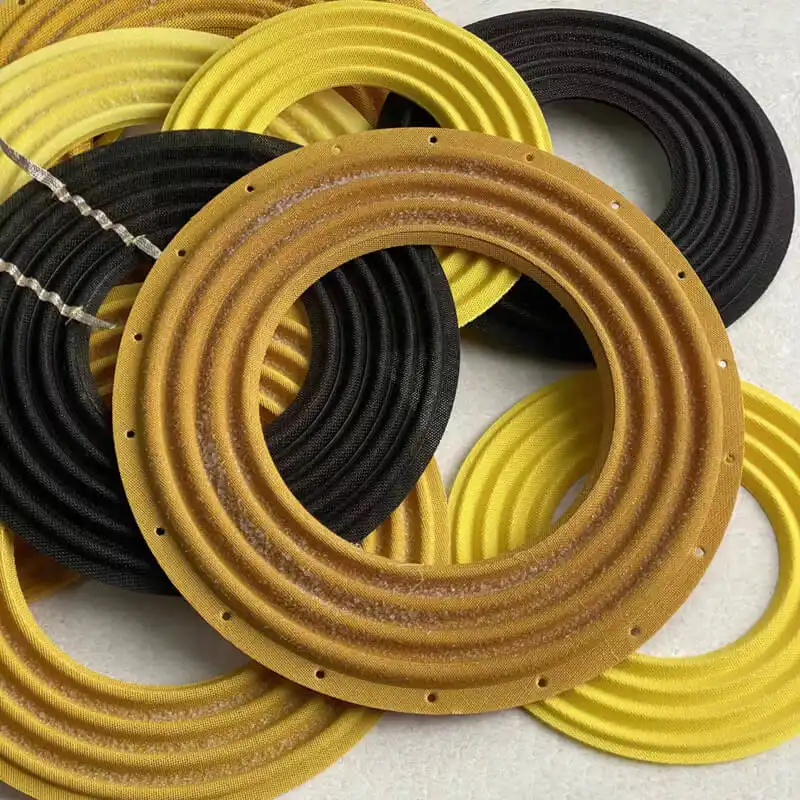
Speaker Spider Dimensions Explained: OD, ID, SOD, FH and EH for Accurate Matching
A practical guide to speaker spider dimensions, measurement checkpoints, tolerance risks, and RFQ details for accurate sampling and production.
Speaker Spider Dimensions Explained: OD, ID, SOD, FH and EH for Accurate Matching
Speaker spider dimensions affect far more than whether a damper can physically fit inside a loudspeaker frame. The spider controls the voice coil's centered movement, supports the moving assembly, and helps define the mechanical behavior of a woofer, subwoofer, midrange driver, or replacement repair assembly. A small mismatch in outer diameter, inner diameter, roll height, or effective height can cause rubbing, offset suspension, glue overflow, unstable compliance, or low assembly yield.
For OEM teams, woofer builders, component sourcing buyers, and repair channels, accurate dimension confirmation is one of the most important steps before sampling or batch production. A spider that looks similar in a photo may not match the basket landing, voice-coil former, top plate clearance, or designed rest position. This is why a complete specification should include OD, ID, SOD, FH, EH, voice-coil group, material code, corrugation design, compliance target, and any assembly reference drawings.
This guide explains the core speaker spider dimensions buyers should confirm, how they are measured, and where dimensional risks usually appear during sample matching and production.
Why Speaker Spider Dimensions Matter Before Sampling
A speaker spider, also called a damper or centering spider, is not only a fabric ring with corrugations. It is a precision suspension component. Its geometry determines how the voice coil is centered in the magnetic gap, how the cone returns to rest, and how the suspension behaves through excursion.
When dimensions are incomplete, the sample process becomes slower and less reliable. A supplier may receive only a photo, an outside diameter, or a general model name, but these details are rarely enough for accurate matching. Two spiders with the same outside diameter can have different inner holes, corrugation profiles, fabric stiffness, resin treatment, and working height.
Dimension mismatch can create several practical problems:
- The spider does not sit correctly on the basket or spider landing.
- The inner hole does not match the voice-coil former or bobbin diameter.
- The corrugation area interferes with the frame, lead wire, cone neck, or voice-coil joint.
- The moving assembly sits too high or too low after gluing.
- The voice coil is not centered vertically or radially in the magnetic gap.
- Compliance varies from the approved sample, affecting driver performance.
- Production yield drops because assemblers need extra adjustment time.
For factories that build loudspeakers in batches, the issue is not just one failed sample. The bigger concern is repeatability. Once a spider is approved, its dimensions must be controlled during material cutting, forming, resin treatment, heat pressing, inspection, packing, and delivery. Clear specifications help both the buyer and the spider manufacturer maintain consistency from sample confirmation to mass production.
Core Speaker Spider Dimensions: OD, ID, SOD, FH and EH
Different companies may use slightly different drawing formats, but most speaker spider dimension discussions include several common checkpoints. The most important are OD, ID, SOD, FH, and EH. These values should be confirmed with a drawing, a measured sample, or both.
OD: Outside Diameter
OD, or outside diameter, is the total outer diameter of the spider. It determines whether the damper can fit the basket landing or mounting area.
For a standard round spider, OD is measured across the widest outer edge. A caliper is commonly used for small and medium sizes, while larger spiders may require a flat measurement fixture to prevent distortion during checking.
OD is important because the spider must bond securely to the basket or frame. If the OD is too large, the spider may curl, compress, or fail to sit flat. If it is too small, the glue contact area may be insufficient, reducing bonding strength and centering reliability.
When confirming OD, buyers should also check:
- Whether the outer edge is plain, cut, coated, or reinforced
- The required glue width on the basket landing
- Whether the spider edge must align with a specific frame step
- Whether trimming or tooling changes are required for batch production
For repair replacement channels, OD is often the first measurement taken from the original spider. However, OD alone is not enough to define a compatible replacement.
ID: Inner Diameter
ID, or inner diameter, is the diameter of the center hole. It is usually matched to the voice-coil former, bobbin, or neck joint where the spider is bonded.
ID is one of the highest-risk dimensions because it directly affects the voice-coil group. If the ID is too small, the spider may not fit over the former or may deform during assembly. If the ID is too large, the bond area may be reduced and the spider may not hold the coil concentrically.
When discussing ID, buyers should confirm whether the measurement refers to:
- The clean cut hole before assembly
- The intended fit over the voice-coil former
- A hole with coating, resin, or edge treatment
- A spider designed for a special bobbin or stepped former
A correct ID supports stable centering. In OEM assembly, the spider is often positioned with jigs and reference tooling. Even with tooling, an incorrect ID can make radial alignment difficult and increase the risk of coil rub.
SOD: Spider Outside Diameter or Support Outside Diameter
SOD is used by some buyers and factories to describe a specific spider outside dimension, support outer diameter, or an effective seating diameter depending on the drawing convention. Because the abbreviation is not universally standardized, it should always be defined clearly in the RFQ or drawing.
In many practical sourcing conversations, SOD may refer to the spider's effective support diameter or the diameter related to the outer support/contact area. In other cases, it may be used interchangeably with spider outside diameter. This difference can create confusion when a buyer compares repair measurements, supplier catalogs, and production drawings.
The safest approach is to mark SOD directly on a drawing or photo with arrows. If a factory asks for SOD, buyers should clarify whether the requested value means:
- The full outer diameter of the spider
- The diameter of the outer glue support area
- The working diameter across a specific corrugation boundary
- A basket-related seating or mounting dimension
This clarification is especially important for spiders with wide outer flats, special corrugation layouts, double spiders, or non-standard suspension structures.
FH: Free Height or Forming Height
FH is often used to indicate a height-related dimension, commonly free height or forming height depending on the supplier's specification system. In spider manufacturing, height is closely related to corrugation profile and the rest position of the suspension.
FH may describe the natural height of the spider when it is not compressed, or the height created by the forming mold. Because usage can vary, FH should be confirmed with a cross-section drawing or a physical reference sample.
FH affects how the spider sits in the speaker assembly. If the height is not suitable, the moving system may be pulled upward or downward after gluing. This can change the voice coil's rest position in the gap and affect available excursion.
Buyers should confirm FH together with:
- Corrugation shape and number of waves
- Material stiffness and resin treatment
- Target compliance or mechanical behavior
- Assembly stack height of cone, coil, spider, and frame
- Whether the spider is measured free, compressed, or installed
A spider with a similar OD and ID but different FH may still behave very differently in the finished speaker.
EH: Effective Height or Edge Height
EH usually refers to another height-related checkpoint, such as effective height or edge height, depending on the drawing standard. Like FH, the abbreviation must be defined clearly before tooling, sampling, or production.
EH can be used to describe the practical working height of the spider in assembly, the height of a certain corrugation reference point, or the edge height relative to the mounting plane. The exact meaning should not be assumed.
EH matters because the spider is part of a complete suspension system. If the effective height does not match the cone and voice-coil group, the assembly may be pre-loaded. Pre-load can influence centering, compliance, and long-term reliability.
A good RFQ should show FH and EH on a simple cross-section sketch. Even a clear hand drawing with measurement arrows can prevent misunderstanding before a mold is prepared or a sample is matched.
How to Measure a Woofer Spider for Matching
Accurate measurement starts with the right reference condition. A used speaker spider removed from a damaged driver may be stretched, compressed, heat-aged, contaminated with glue, or distorted during disassembly. It can still provide useful information, but buyers should separate measured evidence from final specification decisions.
Prepare the Sample and Tools
For physical sample matching, prepare a clean spider or an original driver assembly if the spider cannot be removed without damage. Use a caliper for OD and ID, a height gauge or flat reference surface for height values, and clear photos with scale markers.
Important preparation steps include:
- Remove loose glue only if it does not damage the fabric edge.
- Keep the spider flat without forcing the corrugations down.
- Measure several points around the circumference to check roundness.
- Record whether the part is new, used, or removed from a repair unit.
- Photograph the top, bottom, side profile, and assembly position.
For factory production, a drawing is preferred. The drawing should include dimension tolerances, material code, corrugation profile, and any special treatment such as phenolic resin, cotton blend, Nomex-type fabric, or other specified material systems when applicable.
Measure OD and ID Without Deforming the Spider
Speaker spiders are flexible. Pressing too hard with a caliper can compress the fabric and change the reading. The goal is to contact the edge lightly and measure across the true diameter.
For OD, measure at least two directions, typically 90 degrees apart. If the spider is not perfectly round, record the range instead of a single value. For ID, avoid measuring over glue residue or frayed fibers unless those features are part of the original design.
For replacement projects, also measure the matching parts:
- Voice-coil former outside diameter
- Basket spider landing diameter
- Available glue width
- Cone neck or collar clearance
- Gap-related assembly height if available
Matching only the loose spider can lead to wrong conclusions if the original part was distorted during removal.
Confirm FH and EH With a Cross-Section Reference
Height values are more difficult to measure than diameters because corrugations have curved surfaces. The most reliable method is to define a reference plane and a measurement point.
For example, the outer glue edge may sit on a flat plane, while the highest corrugation peak is measured above that plane. Another drawing may define height from the mounting plane to the inner neck area. Both can be valid, but they are not interchangeable.
Before sample approval, buyers should ask the factory to confirm how FH and EH are inspected. If the production team uses one reference method and the buyer expects another, sample approval may become unclear.
Record Corrugation and Compliance Details
Dimensions describe shape, but they do not fully describe behavior. Corrugation design and material treatment influence stiffness, restoring force, fatigue behavior, and centering performance.
Useful details to include with dimensions are:
- Number of corrugation waves
- Wave depth and pitch if available
- Fabric type or material code
- Resin treatment or coating requirement
- Compliance target or approved sample reference
- Application type, such as woofer, subwoofer, midrange, or repair replacement
A spider with the correct OD, ID, SOD, FH, and EH can still be unsuitable if the compliance is too soft or too stiff for the driver design.
Common Tolerance Risks in Spider Sampling and Production
Tolerance risk appears when a dimension is close enough for one sample but not stable enough for repeat production. Speaker spider manufacturing involves fabric, resin, cutting, forming, heat, pressure, and handling. Each step can influence the finished dimensions.
Outer Edge Fit and Glue Area
If OD tolerance is too loose, some pieces may sit well while others shift during bonding. A narrow basket landing increases the risk because there is less glue area to absorb variation. For high-volume assembly, the spider should have enough contact area for stable bonding without interfering with nearby frame features.
Buyers should confirm whether the outer edge requires a tight cutting tolerance, a special die, or mold support. If an existing mold is used, the actual available dimensions should be checked against the design requirement before production.
Inner Hole Fit and Voice-Coil Centering
ID tolerance is closely linked to centering. A loose fit around the former may allow the voice coil to tilt or shift before adhesive cures. A tight fit may create stress in the spider and pull the coil off center.
For OEM production, the ID should be reviewed together with the voice-coil group. That includes former diameter, winding position, collar structure, adhesive thickness, and any lead wire routing near the spider joint.
Height Variation and Assembly Pre-Load
Height mismatch is often harder to see during incoming inspection but can show up during driver testing. If FH or EH varies, the moving assembly may not settle at the intended rest position. This can affect excursion symmetry and may contribute to rubbing, abnormal noise, or inconsistent performance.
Where height is critical, buyers should define the measurement method clearly and confirm inspection records during sampling. A physical golden sample can also help align expectations between engineering, sourcing, and production teams.
Material and Corrugation Changes
A dimensionally correct spider may change behavior if the material code or treatment changes. Fabric thickness, weave, resin content, and heat forming conditions all influence compliance. Corrugation tooling also affects stiffness and centering force.
This is why a complete specification should avoid vague descriptions such as “same size spider” or “black damper.” Size, material, corrugation, and compliance must be treated as one specification package.
RFQ Checklist for Speaker Spider Dimension Confirmation
A clear RFQ reduces sample cycles and helps the manufacturer evaluate whether an existing mold can be used or a new tool is required. It also helps quality teams control the approved specification during batch production.
For accurate speaker spider dimensions, include the following information wherever possible:
- OD: full outside diameter and tolerance if known
- ID: center hole diameter matched to the voice-coil former
- SOD: clearly defined with arrows if the term is used
- FH and EH: height definitions with reference planes
- Voice-coil group: former diameter, bobbin material, and assembly position
- Material code: fabric type, treatment, color, and coating if specified
- Corrugation: wave count, profile, depth, or approved sample reference
- Compliance: target value or comparison to an approved spider
- Application: woofer, subwoofer, midrange, professional audio, car audio, or repair
- Quantity plan: sample quantity, pilot run, and expected batch volume
- Drawings and photos: top view, side profile, cross-section, and assembly location
- Quality requirements: inspection method, key dimensions, packing, and delivery needs
For sample matching, sending the original spider or a complete driver assembly can be more reliable than measurements alone. If the part cannot be shipped, provide clear photos with measurement tools visible, plus a sketch showing OD, ID, SOD, FH, and EH.
During production approval, buyers should confirm how the factory controls dimensions through inspection. In a direct manufacturing environment, process control may include material confirmation, mold setup, in-process checks, ERP-linked order specifications, final inspection, and packing verification. The goal is to make the batch match the approved sample, not just to make one good prototype.
Practical Takeaways for Accurate Spider Matching
Speaker spider dimensions are a foundation for reliable loudspeaker assembly. OD confirms the basket fit, ID confirms the voice-coil fit, SOD must be clearly defined, and FH/EH control the height relationship of the suspension system. These values should not be separated from material, corrugation, compliance, and centering requirements.
For buyers, the most useful approach is to prepare a complete specification before sampling. A clear drawing, measured reference sample, voice-coil information, and application details help the factory determine whether existing tooling is suitable or whether mold support is needed. The result is faster sample matching, fewer assembly surprises, and better production consistency.
When evaluating a speaker spider, do not stop at the diameter printed in a catalog or measured from a repair part. Confirm how the spider fits, how it centers, how it behaves, and how it will be inspected in batch production.
FAQ
What are the most important speaker spider dimensions to confirm?
The key dimensions are OD, ID, SOD, FH and EH. OD confirms the outer fit on the basket landing, ID matches the voice-coil former, SOD should be clearly defined on the drawing, and FH/EH describe height relationships that affect centering and assembly position.
Is OD enough to match a replacement speaker spider?
No. OD is only the outside diameter. A replacement spider also needs the correct ID, corrugation shape, height, material, compliance and voice-coil fit. Two spiders with the same OD can behave very differently in the same loudspeaker.
Why do FH and EH matter in a speaker damper?
FH and EH relate to the spider's height and working position. If the height does not match the driver design, the moving assembly may be pre-loaded, which can shift the voice coil, reduce excursion symmetry, or cause rubbing and abnormal noise.
What should be included in an RFQ for a custom speaker spider?
An RFQ should include OD, ID, defined SOD, FH, EH, voice-coil former diameter, material code, corrugation details, compliance target or approved sample, application type, sample quantity, batch quantity and clear photos or drawings.
How can buyers reduce tolerance problems during batch production?
Buyers should approve a complete specification package, not only a physical sample. The factory should confirm material, mold, inspection method, key dimensional tolerances, sample approval records and production control steps before batch manufacturing.
Factory RFQ Next Step
Move from research to a specification shortlist with product examples that can be sent for factory quotation.