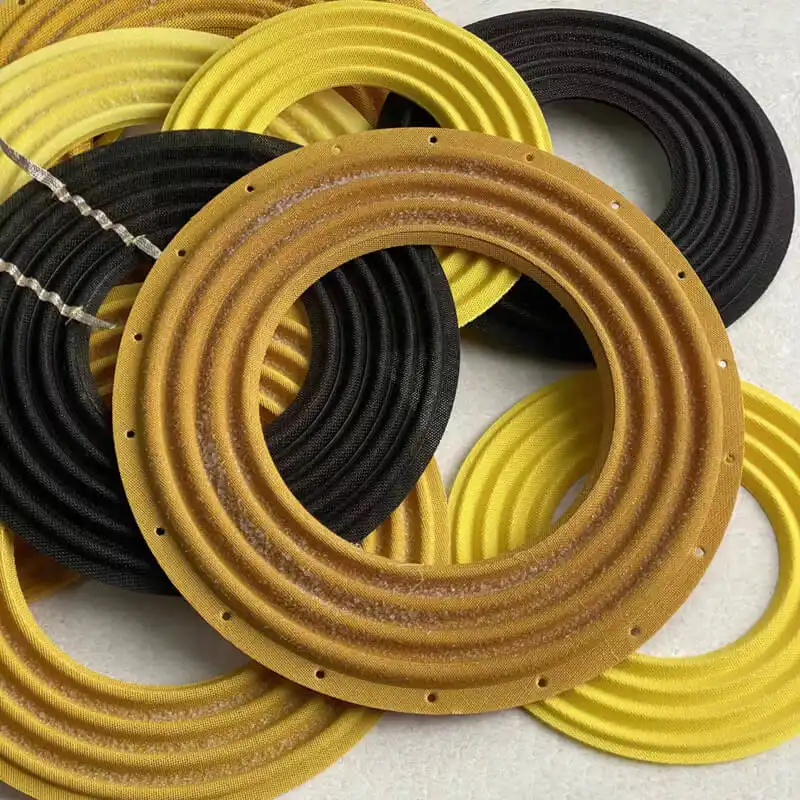
Speaker Spider Quality Inspection: Dimensions, Compliance, Appearance, Bonding and Batch Consistency
A practical QC guide to speaker spider inspection, covering dimensions, free height, compliance, appearance, bonding, packaging, and lot traceability.
Speaker spider quality inspection is not just a final visual check. For loudspeaker OEM teams, woofer builders, repair channels, and component sourcing buyers, the spider directly affects centering, linear movement, control, and long-term reliability. A small deviation in dimensions, resin treatment, stiffness, or bonding can lead to voice-coil rub, unstable compliance, uneven excursion, or inconsistent production results.
For that reason, serious inspection starts before forming and continues through sampling, in-process checks, packaging control, and final lot traceability. Buyers who understand the inspection workflow are in a better position to prepare RFQs, compare suppliers, approve samples, and protect batch consistency in mass production.
Why speaker spider quality inspection matters
The spider is a centering and restoring component in the loudspeaker suspension system. It helps keep the voice coil aligned in the magnetic gap while contributing to compliance and motion control. Because it works under repeated dynamic movement, quality variation shows up quickly in both assembly and performance.
Common problems linked to poor spider QC include:
- Voice-coil misalignment during assembly
- Coil rub after curing or during operation
- Compliance spread between units in the same model
- Inconsistent free height that changes cone position
- Weak or unstable bonding at the neck or landing area
- Cosmetic defects that indicate material or process instability
- Packaging damage that deforms parts before use
For buyers, inspection matters for two reasons. The first is technical fit: dimensions such as OD, ID, SOD, FH, and EH must match the basket, cone, voice-coil group, and assembly method. The second is production consistency: even if an approval sample works well, unstable lot control can create problems during batch production.
Incoming material inspection: fabric, resin treatment, and material identity
A strong QC process begins with incoming material checks. Speaker spiders are often made from treated fabric, and the fabric-resin combination has a direct effect on shape retention, stiffness, fatigue behavior, and forming repeatability.
Material code confirmation
Before production starts, the material should be matched to the approved specification. Buyers typically benefit from confirming:
- Material code or internal part code
- Fabric type and layer structure if applicable
- Resin treatment type or hardness range if specified
- Color and surface finish requirements
- Intended voice-coil group or speaker model match
This step is especially important when a buyer is approving a replacement spider, matching an existing sample, or moving from prototype to batch production.
Fabric condition and appearance checks
Incoming fabric inspection usually focuses on consistency before forming. Typical checks include:
- Surface cleanliness
- Weave uniformity
- No tears, pinholes, contamination, or loose fibers
- Stable resin distribution without obvious dry or over-saturated areas
- No warping or storage damage
Even when the finished spider looks acceptable at first glance, material irregularity can show up later as uneven corrugation, inconsistent stiffness, or bonding issues.
Why resin treatment consistency matters
Resin treatment is central to spider behavior. If resin application is inconsistent, the same geometry may produce different compliance from one batch to another. Overly stiff treatment may reduce the target deflection range. Under-treated material may lose shape stability or drift in use.
From a buyer's perspective, this is one of the most important points to clarify during sample matching and approval. If a supplier can control dimensions but not treatment consistency, batch performance can still vary.
Forming and dimensional inspection: OD, ID, SOD, FH, EH and corrugation control
Once material is approved, the next major QC stage is forming inspection. This is where geometry must match the drawing, sample, or approved production standard.
Core dimensional checkpoints
The most common specification points in speaker spider inspection include:
- OD (Outer Diameter): must fit the basket landing area and adhesive path
- ID (Inner Diameter): must match the neck area and voice-coil former connection
- SOD: often used as an additional structural or seating reference depending on design practice
- FH (Free Height): affects installed profile and suspension position
- EH (Effective Height): important where installed geometry and movement relationship must be controlled
- Neck size and seating area: critical for voice-coil alignment and bonding contact
- Corrugation count and shape: influences compliance, centering, and repeatability
For buyers, tolerances should not be treated as a generic note. A spider with acceptable OD but unstable FH can still create major assembly variation. A part with correct ID but uneven neck shape can still compromise centering.
Free-height control and why it deserves special attention
Free height is one of the most sensitive dimensions in speaker spider QC. It influences the resting geometry of the moving system and can affect cone position, coil centering, and assembly consistency. In woofer and subwoofer applications, FH spread can become especially visible during production.
If FH varies too much:
- glue-up height may drift,
- the moving system may sit too high or too low,
- voice-coil position inside the gap may shift,
- left-right unit consistency may suffer.
That is why buyers should review not only the nominal FH but also the control method used during production and sampling.
Corrugation uniformity and forming quality
Corrugation is not only a design feature; it is also a QC checkpoint. Uneven corrugation can alter compliance and centering. Forming inspection should look for:
- uniform wave depth,
- stable pitch and symmetry,
- no collapsed or distorted sections,
- no edge deformation,
- no cracks or stress marks after forming.
In practical terms, corrugation defects often signal issues with tooling condition, forming pressure, material stability, or resin response.
Compliance and deflection sampling: checking stiffness beyond dimensions
A speaker spider can pass dimensional inspection and still fail in application if its mechanical behavior is outside the target range. That is why compliance or deflection sampling is an essential part of quality control.
What compliance inspection is checking
In simple terms, compliance testing verifies how the spider deflects under controlled load or movement. Buyers may also hear this described as stiffness, restoring force, or deflection test sampling. The exact method can vary by factory equipment and product type, but the purpose is consistent: confirm that the suspension behavior matches the approved standard.
This matters because two spiders with the same OD, ID, and FH may behave differently if the material treatment or forming process differs.
Why stiffness spread matters in production
For loudspeaker manufacturing teams, stiffness variation can affect:
- assembly feel and glue positioning,
- centering behavior during curing,
- system resonance and suspension response,
- unit-to-unit consistency in finished speakers,
- rework rate if coils rub or rest position shifts.
For repair replacement channels, excessive variation can create fit problems even when the nominal size appears correct.
Sampling approach during batch production
Compliance is often checked through sample-based inspection rather than every piece, especially in higher-volume runs. What buyers should pay attention to is not only whether sampling exists, but whether it is tied to:
- approved golden sample or benchmark standard,
- material code and resin treatment lot,
- mold or tooling reference,
- defined production batch,
- recordable pass/fail criteria.
If a supplier can relate compliance sampling back to the approved sample and production lot, batch confidence is much higher.
Appearance, bonding, and functional defects that buyers should screen for
Visual inspection remains important, but it should focus on defects that affect function, assembly, or consistency.
Appearance defects worth flagging
A proper loudspeaker spider inspection should screen for:
- stains, oil marks, or contamination,
- cracks or broken fibers,
- uneven resin marks,
- warping or edge curling,
- burrs or trim irregularity,
- color inconsistency when appearance matters,
- mold marks or shape defects that affect seating.
Some cosmetic variation may be acceptable depending on the product class, but defects that suggest unstable material or process control should not be ignored.
Bonding area inspection
The spider must bond securely to the voice-coil former and basket or cone assembly, depending on design. QC should therefore examine the bonding zones for:
- clean and even contact surfaces,
- no delamination,
- no brittle cracking near the neck,
- correct neck geometry,
- no surface condition that may interfere with adhesive wetting.
Bonding problems are often expensive because they may only appear after assembly or field use. For buyers, this makes sample validation and process consistency more important than simple visual approval.
Centering-related defects
Because the spider serves a centering function, even minor shape irregularities deserve attention if they alter symmetry. Warning signs include:
- uneven height around the circumference,
- neck eccentricity,
- distorted corrugation sections,
- localized stiffness changes,
- deformation caused by poor storage or compression.
These issues may not always be obvious in incoming inspection unless the buyer checks both geometry and handling condition.
Packaging protection, final lot release, and traceability
Quality inspection is incomplete if good parts are damaged after production. Speaker spiders can deform during packing, storage, or transport if stack pressure, humidity exposure, or carton design is not controlled.
Packaging points that affect usable quality
Packaging should protect the spider's formed shape and bonding surfaces. Practical checkpoints include:
- stack method that avoids crushing or height distortion,
- separators or inner protection when needed,
- dry and clean packing condition,
- clear part identification on inner and outer labels,
- lot separation to prevent mixed batches.
For buyers managing international shipments, packaging is part of quality control, not just logistics. A dimensionally correct spider that arrives compressed or contaminated is still a quality failure.
Final lot traceability
Batch consistency depends on traceability. When a problem appears in assembly, buyers need to know whether it is linked to one material lot, one mold, one forming condition, or one shipment.
Useful lot traceability typically includes:
- part number,
- material code,
- voice-coil group or model match,
- production date or batch code,
- inspection status,
- quantity by lot,
- sample retention or approval reference.
Factories using structured process control and ERP-linked records are generally better able to isolate problems, confirm replacement requirements, and maintain repeat production. For sourcing teams, traceability is often the difference between a manageable correction and a prolonged line issue.
What buyers should include in RFQs and sample approvals
Many spider quality problems start with incomplete specification handoff. A buyer asking only for “same as sample” may get close dimensions but not the same compliance, treatment level, or height control.
A stronger RFQ should include as many of the following as possible:
- OD, ID, and SOD
- FH and EH
- overall sample or drawing reference
- voice-coil diameter or voice-coil group match
- material code or required fabric type
- corrugation count and profile expectations
- target compliance or deflection requirement if available
- bonding area requirements
- appearance standards for visible defects
- packaging method and lot labeling needs
- approval sample reference for batch matching
For repair and replacement channels, sending the original sample and identifying the application clearly can reduce mismatch risk. For OEM teams, locking the approved sample, dimensions, material code, and compliance standard before volume release is the safer path.
What changes when QC is done well
When speaker spider quality inspection is disciplined, buyers usually see the difference in four areas:
- More reliable assembly: less centering correction, less rework, and fewer rub-related issues
- Better batch consistency: production behaves like the approved sample, not just the drawing
- Clearer communication: RFQs, sample approvals, and replacement requests become more precise
- Stronger traceability: problems can be isolated quickly instead of spreading across multiple lots
That matters to loudspeaker factories, subwoofer builders, and sourcing teams because the spider is a small component with system-level impact. Good QC is not only about rejecting bad parts. It is about making sure dimensions, compliance, appearance, bonding, and packaging all support stable speaker production from sample stage through batch delivery.
FAQ
What should be checked in speaker spider quality inspection?
Key checkpoints include material code, fabric condition, resin treatment consistency, OD, ID, SOD, FH, EH, corrugation shape, compliance or deflection behavior, bonding areas, appearance defects, packaging protection, and final lot traceability.
Why is free height important in a loudspeaker spider?
Free height affects installed suspension position, cone resting geometry, and voice-coil centering. If FH varies too much, assembly height can drift and the risk of coil misalignment or rub increases.
How is speaker spider compliance usually checked?
Compliance is commonly verified through deflection or stiffness sampling against an approved standard or sample. The goal is to confirm that the spider's mechanical behavior remains consistent across production batches, not just that the dimensions are correct.
What appearance defects are serious in spider inspection?
Defects that may affect function include cracks, broken fibers, contamination, warped shape, uneven corrugation, unstable resin marks, trim irregularity, and any deformation that can interfere with centering or bonding.
What should buyers include in an RFQ for speaker spiders?
A good RFQ should include OD, ID, SOD, FH, EH, voice-coil group or diameter, material code, corrugation details, target compliance if known, bonding area requirements, packaging needs, and the approved sample or drawing reference.
Factory RFQ Next Step
Move from research to a specification shortlist with product examples that can be sent for factory quotation.