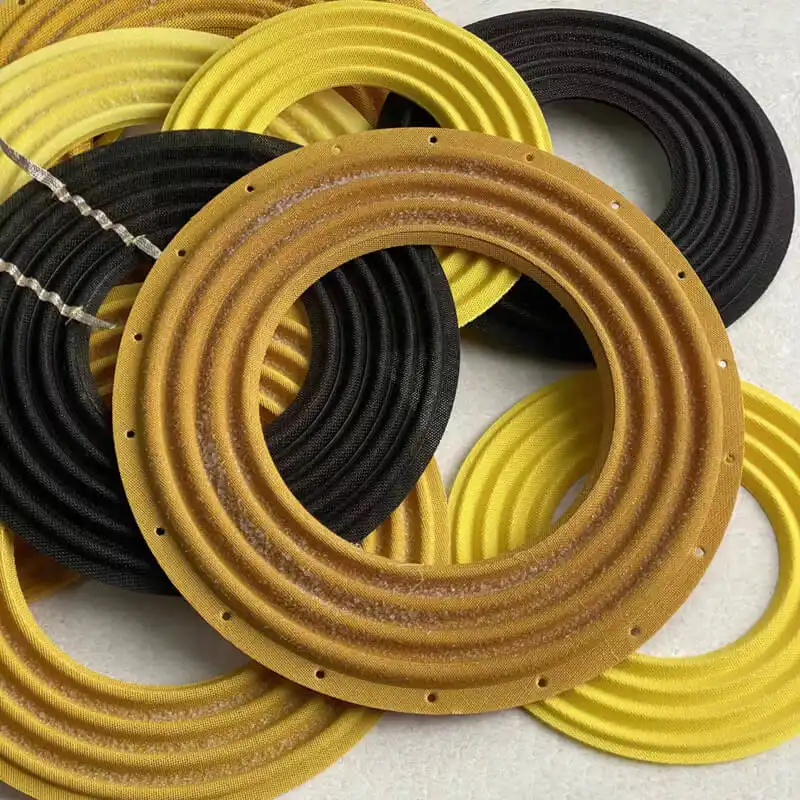
How Speaker Spider Compliance Affects Woofer and Subwoofer Performance
Speaker spider compliance affects excursion, resonance, centering, and long-term stability. Learn what buyers should specify before sampling.
How Speaker Spider Compliance Affects Woofer and Subwoofer Performance
Speaker spider compliance is one of the most important suspension factors behind woofer and subwoofer behavior. It influences how easily the voice coil moves, how well the cone returns to center, how the driver behaves near resonance, and how stable the loudspeaker remains after repeated high-excursion use.
For speaker OEM teams, woofer builders, component sourcing buyers, and repair channels, compliance is not just a laboratory term. It is a purchasing and production issue. A spider that is too soft can allow excessive travel, poor centering, or rubbing risk. A spider that is too stiff can restrict excursion, raise resonance, reduce low-frequency output, or change the feel of a replacement repair part. The right specification depends on the driver design, the voice-coil group, the cone mass, the intended excursion range, and the final performance target.
A reliable spider RFQ should therefore include more than a diameter and photo. Buyers should communicate dimensions, material expectations, corrugation structure, voice-coil matching requirements, compliance targets where available, and sample-matching references. This helps the factory confirm whether the spider can support the intended woofer or subwoofer performance before mold adjustment and batch production.
What Speaker Spider Compliance Means
Speaker spider compliance describes how easily the spider flexes under force. In loudspeaker suspension design, compliance is the inverse of stiffness. A more compliant spider moves more easily. A stiffer spider resists movement more strongly.
The spider, also called a damper or centering spider, is part of the loudspeaker suspension system together with the surround. Its main jobs are to:
- Keep the voice coil centered in the magnetic gap
- Provide restoring force as the cone moves forward and backward
- Control excursion and help prevent mechanical instability
- Support repeatable motion over the working stroke
- Maintain suspension behavior after aging, heat, and repeated movement
In practical sourcing language, compliance is connected to material, resin treatment, fabric structure, corrugation geometry, thickness, forming process, and final dimensions. Two spiders may share the same outer diameter but behave differently if their fabric, impregnation, wave shape, or forming height differs.
Common dimensional checkpoints include:
- OD: outer diameter of the spider
- ID: inner diameter for the voice-coil former or neck position
- SOD: surround or support-related outer step dimension, where used in the buyer's drawing
- FH: free height or forming height, depending on the drawing convention
- EH: effective height or edge height, depending on the design requirement
- Voice-coil group: former diameter, winding height, collar structure, and assembly clearance
- Corrugation: number of waves, wave depth, pitch, and profile
- Material code: fabric, resin, and treatment reference used for repeat production
When buyers request a spider only by OD and ID, the factory can make a part that fits physically, but performance may still miss the target. Compliance is the bridge between mechanical fit and acoustic behavior.
How Compliance Changes Woofer and Subwoofer Performance
Excursion Control
Woofer and subwoofer drivers are designed to move significant air. This requires controlled cone travel. Speaker spider compliance affects how easily the cone assembly can move under motor force and how strongly it returns toward its rest position.
A softer spider can support larger motion with less resisting force, which may help low-frequency movement if the rest of the driver design is suitable. However, excessive softness can create problems. The voice coil may be less stable under high drive levels, rocking risk can increase, and the suspension may not provide enough restoring force near the limits of excursion.
A stiffer spider provides stronger mechanical control. It can improve centering support and limit over-travel, especially in designs that need more suspension resistance. The tradeoff is that excessive stiffness can reduce usable excursion and make the driver less efficient at low frequencies.
For sourcing teams, the question is not whether soft or stiff is better. The question is whether the compliance matches the moving system, motor strength, cabinet target, and expected power range.
Resonant Frequency Influence
Woofer compliance affects the driver's resonant frequency. In general, a more compliant suspension lowers the mechanical stiffness of the moving system, while a stiffer suspension raises it. The spider is only one part of total suspension compliance because the surround also contributes, but the spider often plays a major role in centering and long-term mechanical control.
If replacement spiders are stiffer than the original parts, the repaired woofer may no longer behave like the original driver. Low-frequency response can change, excursion behavior can feel restricted, and the driver may no longer match the system tuning. If replacement spiders are too soft, the driver may show excessive movement, reduced control, or reliability concerns.
For OEM projects, spider compliance should be discussed alongside target driver parameters, sample test results, and the intended application. A subwoofer built for long excursion and low tuning may need a different spider approach than a mid-woofer designed for controlled response in a smaller stroke range.
Large-Signal Behavior
Small-signal compliance values are useful, but woofers and subwoofers often operate at large excursion. Under large-signal movement, the spider does not always behave with perfectly linear compliance across the full stroke. Corrugation geometry, fabric treatment, and forming height affect how stiffness changes as the cone moves forward and backward.
Linear compliance in the working range is important because uneven stiffness can contribute to distortion, asymmetric travel, and unstable centering. If the spider becomes much stiffer near one side of travel, the driver may not behave the same in both directions. If it is too loose around the center position, the voice coil may be less controlled during demanding signals.
Buyers should treat large-signal behavior as a design and sampling topic, not just a catalog selection. When a driver has a demanding excursion requirement, the RFQ should mention the expected movement range and the type of woofer or subwoofer application. This gives the spider factory a clearer basis for material and corrugation recommendations.
Centering and Voice-Coil Stability
The spider is responsible for keeping the voice coil aligned in the magnetic gap. Compliance that is too high, meaning the spider is too soft, can reduce lateral support. Compliance that is too low, meaning the spider is too stiff, can make assembly more difficult or introduce unwanted stress if the part does not match the voice-coil group and frame geometry.
Good centering depends on both design and production consistency. OD, ID, forming height, hole position if applicable, and bonding surfaces must match the speaker assembly. The spider must also sit correctly in relation to the basket, cone neck, and voice-coil former.
For batch production, centering is not only a sample approval issue. Buyers should confirm inspection points for inner diameter, outer diameter, free height, corrugation shape, material code, and appearance. A direct factory process with specification confirmation and ERP process control helps keep approved requirements connected to production orders, material use, and delivery records.
Why Material and Corrugation Matter
Speaker damper stiffness is not determined by one factor. A factory adjusts compliance through a combination of material selection, resin treatment, forming geometry, and tooling.
Material Selection
Spider materials are commonly selected for stiffness, fatigue behavior, heat resistance, forming stability, and bonding compatibility. Fabric type, thickness, weave, and impregnation all influence the final part. A material that looks similar may not produce the same compliance after forming and treatment.
For OEM sourcing, material code control is important because it gives the buyer and factory a shared reference for repeat orders. Without a clear material reference, a future batch may match the dimension but differ in stiffness or fatigue behavior.
Corrugation Geometry
Corrugation is one of the main design levers for spider compliance. The number of waves, wave depth, pitch, and profile determine how the spider flexes. A deeper or differently spaced corrugation can change the movement curve even when OD and ID remain the same.
Key corrugation checkpoints include:
- Number of corrugation waves
- Wave height and depth
- Wave pitch and spacing
- Inner and outer flat bonding areas
- Symmetry of formed waves
- Match to existing sample or drawing
For subwoofer spiders, corrugation design becomes especially important because the part must support larger travel while still controlling the voice coil. For replacement channels, corrugation matching is often essential because the customer expects the repaired driver to behave close to the original unit.
Forming Height and Effective Geometry
FH and EH should be treated carefully because different drawings and factories may use these terms differently. Buyers should define what each dimension means in their drawing or sample request. The actual formed geometry affects installed position, preload, clearance, and available travel.
A spider can be dimensionally close but still unsuitable if the formed height changes the rest position of the moving assembly. This is why sample confirmation should include both measurement and assembly testing whenever the driver performance is sensitive.
Fatigue Shift and Batch Consistency
A spider does not remain completely unchanged after repeated movement. Fatigue shift refers to changes in suspension behavior after cycling, use, or stress. Some change may occur as the part settles, while excessive change can alter driver performance or create reliability concerns.
For woofers and subwoofers, fatigue shift matters because the spider is repeatedly flexed during operation. If compliance changes too much, the resonant behavior, centering force, and excursion control may drift. A driver that passes initial assembly inspection may behave differently after extended use if the spider material and forming process are not stable enough for the application.
Buyers should pay attention to:
- Initial compliance target or reference sample behavior
- Compliance after break-in or cycling, if tested by the buyer
- Visual stability of corrugations after movement
- Centering after assembly and signal testing
- Batch-to-batch consistency of material and forming
- Storage and handling conditions before assembly
Quality inspection should include the dimensions that control fit and the process items that control repeatability. For a spider factory, this typically means checking OD, ID, height, forming consistency, material identification, appearance, and packaging condition. For buyers, it means keeping approved samples, drawings, and RFQ records aligned so the same requirements are used for future production.
How Buyers Should Communicate Compliance Targets to a Spider Factory
The best way to source a speaker spider is to provide the factory with enough information to understand both fit and function. A spider used in a small woofer, a high-excursion subwoofer, and a repair replacement program may require very different compliance decisions.
Prepare a Clear RFQ
A practical RFQ should include:
- Product type: woofer, subwoofer, mid-woofer, replacement spider, or custom OEM component
- OD, ID, SOD, FH, EH, and any drawing-specific definitions
- Voice-coil group details, including former diameter and assembly position
- Material code or reference material, if already approved
- Corrugation count, wave profile, and bonding area requirements
- Target compliance or stiffness data, if available
- Original sample for matching, when replacing or duplicating an existing design
- Expected excursion range or application notes
- Quantity range for sampling and batch production
- Inspection requirements and packaging expectations
If the buyer does not have compliance data, a physical sample becomes more important. Sample matching allows the factory to compare dimensions, material feel, corrugation structure, and forming height. It does not replace acoustic testing by the speaker manufacturer, but it improves the starting point for development.
Confirm Samples Before Batch Production
Sampling is where the compliance discussion becomes practical. The buyer should test whether the spider fits the assembly, centers the voice coil correctly, supports the intended excursion, and produces acceptable driver behavior. If the sample is too stiff or too soft, the factory can review material, corrugation, and forming options before batch production.
A good sample review should answer these questions:
- Does the spider fit the basket, cone, and voice-coil former correctly?
- Is the voice coil centered after assembly?
- Does the driver show rubbing, rocking, or unstable movement?
- Does low-frequency behavior match the project target?
- Is excursion controlled at the expected drive level?
- Are the dimensions and material repeatable enough for production?
For Qiao Tai, a Guangzhou Panyu factory founded in 2006, this type of project discussion fits the normal work of direct spider manufacturing: sample matching, mold support, specification confirmation, and batch production. The buyer still needs to validate the complete loudspeaker, but the spider factory can help turn the approved sample and specification into a repeatable production item.
Keep Compliance Connected to Production Control
Once a sample is approved, the specification should be locked in a way that production can follow. Material code, mold reference, OD, ID, SOD, FH, EH, corrugation, and inspection points should be recorded clearly. ERP process control is useful because it connects the approved requirements with order processing, material preparation, production scheduling, inspection, and delivery.
This matters most when a buyer orders repeat batches. A small change in fabric treatment, wave forming, or height can affect compliance even if the spider still looks correct at a glance. Clear records reduce the risk of silent changes and make future troubleshooting faster.
Practical Takeaways for Woofer and Subwoofer Buyers
Speaker spider compliance should be treated as a performance specification, not only a component description. It affects woofer compliance, subwoofer stiffness, excursion control, resonant frequency, large-signal movement, centering, and long-term stability.
For new OEM designs, buyers should communicate the target driver application, dimensional requirements, voice-coil group, material expectations, and compliance goals as early as possible. For repair replacement channels, original sample matching and careful corrugation comparison are especially important because the replacement spider must preserve the behavior of an existing driver.
The most useful sourcing approach is to combine engineering intent with factory-ready details. A clear RFQ, approved sample, controlled material code, confirmed corrugation, and agreed inspection checkpoints give both the buyer and the spider factory a practical path from prototype to repeatable batch production.
FAQ
What is speaker spider compliance?
Speaker spider compliance describes how easily the spider flexes under force. A more compliant spider is softer, while a less compliant spider is stiffer. It affects excursion, centering, resonant behavior, and the restoring force of the loudspeaker suspension.
How does spider stiffness affect a subwoofer?
Subwoofer spider stiffness influences how far and how smoothly the cone assembly can move. A spider that is too stiff may restrict low-frequency excursion and raise resonance, while one that is too soft may reduce control, increase rocking risk, or make voice-coil centering less stable.
What information should buyers include in a speaker spider RFQ?
A useful RFQ should include OD, ID, SOD, FH, EH, voice-coil group details, material code or sample reference, corrugation requirements, target compliance or stiffness data if available, application type, quantity, and inspection requirements.
Can a factory match speaker spider compliance from an original sample?
A factory can use an original sample to compare dimensions, material, corrugation, forming height, and general stiffness behavior. The buyer should still test the sample in the complete driver to confirm resonance, excursion control, centering, and acoustic performance.
Why does fatigue shift matter for woofer spiders?
Fatigue shift matters because spider compliance can change after repeated movement. Excessive shift may alter resonant frequency, reduce centering stability, or change excursion control, especially in woofers and subwoofers that operate at higher stroke levels.
Factory RFQ Next Step
Move from research to a specification shortlist with product examples that can be sent for factory quotation.