How to Match a Speaker Spider Sample for Replacement, Repair, or OEM Production
A practical guide to speaker spider sample matching, covering measurements, material checks, corrugation, stiffness, RFQ details, and production approval.
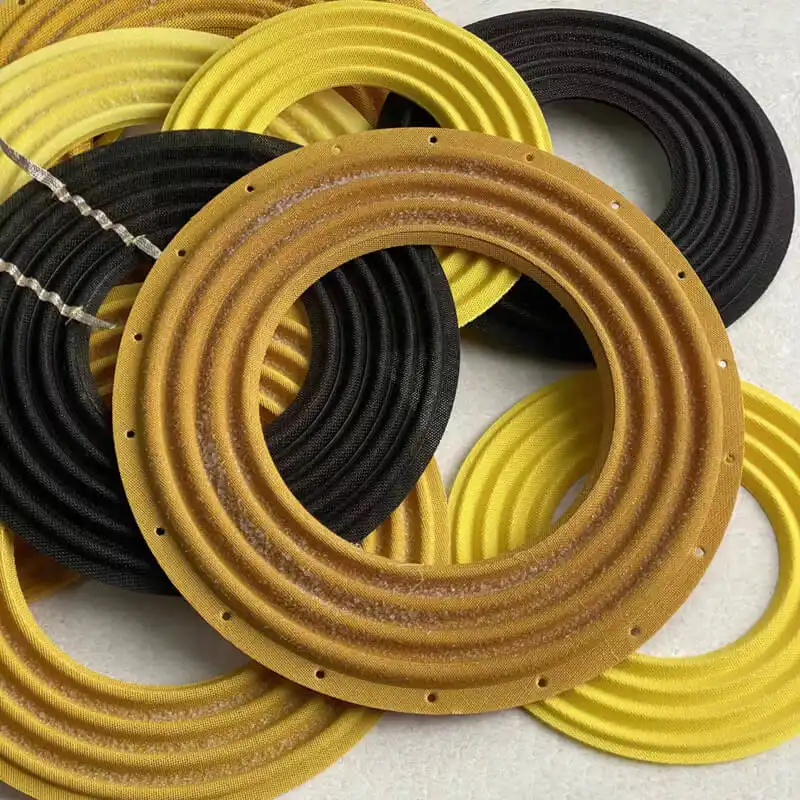
Speaker spider sample matching is one of the most practical ways to keep a loudspeaker repair, recone program, or OEM production project close to the intended mechanical behavior of the original driver. A spider is not just a fabric ring with corrugations. It controls centering, restoring force, suspension travel, and voice-coil alignment, so a poor match can change the sound, reduce power handling, or create rubbing after assembly.
For buyers, the challenge is that used spiders rarely look or measure exactly like new parts. Heat, fatigue, resin aging, adhesive residue, and cone movement can all change the spider’s height, stiffness, and visible shape. A good sample-matching process separates what can be copied directly from what must be confirmed through drawings, measurements, voice-coil data, and application requirements.
Qiao Tai, a speaker spider and damper factory in Guangzhou Panyu founded in 2006, typically treats sample matching as a technical confirmation process: receive the original part, identify key dimensions, review material and corrugation, confirm fit with the voice-coil group, prepare a sample, then move to batch production only after approval. The same logic is useful for speaker OEM teams, woofer and subwoofer builders, component sourcing buyers, and repair channels preparing an RFQ.
Why Speaker Spider Sample Matching Matters
A speaker spider, also called a damper or centering spider, sits inside the loudspeaker suspension system and helps keep the voice coil centered in the magnetic gap. It works with the surround, cone, voice coil, adhesive joints, and frame geometry. When a replacement spider is too stiff, too soft, too high, too low, or incorrectly centered, the driver may no longer behave like the original.
Common reasons buyers request sample matching include:
- Replacing a damaged or aged spider in a repair or recone job
- Rebuilding a woofer or subwoofer where the original specification is unavailable
- Developing a custom speaker damper for a new driver platform
- Matching a legacy OEM part for repeat production
- Comparing supplier samples before batch procurement
- Converting a physical sample into a controlled production specification
The important change in the market is that many repair and sourcing projects no longer start with a complete engineering drawing. Buyers often have an original part, a used driver, or a partial specification. Sample matching helps bridge that gap, but it must be done carefully. A spider taken out of an old loudspeaker is evidence, not a perfect master drawing.
For OEM production, the matching process should lead to stable production data: OD, ID, SOD, FH, EH, material code, color, corrugation profile, stiffness expectation, glue area, voice-coil matching, packing requirement, and inspection criteria. For repair channels, the goal is usually practical compatibility: correct fit, centering, travel, and performance close enough for the intended repair standard.
Step 1: Send the Right Sample and Application Information
A factory can match a speaker spider more accurately when the sample is complete, clean enough to inspect, and supported by application details. Sending only a torn section or a heavily glued spider may still help, but it increases uncertainty.
What to Send
When possible, prepare the following:
- One unused original spider if available
- One used spider removed from the driver, with adhesive residue noted
- Photos of the driver assembly before removal
- Voice coil dimensions or a voice-coil sample
- Frame, cone, and top-plate fit information if relevant
- Any existing drawing, part code, or old purchase specification
- Target use: repair replacement, recone kit, woofer production, subwoofer production, or OEM batch production
A new original sample is best because it has not been flattened, stretched, heat-aged, or contaminated by glue. A used sample is still valuable, especially for repair and legacy driver projects, but the buyer should treat its measured height and stiffness with caution.
Describe the Expected Application
The same size spider can behave differently depending on the driver. A spider for a high-excursion subwoofer is not selected in the same way as a spider for a midrange, PA woofer, or general repair unit. The application helps the factory interpret stiffness, corrugation depth, cloth treatment, and glue area.
Useful application notes include:
- Driver type: woofer, subwoofer, midwoofer, compression-related assembly, or repair kit
- Nominal driver size and power class if known
- Voice-coil diameter and former material if known
- Expected excursion or mechanical travel requirement
- Whether the goal is OEM-like performance or practical repair compatibility
- Whether the spider will be used alone or in a dual-spider system
This information does not replace measurement, but it prevents a purely dimensional match from becoming a functional mismatch.
Step 2: Measure the Core Dimensions Correctly
Speaker spider sample matching should begin with a clear measurement table. Even when the factory will re-measure the sample, buyers save time by documenting the visible dimensions before sending the RFQ.
OD, ID, and SOD
Three diameter measurements are especially important:
- OD: Outside diameter of the spider, used to confirm frame or landing fit
- ID: Inside diameter, used to confirm clearance and bonding around the voice-coil area
- SOD: Shoulder outside diameter or step-related outside diameter, when the spider has a defined mounting shoulder or special formed section
The exact meaning of SOD should be clarified with a sketch or marked photo because different teams may use the term differently. If the spider has a flat outer glue ring, stepped inner area, or molded profile, mark the measurement points directly on a photo.
A common mistake is measuring the outer edge after removal from the frame while glue is still attached. Adhesive residue can make OD look larger than the real fabric edge. Remove loose debris carefully, but do not trim or reshape the spider before documenting it.
FH and EH
Height measurements affect centering and coil position. Two practical checkpoints are:
- FH: Free height or formed height, depending on the buyer’s drawing convention
- EH: Effective height or working height, depending on the assembly reference
Because FH and EH can be interpreted differently, always define the measurement method. State whether height is measured from the bottom plane to the top corrugation, from the glue surface to the inner landing, or from another assembly reference. A simple side-view sketch can prevent production mistakes.
Used spiders often relax, sag, or deform after long operation. If a used sample is the only reference, it is better to provide driver assembly information so the factory can judge whether the target height should follow the old part exactly or be adjusted toward the intended working position.
Voice-Coil Group Matching
The spider must match the voice-coil group mechanically. For a replacement or custom speaker damper sample, provide:
- Voice-coil outside diameter
- Former diameter and material if known
- Winding height if relevant to travel
- Collar or neck joint design
- Inner glue width required
- Clearance requirement around the coil and cone neck
The ID of the spider is not only a hole size. It influences how the inner glue joint forms, how the coil remains centered, and whether the cone-neck area has enough bonding surface. For OEM teams, confirming the voice-coil group early reduces the risk of sample approval delays.
Step 3: Document Material, Color, Corrugation, and Stiffness
A spider that matches OD and ID can still fail if the material and forming are wrong. Material selection, resin treatment, corrugation geometry, and cloth behavior all influence compliance and centering.
Material and Color
Speaker spiders are commonly specified by material type, treatment, and color. Color can be a visible clue, but it should not be treated as the full specification. Brown, black, yellow, or other colors may reflect material, resin, coating, or customer preference. Two parts with similar color may have different stiffness or durability.
For sample matching, document:
- Material appearance and texture
- Color on both sides if different
- Resin or coating appearance
- Fabric thickness if measurable
- Any printed or stamped material code
- Heat marks, aging, or discoloration on used samples
If an existing material code is available, include it in the RFQ. If not, the factory can use the sample, application, and stiffness expectation to recommend a close material option.
Corrugation Profile
Corrugation is central to spider performance. Count the waves, note the shape, and describe whether the corrugations are shallow, deep, narrow, wide, symmetrical, or progressive.
Key corrugation checkpoints include:
- Number of corrugation waves
- Corrugation depth and pitch
- Flat inner and outer glue areas
- Whether the profile is raised, depressed, or mixed
- Whether the spider is flat, cupped, or shaped for a specific frame height
- Any special forming around the inner or outer diameter
Photos should be taken from the top, bottom, and side. A side photo with a ruler next to the spider is especially useful because it shows corrugation height and formed profile more clearly than a top view.
Compliance and Stiffness
Compliance is one of the hardest details to copy from a used speaker repair spider. A spider becomes softer or mechanically changed through use, and heat can change the resin behavior. If the original speaker is old, matching the used stiffness exactly may not restore the original driver behavior.
Buyers should state the target clearly:
- Match the used sample as closely as practical for repair compatibility
- Match the expected original behavior for OEM-like performance
- Adjust stiffness for a modified woofer or subwoofer build
- Prepare several sample options for comparison
For OEM production, stiffness should ideally be verified through agreed inspection methods rather than hand feel alone. For repair channels, hand comparison and fit testing may be part of the process, but they should be supported by dimensional checks and listening or mechanical tests when possible.
Step 4: Check Glue Areas, Centering, and Assembly Fit
A spider works only after it is bonded into the loudspeaker assembly. Glue area and centering accuracy are therefore as important as the free part itself.
Inner and Outer Glue Areas
Measure and photograph both bonding zones:
- Outer glue ring width and surface condition
- Inner glue ring width around the voice coil or cone neck
- Any step, notch, or relief area for assembly clearance
- Whether adhesive must sit on a flat area or part of a corrugation
- Whether the spider needs pre-formed height to align with the frame landing
If the replacement spider has less glue width than the original, bonding strength and centering may suffer. If it has too much glue width, it may interfere with movement or assembly clearance.
Centering and Mechanical Travel
The spider must help the voice coil move vertically without rubbing. During sample review and trial assembly, buyers should check:
- Coil centering in the magnetic gap
- Symmetry of upward and downward movement
- Whether the spider pulls the coil off-center after bonding
- Whether the formed height matches the frame and cone position
- Whether corrugations allow the required travel without noise or stress
For a woofer spider replacement, this step can determine whether the repair succeeds. For OEM teams, it protects repeatability before batch production begins.
Step 5: Prepare an RFQ That a Factory Can Act On
A clear RFQ reduces back-and-forth communication and helps the factory decide whether an existing mold, modified mold, or new mold is required. Qiao Tai and similar direct manufacturers typically need enough information to confirm feasibility, sample cost, mold support, production process, and delivery planning.
A practical RFQ for speaker spider sample matching should include:
- Product name: speaker spider, damper, centering spider, or related suspension component
- Target application: speaker repair, recone parts, woofer, subwoofer, OEM production, or custom project
- Quantity for sampling and estimated batch quantity
- OD, ID, SOD, FH, EH, and any marked measurement definitions
- Voice-coil group information
- Material code or material preference if known
- Color requirement
- Corrugation count and profile photos
- Glue area width and bonding notes
- Stiffness or compliance expectation
- Required tolerances if already defined
- Packaging, labeling, and delivery requirements
- Whether the buyer can send a physical sample
For sample matching projects, physical samples and marked drawings are often more reliable than text descriptions alone. A factory can then compare the sample against available tooling, confirm whether a mold is suitable, and prepare a trial part for approval.
Sampling, Inspection, and Batch Production
The normal progression is sample confirmation before batch production. A buyer should inspect the trial spider in three ways:
- Dimensional check: OD, ID, SOD, FH, EH, glue areas, and corrugation profile
- Assembly check: fit with voice coil, cone, frame, and adhesive process
- Functional check: centering, travel, stiffness, noise, and driver behavior
For production orders, ERP process control and inspection records help keep the confirmed specification consistent from order to order. Buyers should keep the approved sample, drawing, and specification sheet linked to the purchase order so later batches can be checked against the same standard.
Practical Takeaways for Buyers
Speaker spider sample matching works best when the buyer treats the part as both a dimensioned component and a functional suspension element. OD, ID, SOD, FH, and EH define fit, but material, corrugation, compliance, glue area, and voice-coil matching define performance.
For repair and recone channels, the priority is usually a replacement spider that fits the driver and restores stable movement without rubbing. For woofer and subwoofer builders, stiffness and travel become more critical. For OEM teams, the goal is a repeatable specification that can move from sample approval to batch production with controlled inspection.
The strongest RFQ combines a physical sample, marked photos, a measurement table, application notes, and voice-coil information. That gives the factory enough context to recommend material, confirm tooling, prepare samples, and support reliable production without relying on guesswork.
FAQ
What is speaker spider sample matching?
Speaker spider sample matching is the process of using an original spider, damper, or centering spider as a reference to create a replacement or production part. The factory checks dimensions, material, corrugation, stiffness, glue areas, and voice-coil fit before preparing a sample for approval.
Which dimensions are most important when matching a speaker spider?
The key dimensions are OD, ID, SOD, FH, and EH. Buyers should also document inner and outer glue areas, corrugation count, corrugation height, and the measurement method used for each value, especially when the sample is used or deformed.
Can a used spider be matched accurately for speaker repair?
A used spider can be matched, but it should be treated carefully because heat, fatigue, glue residue, and long-term movement may change its height and stiffness. Providing photos, driver application details, and voice-coil information helps the factory judge whether to copy the used part directly or adjust the sample toward the intended working condition.
What should be included in an RFQ for a custom speaker damper sample?
An RFQ should include the target application, sample and batch quantity, OD, ID, SOD, FH, EH, voice-coil group details, material or color requirement, corrugation photos, glue area measurements, stiffness expectation, tolerance requirements, and whether a physical sample can be sent.
Why does voice-coil matching matter for a replacement spider?
The spider must keep the voice coil centered in the magnetic gap while allowing controlled movement. If the ID, inner glue area, formed height, or stiffness does not match the voice-coil group and assembly geometry, the driver may rub, lose travel, or perform differently from the original design.
Factory RFQ Next Step
Move from research to a specification shortlist with product examples that can be sent for factory quotation.