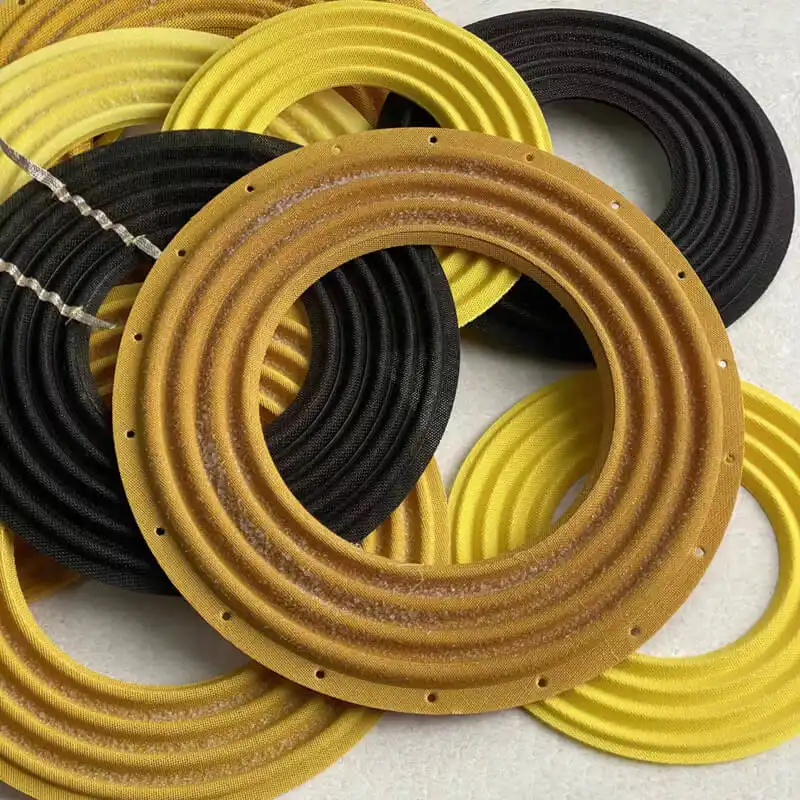
How to Specify a Custom Speaker Spider for OEM Loudspeaker Production
A practical RFQ guide for specifying custom speaker spiders, including material, compliance, corrugation, dimensions, sample matching, and tolerances.
A custom speaker spider is a small component with a large influence on loudspeaker performance. It helps center the voice coil, supports controlled axial movement, and works with the surround and motor structure to define suspension behavior. For OEM loudspeaker production, an unclear spider specification can cause sample delays, mismatched compliance, assembly interference, inconsistent centering, or avoidable changes after tooling has already started.
For buyers working with a custom speaker spider manufacturer, the goal is not only to ask for a price. The goal is to give the factory enough information to confirm whether the spider can be matched, tooled, sampled, inspected, and produced consistently. A complete RFQ should connect the speaker application, target mechanical behavior, voice-coil group, material, corrugation profile, and key dimensions such as OD, ID, SOD, FH, and EH.
Qiao Tai, a Guangzhou Panyu factory founded in 2006, manufactures speaker spiders, dampers, centering spiders, and related loudspeaker suspension components. From a buyer's perspective, the most efficient projects usually start with a clear specification sheet, reference samples where available, and realistic tolerance discussions before batch production.
Start With the Loudspeaker Application and Performance Target
A custom loudspeaker spider should be specified around the application it needs to support. A spider for a small full-range driver, a midbass unit, a woofer, a high-excursion subwoofer, or a replacement repair part may require different stiffness, free height, corrugation shape, and material treatment.
Before choosing dimensions, confirm the basic use case:
- Driver type: woofer, subwoofer, midrange, full-range, compression-related assembly, or repair replacement
- Nominal speaker size and basket structure
- Voice-coil diameter and winding height
- Expected excursion range
- Target compliance or stiffness direction
- Assembly method and glue contact areas
- Operating environment, where humidity, heat, and long-term fatigue may matter
- Whether the spider must match an existing sample or support a new OEM design
The spider does not work alone. It must fit the cone, voice-coil former, frame, surround, dust cap, and magnetic gap. A spider that looks correct on a drawing can still fail in assembly if the free height, roll shape, or inner landing area does not match the voice-coil group.
Define the Compliance Requirement Clearly
Compliance is one of the most important functional requirements for a speaker spider. Buyers often describe it as soft, medium, hard, high compliance, or low compliance, but those terms can mean different things across factories and engineering teams. When possible, provide target test data, approved sample behavior, or a physical reference sample.
For OEM speaker spider projects, compliance selection affects:
- Voice-coil centering and restoring force
- Low-frequency behavior and suspension control
- Excursion symmetry
- Resistance to rocking or tilting
- Long-term stability after repeated movement
- Matching between production batches
If the design is new and there is no approved sample, the RFQ should explain the target application and expected suspension behavior. A speaker damper manufacturer can then recommend material, corrugation, and structure options for sampling, but final approval should still come from testing in the complete driver assembly.
Specify Material, Treatment, and Corrugation Profile
Material selection is a major part of custom speaker spider manufacturing. The material affects stiffness, durability, forming stability, glue compatibility, and production repeatability. Many spiders use woven fabric materials with resin treatment, but the correct selection depends on the application and the target mechanical behavior.
A strong RFQ should include the material code if known. If the exact code is unknown, provide a sample, describe the application, and state whether the requirement is to match an existing part or develop a new part. Sample matching is often the most practical route for repair channels and replacement projects, while OEM programs may combine sample review with drawing confirmation.
Material Checkpoints for Buyers
When discussing material with a custom speaker spider manufacturer, confirm the following:
- Material code or reference sample
- Fabric type and surface condition, if known
- Resin or impregnation requirement, if specified by the design
- Color requirement, when visually important for assembly or replacement channels
- Target stiffness or compliance range
- Heat, humidity, or fatigue expectations, if relevant to the product category
- Glue compatibility with the buyer's assembly process
Material should be reviewed together with corrugation and dimensions. Changing only the material can change compliance. Changing only the corrugation profile can also change compliance, centering behavior, and available travel. A controlled OEM project should avoid changing several variables at once unless the goal is an exploratory sample round.
Corrugation Profile and Centering Behavior
The corrugation profile is not just a visual feature. Corrugation depth, pitch, number of waves, roll shape, and usable movement range influence spider behavior. A spider with a larger diameter and different corrugation pattern may not behave like a smaller spider even if the material is similar.
For custom loudspeaker spider specifications, include:
- Number of corrugations or wave count
- Corrugation shape, depth, and spacing if available
- Flat areas for bonding to the frame and voice-coil former
- Required inner and outer landing widths
- Whether the spider must resist rocking under high excursion
- Whether the design is single spider, dual spider, or part of a stacked suspension layout
For woofer and subwoofer builders, corrugation stability becomes especially important because the spider must maintain centering over larger movement. For smaller drivers, space limitations and assembly height may be the main constraints. In both cases, corrugation should be discussed as a functional design element, not only as a tooling detail.
Confirm Critical Speaker Spider Dimensions Before RFQ
Dimensional clarity is the fastest way to reduce back-and-forth during RFQ preparation. A factory cannot reliably quote, sample, or inspect a spider if the dimensions are incomplete or use unclear naming. Buyers should define OD, ID, SOD, FH, and EH with the same measurement convention used by their engineering and assembly teams.
OD, ID, and SOD
OD, or outside diameter, is the full outer diameter of the spider. It must match the basket or frame landing area and leave enough bonding surface for reliable assembly.
ID, or inside diameter, is the center opening that fits around the voice-coil former or related assembly. This dimension must be matched carefully to the voice-coil group. If the ID is too tight, assembly becomes difficult or may distort the spider. If it is too loose, centering and bonding reliability may suffer.
SOD, or spider outside diameter for the effective corrugation or specified outer working area, should be clearly defined on the drawing because naming conventions vary. Some teams use SOD to describe a functional diameter related to the corrugated working area, while others use it differently in internal drawings. The safest approach is to label the measurement points directly on the drawing or sample evaluation sheet.
For RFQ preparation, include:
- OD with tolerance
- ID with tolerance
- SOD definition and tolerance
- Inner bonding width
- Outer bonding width
- Hole position or special cutouts, if any
- Drawing revision or sample reference number
FH and EH
FH, or free height, describes the height of the spider in its unassembled condition. EH, or effective height, is the working height relevant to the assembled speaker structure. Both dimensions can affect voice-coil alignment, cone position, and available excursion.
Free height is especially important when the spider must match an existing design. A small change in FH can shift the voice-coil resting position or affect assembly stress. Effective height matters because the spider must work correctly inside the finished driver, not only sit correctly on a measurement table.
Buyers should confirm how FH and EH are measured, including the reference surface, load condition, and whether the part is measured before or after any forming or treatment process. This is important for consistent inspection between sample approval and batch production.
Voice-Coil Group Matching
The spider ID and inner bonding area must match the voice-coil group. This includes the former diameter, former material, winding height, collar height, adhesive area, and the target resting position in the magnetic gap. If the spider is being developed without full voice-coil information, sampling may require multiple revisions.
Useful RFQ information includes:
- Voice-coil outer diameter
- Former diameter and material, if relevant
- Assembly height relationship between coil, cone, and spider
- Required bond area at the inner diameter
- Whether the spider must match an existing coil assembly
- Any known interference risks with lead wires, cone neck, or frame geometry
A speaker spider is a centering component. If the voice-coil group is not defined, the centering function cannot be fully confirmed.
Use Sample Matching and Tolerance Control to Reduce Production Risk
Sample matching is often the most practical path when buyers need a replacement spider, a repair-channel component, or a custom part that must match an existing loudspeaker design. A physical sample gives the manufacturer direct information about material feel, corrugation shape, height, forming style, and bonding areas that may not be obvious from photos.
A good sample matching process should still end with confirmed specifications. The sample helps the factory evaluate the part, but production needs measurable checkpoints. For OEM production, a drawing or inspection sheet should define the approved dimensions and tolerances after the sample is accepted.
What to Send for Sample Matching
For a custom speaker spider manufacturer to evaluate a sample efficiently, buyers should prepare:
- Clean physical samples, ideally more than one piece
- Photos showing the spider in the driver assembly, if available
- OD, ID, SOD, FH, and EH measurements
- Voice-coil group information
- Material code or known material requirement
- Target application and speaker size
- Required quantity range for sampling and batch production
- Any known failure issue the new spider must solve
If the sample is old, damaged, or removed from a used speaker, note that it may no longer represent the original free height or compliance. In that case, the sample is still useful, but final approval should rely on tested prototypes in the actual speaker assembly.
Production Tolerances and Inspection Points
Tolerances should be realistic and connected to function. Very tight tolerances may increase production difficulty, while loose tolerances may create assembly variation. Buyers should identify which dimensions are critical to performance and which are mainly for assembly fit.
Common inspection points include:
- OD and ID
- SOD or defined working diameter
- Free height and effective height
- Corrugation shape and consistency
- Material appearance and treatment consistency
- Flatness of bonding areas
- Centering behavior during assembly checks
- Batch consistency against the approved sample
For batch production, process control matters as much as the first sample. ERP process control, incoming material checks, in-process inspection, and final quality inspection help keep approved specifications stable from order to order. Buyers should ask how the factory records specifications, tracks production requirements, and separates different material codes or drawing revisions.
Build a Complete Speaker Spider RFQ Checklist
A clear RFQ helps the factory quote accurately, prepare tooling or mold support, confirm sampling, and plan delivery. It also helps the buyer compare suppliers on capability rather than only unit price. For custom loudspeaker suspension components, missing details often lead to assumptions. Assumptions are risky when the spider must center a voice coil inside a narrow magnetic gap.
RFQ Information to Prepare
Before sending a speaker spider RFQ, prepare the following checklist:
- Application: speaker type, size, and intended market use
- Function: target compliance, stiffness direction, excursion expectation, and centering requirement
- Dimensions: OD, ID, SOD, FH, EH, bonding widths, and tolerances
- Voice-coil group: former diameter, coil position, bonding area, and related assembly height
- Material: material code, treatment requirement, color, and reference sample if available
- Corrugation: wave count, profile, depth, pitch, and special forming requirements
- Tooling: existing mold availability, need for mold support, or sample-based development
- Sampling: required sample quantity, test plan, approval criteria, and revision process
- Production: forecast quantity, batch quantity, packaging requirement, and delivery expectation
- Quality: inspection points, approved sample control, drawing revision, and documentation needs
Questions to Resolve Before Tooling or Batch Production
Buyers should clarify several points before moving from sample to production:
- Does the approved sample match both mechanical behavior and assembly fit?
- Are OD, ID, SOD, FH, and EH measured using the same method by buyer and manufacturer?
- Is the material code confirmed and controlled for future batches?
- Are tolerances practical for the selected material and corrugation profile?
- Does the spider keep the voice coil centered through the intended movement range?
- Is the drawing revision or sample reference locked before mass production?
These questions are especially important for OEM speaker spider projects where one part may support a long production run. They also matter for repair replacement channels, where the part must fit existing speakers with minimal modification.
Practical Takeaways for OEM Buyers
Specifying a custom speaker spider is a combined engineering and sourcing task. The buyer needs to define what the spider must do, not only what it looks like. A complete RFQ should connect application, compliance, material, corrugation, dimensions, voice-coil matching, and tolerance expectations.
The most useful preparation includes a drawing with OD, ID, SOD, FH, and EH; a reference sample when matching is required; a clear material or compliance target; and a realistic sample approval process. A manufacturer can support mold confirmation, sample development, specification checking, ERP-controlled production, and quality inspection more effectively when these inputs are available at the beginning of the project.
For OEM loudspeaker teams, sourcing buyers, woofer and subwoofer builders, and repair channels, the right speaker spider specification reduces avoidable revisions and improves batch consistency. It also gives both buyer and manufacturer a shared technical language before quotation, sampling, and production delivery begin.
FAQ
What information should buyers send to a custom speaker spider manufacturer?
Buyers should send the application, speaker size, target compliance, material code or reference sample, corrugation details, OD, ID, SOD, FH, EH, voice-coil group information, required tolerances, sample quantity, and expected batch quantity. A drawing and physical sample are especially useful when the spider must match an existing design.
Why are OD, ID, SOD, FH, and EH important for speaker spider RFQs?
These dimensions affect assembly fit, voice-coil centering, suspension height, bonding area, and usable movement. OD relates to the outer frame landing area, ID fits the voice-coil former, SOD should define the specified working diameter, FH is the unassembled free height, and EH relates to the effective working height in the speaker assembly.
How does corrugation affect a custom loudspeaker spider?
Corrugation shape, depth, pitch, and wave count influence compliance, restoring force, travel, and resistance to rocking. The corrugation profile should be selected together with material and dimensions because changing one factor can change the spider's mechanical behavior.
When is sample matching useful for speaker spiders?
Sample matching is useful when replacing an existing spider, supporting repair channels, or developing an OEM part from a proven design. A physical sample helps the manufacturer review material, profile, height, and bonding areas, but the approved production part should still be controlled with measurable dimensions and tolerances.
What should be confirmed before batch production of OEM speaker spiders?
Before batch production, confirm the approved sample, material code, drawing revision, OD, ID, SOD, FH, EH tolerances, corrugation profile, voice-coil matching, inspection checkpoints, packaging needs, and delivery requirements. This reduces the risk of variation between sampling and production.
Factory RFQ Next Step
Move from research to a specification shortlist with product examples that can be sent for factory quotation.