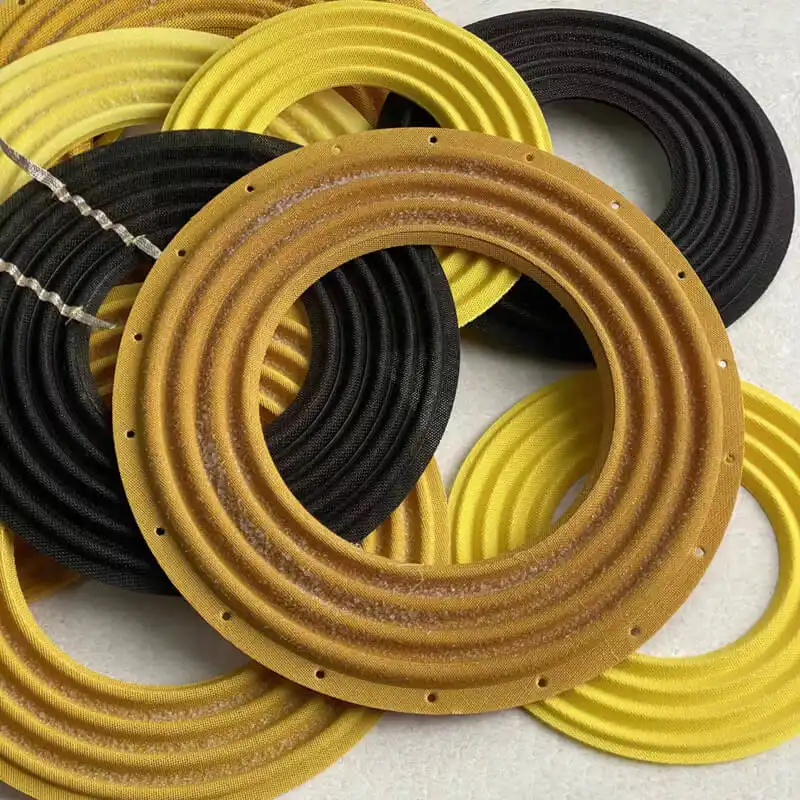
Speaker Spider RFQ Checklist: What to Prepare Before Requesting a Factory Quote
A practical RFQ checklist for speaker spiders, covering dimensions, material, compliance, samples, tolerances, testing, packaging, and quote data.
Speaker Spider RFQ Checklist: What to Prepare Before Requesting a Factory Quote
A speaker spider RFQ is only as useful as the information behind it. When OD, ID, SOD, FH, EH, material, compliance, and voice-coil matching details are unclear, the factory has to quote with assumptions. That slows the quotation, increases sample revisions, and can lead to a spider that fits the drawing but fails in centering, excursion, durability, or assembly.
For speaker OEM teams, woofer and subwoofer builders, component sourcing buyers, and repair replacement channels, the goal is simple: send enough technical and commercial information for the factory to confirm manufacturability, match the required suspension behavior, and quote production with fewer open questions.
Qiao Tai, a Guangzhou Panyu speaker spider and damper factory founded in 2006, commonly supports projects through sample matching, mold confirmation, specification review, and batch production. From a buyer's perspective, the same principle applies to any serious supplier conversation: the RFQ should describe not only the part shape, but also how the spider must perform inside the loudspeaker.
Why a Complete Speaker Spider RFQ Matters
A speaker spider, also called a damper or centering spider, controls voice-coil centering and contributes to suspension compliance. It must align with the voice-coil group, frame, cone, surround, magnet gap, adhesive process, and target acoustic behavior. A small dimensional or material mismatch can affect rubbing risk, excursion control, Fs consistency, power handling, and long-term stability.
Incomplete RFQs usually create three problems.
- Slow quotation: the supplier has to ask for missing drawings, dimensions, material choices, or sample requirements.
- Wrong sampling direction: the first sample may have the right diameter but the wrong compliance, height, corrugation, or centering behavior.
- Unclear batch control: without tolerances, inspection points, and packaging needs, production quality expectations are difficult to lock before mass order.
A complete speaker spider RFQ checklist gives the factory enough information to answer four questions:
- Can the part be made with an existing mold, or is a new mold needed?
- Which material, impregnation, layer count, and corrugation structure are suitable?
- What dimensions and tolerances must be controlled during inspection?
- What sample, test, packaging, and delivery conditions should be included in the quote?
Core Drawing and Dimension Checklist
The drawing is the most important RFQ document. A photo or sample can help, but a clear drawing reduces uncertainty and gives both buyer and factory a shared reference for quotation, sampling, and inspection.
1. OD, ID, and SOD
The RFQ should clearly list the main diameters:
- OD: outside diameter of the spider.
- ID: inner diameter, normally related to the voice-coil former or neck area.
- SOD: surround outer diameter or secondary outer diameter when the design uses a specific landing, shoulder, or outer bonding reference.
These dimensions affect whether the spider fits the basket and cone assembly. They also influence available corrugation space. If the corrugation zone is too narrow for the required compliance or excursion, the factory may need to suggest a different profile, layer structure, or material.
When preparing the RFQ, specify whether the dimensions are measured before forming, after forming, or after any treatment process if that distinction matters for your inspection method.
2. FH and EH
Flat height and effective height are often overlooked in early sourcing discussions. They should be defined clearly because spider height affects assembly alignment and resting position.
- FH: flat height or formed height reference used by the buyer's drawing or factory inspection method.
- EH: effective height related to the functional working position of the spider in the loudspeaker assembly.
If your internal drawing uses these terms differently, define them on the drawing. Do not assume every supplier reads FH and EH in exactly the same way. A simple section view, height reference line, or sample note can prevent a mismatch.
3. Voice-Coil Group Matching
The speaker spider is not an isolated textile component. It must match the voice-coil group and magnetic gap. The RFQ should include:
- Voice-coil former outside diameter.
- Former material if relevant to bonding or heat requirements.
- Coil height and winding position if the spider's working height is tied to excursion.
- Neck joint or collar details where the spider bonds near the voice coil.
- Required centering accuracy or known rubbing sensitivity.
For replacement or repair channels, a physical sample can be especially useful when original drawings are unavailable. In that case, note whether the factory should match the sample's dimensions only or also attempt to match stiffness, corrugation, color, and fabric treatment.
4. Corrugation Profile
Corrugation shape has a direct effect on compliance, restoring force, and movement symmetry. A useful RFQ should state whether the design requires a specific corrugation profile or whether the factory may recommend one.
Relevant corrugation details include:
- Number of waves or corrugations.
- Wave height and pitch if controlled by drawing.
- Inner and outer flat bonding widths.
- Symmetric or asymmetric profile requirements.
- Special forming requirements for high-excursion woofers or subwoofers.
If the spider is for a woofer, subwoofer, compression driver, midrange, or replacement unit, include that application context. The factory should not have to infer the operating demand from diameter alone.
Material, Compliance, and Construction Details
Many RFQs focus on diameter and quantity but leave material and mechanical behavior vague. For speaker spider quotations, material selection and compliance targets are central to the part's function.
1. Material Code and Fabric Type
If your company already has a material code, include it. If not, provide a known reference sample or describe the required material family. Speaker spiders may use different fabric structures and treatments depending on stiffness, heat resistance, damping behavior, thickness, and forming stability.
Useful RFQ details include:
- Material code or previous supplier reference.
- Fabric type if known.
- Resin or impregnation requirement if specified.
- Thickness target or measured sample thickness.
- Color requirement, such as black, yellow, brown, or custom color.
- Any restrictions related to odor, surface finish, or adhesive compatibility.
Do not treat color as only a visual preference. In some production environments, color may help identify product families, repairs, or customer-specific assemblies. If color must match an existing model, provide a sample or clear tolerance expectation.
2. Hardness or Compliance Target
A spider may be dimensionally correct but mechanically unsuitable. The RFQ should describe the target in terms the buyer can verify.
Depending on your engineering process, this may include:
- Hardness target.
- Compliance target.
- Load-deflection requirement.
- Stiffness comparison against an approved sample.
- Application target, such as woofer, subwoofer, midrange, or repair replacement.
- Required excursion behavior or centering stability.
If the target is based on an approved sample, say so. Sample matching allows the factory to compare feel, corrugation, fabric treatment, layer count, and forming behavior. For more controlled OEM projects, the RFQ should include test method, fixture condition, displacement point, and acceptance range where available.
3. Layer Count and Lamination
Layer count affects stiffness, durability, mass, and forming behavior. A single-layer spider may behave very differently from a multi-layer spider with the same OD and ID.
State the required layer count if it is fixed. If the factory may recommend the construction, provide the performance target and assembly constraints. The RFQ should also note whether the layer structure must match an existing sample or whether an equivalent construction is acceptable.
Important points include:
- Single-layer or multi-layer construction.
- Required total thickness.
- Stiffness or compliance priority.
- Heat, power, or excursion environment.
- Visual match requirement for replacement channels.
4. Bonding Areas and Assembly Fit
The spider's inner and outer bonding areas must suit the cone, voice-coil former, and frame. The RFQ should show the flat bonding widths and any surface requirements.
For production stability, it is useful to include:
- Inner bonding width.
- Outer bonding width.
- Adhesive type or bonding process if fixed.
- Whether the spider is bonded to paper, aluminum, Kapton, glass fiber, or another former material.
- Any assembly clearance limits around the basket or cone neck.
When buyers provide both a drawing and the related assembly context, the factory can check whether the spider dimensions are practical for manufacturing and installation.
Tolerances, Inspection, and Testing Requirements
A quotation should not only price the part. It should also reflect the level of inspection and testing expected before shipment. Clear tolerances help the supplier estimate process control needs and reduce disputes after delivery.
1. Dimensional Tolerances
List tolerances for the dimensions that matter most to assembly and performance. Common checkpoints include:
- OD tolerance.
- ID tolerance.
- SOD tolerance where applicable.
- FH and EH tolerance.
- Thickness tolerance.
- Bonding width tolerance.
- Corrugation height or profile tolerance if controlled.
If you do not have final tolerances, identify critical dimensions and ask the factory to confirm achievable production tolerance. This is especially important when new molds, special materials, or tight voice-coil clearances are involved.
2. Centering and Functional Inspection
Speaker spider quality is closely tied to centering. Poor centering can create voice-coil rub, uneven movement, and assembly scrap. For OEM speaker parts sourcing, the RFQ should state any centering inspection expectation or related assembly risk.
Inspection requests may include:
- Visual inspection for deformation, stains, broken fibers, or surface defects.
- Dimensional inspection report for key sizes.
- Centering or flatness checks.
- Sample comparison against an approved reference.
- Batch traceability or production record expectations.
A factory using structured production control, including ERP-based order and process management, can better connect the approved specification with purchasing, forming, inspection, packing, and delivery records. Buyers should still define which inspection results must be reported with samples or production shipments.
3. Testing Needs for Samples and Batch Orders
Not every project needs the same test package. A repair replacement order may require close sample matching and visual consistency. A new OEM woofer project may require compliance testing, assembly verification, and longer validation before mass production.
Useful RFQ testing details include:
- Required sample quantity for engineering review.
- Whether the sample should match an existing part.
- Load-deflection or compliance test requirement.
- Heat or aging test requirement if relevant.
- Assembly trial requirement before batch approval.
- Production inspection report requirement.
When the testing method is internal to the buyer, include the pass criteria. When it is open, ask the factory what test data can be supplied for the quoted production route.
Commercial and Production Information to Include
A technically complete RFQ still needs enough commercial information for a realistic quotation. The same speaker spider may quote differently depending on sample work, mold status, quantity, packaging, and delivery needs.
1. Quantity and Order Pattern
Factories need expected quantities to calculate production planning and pricing. Include both sample and mass production assumptions.
Your RFQ should state:
- Prototype or sample quantity.
- First batch quantity.
- Forecast quantity if available.
- Whether releases are one-time, monthly, quarterly, or project-based.
- Expected approval timeline after sample receipt.
Avoid requesting only a very large annual quantity if the immediate order is small. A practical RFQ gives the factory enough context to quote the first batch and understand future potential without distorting the production plan.
2. Mold Status and Tooling Support
Speaker spider designs often depend on forming molds. If you have an existing drawing that matches a common size, the factory may be able to use an available mold. If the corrugation profile, height, or diameter is unique, new mold support may be required.
Include these points in the RFQ:
- Whether the design is new or a replacement for an existing part.
- Whether an approved sample is available.
- Whether the corrugation profile must be exact.
- Whether equivalent tooling is acceptable.
- Whether mold cost, lead time, and ownership need to be quoted separately.
Mold confirmation should happen before sample approval. Otherwise, the buyer may approve a sample that is not aligned with the intended batch production method.
3. Packaging and Labeling
Packaging affects part condition when spiders arrive at the assembly line. Deformation, moisture exposure, mixed items, and unclear labels can create production delays even when the parts themselves are correct.
A useful packaging request may include:
- Pieces per bag or carton.
- Layer separation or anti-deformation packing.
- Moisture protection if needed.
- Item label, part number, batch number, and quantity per carton.
- Export carton requirements for international shipments.
For repair channels, model labeling and small-batch separation may be more important. For OEM assembly plants, line-side identification and consistent carton quantity may matter more.
4. Delivery and Documentation
Production delivery depends on confirmed specifications, approved samples, material availability, mold readiness, and batch quantity. The RFQ should ask for estimated lead time for sampling and mass production after approval.
Common documentation requests include:
- Formal quotation with unit price, tooling cost if any, and validity period.
- Drawing confirmation or specification sheet.
- Sample report or inspection data if required.
- Packing details.
- Production lead time after deposit or purchase order.
- Shipping terms and destination information.
Clear documentation helps sourcing, engineering, and quality teams work from the same approved version.
Practical Speaker Spider RFQ Template
The most efficient RFQ is concise but complete. Buyers can adapt the following structure for a speaker spider quotation, speaker damper RFQ, or broader loudspeaker component sourcing request.
Project Information
- Product application: woofer, subwoofer, midrange, repair replacement, or other speaker type.
- New design or replacement part: state whether the part must match an existing sample.
- Target market or assembly requirement if it affects quality or packaging.
Drawing and Dimensions
- Drawing file with revision number.
- OD, ID, SOD.
- FH and EH with definition if needed.
- Thickness and bonding widths.
- Corrugation count, height, pitch, and profile requirement.
- Critical tolerances.
Voice-Coil and Assembly Matching
- Voice-coil former outside diameter.
- Former material and bonding surface.
- Coil height or working position if relevant.
- Cone neck, basket landing, and clearance notes.
- Centering requirement or known assembly risk.
Material and Performance
- Material code or reference sample.
- Fabric type or treatment if known.
- Color requirement.
- Layer count.
- Hardness, compliance, or load-deflection target.
- Heat, excursion, or durability requirement if relevant.
Samples, Testing, and Quality
- Sample quantity.
- Sample matching requirement.
- Test method and acceptance criteria.
- Dimensional inspection requirements.
- Visual, centering, and packaging inspection expectations.
- Approval process before mass production.
Commercial Terms
- First order quantity and forecast.
- Required quotation currency and price basis.
- Tooling or mold quotation requirement.
- Packaging and labeling requirements.
- Target delivery schedule.
- Shipping terms and destination.
A strong RFQ does not need to be long, but it must remove avoidable guesswork. The more clearly the buyer defines dimensions, material, compliance, centering, inspection, and production needs, the faster a speaker suspension factory can respond with a useful quotation and a sample plan that fits the project.
FAQ
What information should be included in a speaker spider RFQ?
A complete speaker spider RFQ should include drawings, OD, ID, SOD, FH, EH, corrugation details, voice-coil group information, material code, color, layer count, compliance or hardness target, tolerances, sample quantity, testing needs, packaging, and batch order quantity.
Why are OD, ID, SOD, FH, and EH important for a speaker spider quotation?
These dimensions determine how the spider fits the basket, cone, and voice-coil assembly. They also affect corrugation space, working height, centering, and assembly clearance. Clear definitions help the factory quote the right mold route and reduce sample errors.
Should buyers send a physical sample when requesting a speaker spider quote?
A physical sample is useful when drawings are incomplete, the part is for repair replacement, or the buyer needs to match stiffness, corrugation, color, and forming behavior. For OEM projects, a sample works best when paired with a drawing and measurable acceptance criteria.
How should compliance or hardness be specified in a speaker damper RFQ?
The best method is to provide a target test value, load-deflection requirement, or approved sample for comparison. If the test method is internal, include the fixture condition, displacement point, and acceptance range so the factory understands how the part will be evaluated.
When is a new mold needed for a speaker spider?
A new mold may be needed when the OD, ID, corrugation profile, height, or bonding layout does not match available tooling. Buyers should ask the factory to confirm existing mold availability, tooling cost, sample lead time, and whether the mold route will be used for batch production.
Factory RFQ Next Step
Move from research to a specification shortlist with product examples that can be sent for factory quotation.