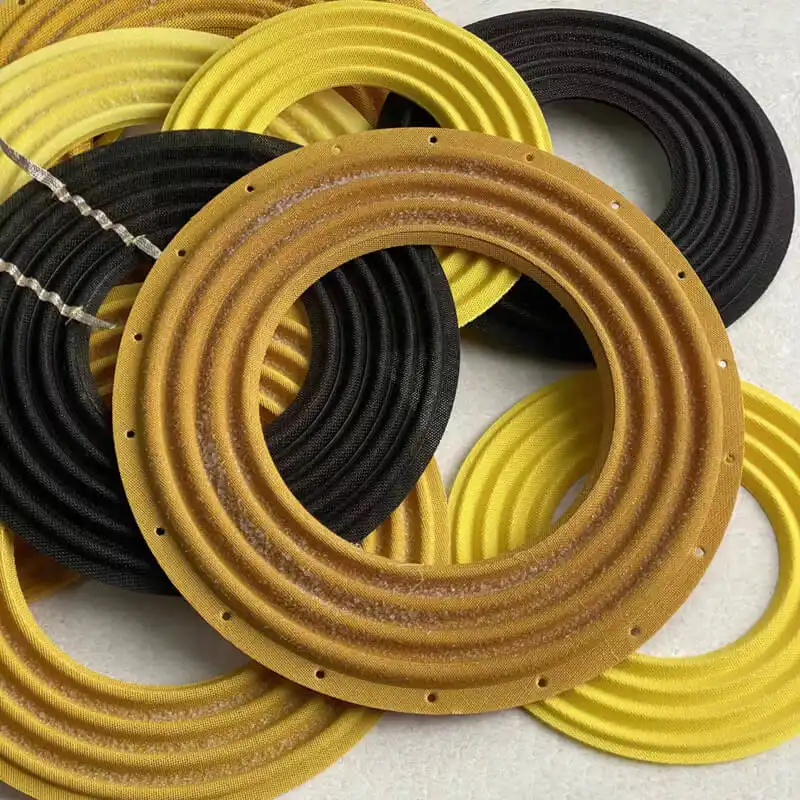
Speaker Spider Materials: Cotton, Conex, Nomex, Blends, and Resin Treatment
A practical buyer's guide to speaker spider material choices, comparing cotton, Conex, Nomex, blends, and resin treatment for heat resistance, stiffness, fatigue life, and cost control.
Speaker Spider Materials: Cotton, Conex, Nomex, Blends, and Resin Treatment
Speaker spider material has a direct impact on how a loudspeaker moves, centers, and survives repeated excursion. For OEM teams, repair buyers, and component sourcing teams, the material choice is not just a catalog decision. It affects thermal behavior, compliance stability, fatigue life, production consistency, and the final cost of the suspension system.
A spider has one job that looks simple on paper: keep the voice coil centered while allowing controlled axial movement. In practice, that means the cloth, fiber structure, weave, and resin treatment all need to work together. A material that feels correct in a sample may behave differently under heat, humidity, or long-cycle loading. That is why spider selection should be treated as a specification process, not a visual match.
What speaker spider material actually controls
The spider is part of the suspension system, but it is also a mechanical tuning element. Its material and treatment influence several properties at once:
- Compliance: how easily the spider flexes under load
- Centering stability: how well the voice coil stays aligned in the magnetic gap
- Heat resistance: how the spider holds shape during higher power use
- Fatigue life: how long the corrugations survive repeated motion
- Damping behavior: how the spider controls motion near resonance
- Production repeatability: how consistently batch units match the approved sample
Buyers often focus on one property, such as stiffness, and discover later that the same change altered sensitivity, distortion behavior, or assembly tolerance. In loudspeaker development, the spider should be specified together with the voice-coil group, cone assembly, surround, and target excursion.
Material choice also affects how easy it is to control key dimensions during sampling and mass production. OD, ID, SOD, FH, and EH need to remain stable enough that the spider sits correctly in the basket and lines up with the coil former. If the material relaxes too much, the assembly can shift. If it is too stiff, the suspension can restrict travel or raise the mechanical resonance.
Cotton, Conex, Nomex, and blended cloths
The common spider cloth families are not interchangeable. Each brings a different balance of cost, processability, and performance.
Cotton speaker spider material
Cotton remains a familiar option in many speaker damper spider constructions because it is workable, available, and often cost-effective. It can be suitable where the target application does not demand the highest thermal margin or the tightest long-term shape retention.
Cotton-based cloths are often chosen when the design needs a more compliant feel or when the build targets price control. The main tradeoff is that cotton generally offers less heat resistance and dimensional stability than aramid-based alternatives. Under harsher operating conditions, compliance drift and fatigue behavior deserve closer attention.
For buyers, cotton makes sense when:
- The speaker is aimed at moderate duty use
- Cost control is a major constraint
- The design has already been validated for the expected power range
- The production process is tuned around this cloth family
Cotton spiders still need careful sample matching. Two pieces that look similar can behave differently after impregnation, curing, and trimming.
Conex speaker spider material
Conex is often discussed in the same conversation as heat-resistant spider cloth because it is used where better thermal tolerance and mechanical stability are needed than basic cotton can provide. In sourcing discussions, Conex damper spider options are usually considered for applications that need stronger shape retention and more reliable behavior under load.
Compared with cotton, Conex can offer a more robust balance between stiffness and endurance. That makes it useful for designs where the spider must hold centering accuracy while handling higher excursion or prolonged use. For buyers, the benefit is not just heat resistance. It is also the ability to keep compliance more consistent over time.
Conex is often evaluated when:
- The speaker runs hotter or at higher duty cycles
- The design needs better long-term centering stability
- The buyer wants a more durable suspension without moving to the highest-cost material tier
- The assembly must pass more demanding repeat-cycle verification
Nomex speaker spider material
Nomex speaker spider material is commonly selected for higher thermal stability and strong fatigue performance. It is a frequent choice for designs where heat, power handling, and sustained shape retention matter more than minimal cost.
Nomex is attractive to design engineers because it helps reduce compliance drift in demanding operating conditions. That matters in subwoofers, professional audio, and other applications where the suspension sees repeated high excursion. A Nomex spider can support better alignment consistency when the voice coil is working hard and the thermal environment is less forgiving.
The tradeoff is cost and, in some builds, stiffness tuning. Nomex may not be the best fit if the design needs a very soft suspension and low restoring force. It is often a better match when the buyer needs a stable mechanical profile that holds up across production lots and field use.
Nomex is often preferred when:
- Heat resistance is a top priority
- Fatigue life is more important than lowest unit cost
- The platform needs more stable compliance over time
- The OEM wants tighter batch-to-batch repeatability
Blended spider cloths
Blended loudspeaker spider cloths are used when the design needs a middle ground. A blend can help balance compliance, stiffness, cost, and durability without committing fully to one material family.
Blends are common in iterative development because they give sourcing teams room to tune the spider toward the target feel. A blended cloth may be appropriate when the initial sample is too stiff, too soft, too expensive, or not durable enough. It can also help close the gap between prototype behavior and production feasibility.
The main risk with blends is assuming that a small change in fiber mix will have a small change in performance. In practice, the effect can be meaningful. The same nominal geometry can behave differently after resin treatment or curing because the cloth structure responds differently under load.
Blended cloths are useful when:
- The project is still balancing cost and performance
- The original material is close, but not quite on target
- The OEM needs a controlled adjustment in compliance or recovery
- Sample matching must preserve familiar assembly behavior while improving one weakness
Resin treatment changes more than surface feel
Material selection does not end with the cloth itself. Resin treatment, sometimes referred to as impregnation, is a major part of how the spider actually performs. A phenolic treated spider or other resin-treated cloth can behave very differently from untreated or lightly treated cloth.
Resin treatment affects:
- Stiffness and restoring force
- Heat resistance and shape retention
- Damping characteristics
- Moisture behavior and dimensional stability
- Surface finish and handling during assembly
A softer base cloth can become much stiffer after impregnation. A stronger cloth can also become brittle if the treatment is too heavy or the cure is not well controlled. That is why buyers should not approve a spider based on raw cloth designation alone.
The resin system must be matched to the intended use. A design meant for long excursion and elevated temperature may need a different treatment level than a replacement part aimed at matching an existing legacy speaker. In repair channels, the challenge is often to reproduce the original feel closely enough that the restored speaker behaves as expected. In OEM production, the challenge is to keep the approved performance steady across batches.
A practical specification review should cover:
- Resin type or treatment code
- Impregnation level and cure condition
- Finished stiffness target
- Whether the spider is intended to be phenolic treated or another treated construction
- Any change in compliance after curing and conditioning
How to choose the right spider for the application
The best speaker spider material depends on the operating environment and the way the rest of the system is built. There is no universal winner.
For cost-sensitive designs
Cotton or a balanced blend may be the right starting point when the speaker is not expected to run at very high thermal load. This keeps the bill of materials under control, but the buyer still needs to verify that the spider holds centering and survives realistic life testing.
For higher power and heat exposure
Conex or Nomex is usually the more defensible choice when the voice coil sees higher thermal load or the platform is expected to maintain performance over a longer service life. These materials are typically chosen when compliance stability and fatigue life are more important than minimizing raw material cost.
For repair and replacement channels
Replacement work often needs a closer match to the original assembly than a pure upgrade. In that case, the best material is the one that reproduces the original compliance, cone motion, and coil centering behavior. A repair buyer should not assume that a newer, stronger cloth will automatically be a better substitute.
For OEM development
In new product development, the spider should be reviewed together with the whole suspension stack. The wrong spider material can force unwanted changes in cone weight, surround geometry, or voice-coil gap tolerance. Material choice should be locked only after sample matching proves the system still meets the target behavior.
What to include in an RFQ or sample approval request
If the spider is being sourced for OEM production, the RFQ should carry enough detail to prevent vague substitutions. A good request makes the material and geometry clear before tooling or batch production begins.
Include these checkpoints:
- Material code or cloth family: cotton, Conex, Nomex, or blend
- Resin treatment requirement: treated or phenolic treated spider, if needed
- OD, ID, SOD, FH, and EH
- Corrugation profile and height
- Voice-coil group and former fit requirement
- Target compliance and centering behavior
- Required sample matching standard
- Inspection points for batch production
- Packaging and delivery requirements
Do not leave the material description at a generic level. "High temperature" or "good elasticity" is not enough for a production quote. The supplier needs a usable specification that ties the cloth family to the finished geometry and performance target.
For buyers comparing options, it helps to request both sample units and process confirmation. That means checking whether the same result can be repeated after curing, trimming, and batch inspection. A spider that matches once but drifts in production can create more cost than a slightly more expensive, stable material.
Quality control matters as much as the cloth choice
Speaker spider material only becomes meaningful when the factory can hold it within spec. Quality issues often appear as inconsistent centering, uneven corrugation, loose tolerances, or compliance variation between batches.
A disciplined manufacturing process should verify:
- Incoming cloth consistency
- Resin application and curing repeatability
- Geometry control after forming and trimming
- Corrugation symmetry
- Finished OD/ID/SOD/FH/EH dimensions
- Fit with the voice-coil group and basket structure
- Batch inspection against the approved sample
This is especially important for buyers who source multiple models or run recurring orders. A stable spider material is only one part of the system. The other part is process control. If the supplier cannot keep the same stiffness and centering behavior across production, the material advantage is lost.
ERP tracking, sample records, and lot traceability are useful here because they help maintain the link between the approved sample and the delivered batch. That matters when a customer later asks why a replacement run feels different from the original approval piece.
Practical buying takeaways
For speaker buyers, the right spider material choice is usually the one that best balances performance and repeatability for the target application.
A simple way to think about it:
- Cotton: cost-friendly and workable, but less robust under heat
- Conex: stronger thermal and mechanical stability for demanding builds
- Nomex: a strong choice for heat resistance and long-term compliance stability
- Blends: useful for tuning cost and performance between material families
- Resin treatment: critical for final stiffness, damping, and dimensional stability
The most reliable sourcing decisions come from sample matching and clear specification control. Material name alone is not enough. The buyer should confirm geometry, treatment, corrugation, and the way the spider behaves with the intended voice-coil group.
A well-chosen spider can improve centering, reduce field failures, and keep production more predictable. A weak choice can quietly raise returns, assembly variation, and tuning trouble. That is why spider material selection should be treated as an engineering decision with purchasing consequences, not just a line item in the BOM.
FAQ
What is the best speaker spider material for high power use?
Nomex and Conex are often considered for higher power or hotter operating conditions because they offer better heat resistance and more stable mechanical behavior than basic cotton cloth.
Does resin treatment change spider performance?
Yes. Resin treatment can increase stiffness, improve shape retention, and change damping behavior. A treated spider may behave very differently from the base cloth, so the finished sample must be evaluated, not just the raw material.
How should I specify a spider in an RFQ?
Include the cloth family, treatment requirement, OD, ID, SOD, FH, EH, corrugation profile, voice-coil group fit, and the target compliance and centering behavior. Clear dimensional and material detail reduces sampling errors.
Can a blended spider cloth replace Nomex or cotton directly?
Sometimes, but only after sample matching. A blend can shift stiffness, recovery, and fatigue life enough to change the speaker's behavior, so it should be validated in the full assembly.
Factory RFQ Next Step
Move from research to a specification shortlist with product examples that can be sent for factory quotation.