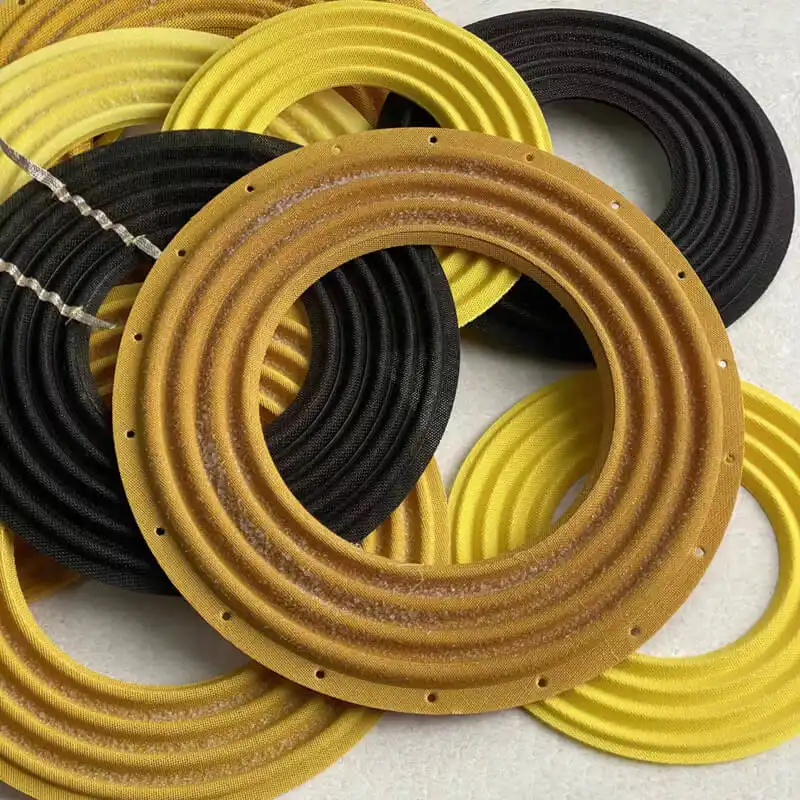
Nomex Speaker Spider vs Cloth Spider: How to Choose Material for Woofer and Subwoofer Production
A practical guide to Nomex, poly-cotton, treated cloth, and other speaker spider materials for woofer, subwoofer, PA, car audio, and repair use.
Choosing the Right Speaker Spider Material Is a Production Decision
A speaker spider looks simple, but its material choice affects centering, compliance, thermal stability, fatigue behavior, and long-term consistency in a woofer or subwoofer. For OEM teams and component buyers, the question is rarely “Which material is best?” A better question is: which spider material matches the driver’s power level, voice-coil size, target compliance, working temperature, production tolerance, and end-use environment?
Nomex speaker spider materials are often considered when heat resistance and dimensional stability are important. Cloth speaker spiders, including poly-cotton and treated fabrics, remain widely used because they offer flexible tuning, familiar behavior, and cost-effective production for many woofer and replacement applications. Other synthetic or blended materials may also be used where a specific balance of stiffness, damping, and fatigue life is required.
For speaker factories, the material decision should be made together with key dimensions and performance targets: OD, ID, SOD, FH, EH, corrugation profile, material code, resin treatment, compliance, and voice-coil group matching. A well-selected spider supports stable centering during assembly and helps the driver maintain reliable excursion behavior during use.
Main Speaker Spider Materials and Their Typical Characteristics
Nomex Speaker Spider
Nomex is an aramid-based material known in the loudspeaker industry for heat resistance and stability under demanding operating conditions. In spider production, Nomex is typically selected for drivers that face higher coil temperatures, stronger motor structures, or extended power handling requirements.
For PA woofers, subwoofers, professional audio drivers, and some car audio applications, a Nomex speaker spider can help maintain structure when the suspension area is exposed to elevated heat from the voice-coil assembly. It is also valued when the design requires more stable mechanical behavior over repeated high-excursion cycles.
Typical reasons buyers consider Nomex include:
- Better heat resistance than many conventional cloth materials
- Good dimensional stability under demanding conditions
- Suitability for higher-power woofers and subwoofers
- Stable support for larger voice-coil groups
- Stronger material positioning for premium or professional driver platforms
Nomex is not automatically the correct choice for every woofer. The finished spider’s behavior depends on fabric construction, impregnation, corrugation geometry, thickness, and forming process. A Nomex spider that is too stiff for the motor and cone system may reduce low-frequency compliance or change the intended Fs and excursion behavior. Material selection still needs to be verified through sample testing.
Poly-Cotton Speaker Spider
Poly-cotton is a common speaker spider material because it offers a practical balance of formability, cost, damping, and compliance control. The blend can be treated and formed into a wide range of corrugation designs, making it suitable for many standard woofers, midbass drivers, and replacement parts.
A poly-cotton spider can be tuned through fabric weight, resin treatment, press forming, and corrugation shape. This makes it useful when a buyer needs to match an existing spider sample or maintain a known suspension feel for a mature product.
Common advantages include:
- Flexible compliance tuning
- Good availability for regular production
- Familiar behavior in general woofer applications
- Useful for sample matching and repair replacement channels
- Cost-effective for many driver categories
Poly-cotton may not provide the same high-temperature margin as Nomex in demanding applications. If the driver uses a large voice coil, high input power, or operates in a poorly ventilated structure, buyers should confirm whether the chosen cloth material and treatment can maintain stiffness and centering after thermal and fatigue testing.
Treated Cloth Speaker Spider
“Treated cloth” is a broad term. It can refer to cotton, poly-cotton, polyester-based fabric, or other woven material treated with resin or phenolic-type systems to achieve target stiffness, recovery, and forming stability.
The treatment process strongly affects the final damper material behavior. Two cloth spiders made from similar fabric can perform differently if their resin content, curing condition, corrugation shape, or thickness are different. This is why material code and production process control are important during RFQ and batch production.
Treated cloth spiders are often used where the buyer needs:
- A specific stiffness curve
- Controlled damping behavior
- Good centering during cone and coil assembly
- Compatibility with existing woofer designs
- Consistent replacement for discontinued or legacy parts
For replacement parts, treated cloth is often preferred when the goal is to reproduce the mechanical feel of an original spider. In repair channels, a spider that fits the OD and ID but has the wrong compliance can still change the driver’s sound and excursion limits. Sample matching should include dimensions and mechanical behavior, not only visual appearance.
Other Synthetic or Blended Spider Materials
Some loudspeaker designs use synthetic fiber blends, specialty woven fabrics, or customized damper materials. These may be selected to improve fatigue resistance, moisture behavior, stiffness consistency, or forming repeatability.
The buyer should treat these materials as engineered options rather than generic substitutes. A different fiber or coating can affect not only heat resistance but also glue bonding, forming memory, resonance behavior, and long-term compliance drift. When switching from a cloth spider to a synthetic or aramid-based option, the driver should be rechecked as a complete system.
Comparing Nomex, Cloth, and Other Spider Materials by Performance Factor
Heat Resistance
Heat resistance is one of the clearest reasons to consider a Nomex speaker spider. In high-power woofers and subwoofers, the voice coil generates heat that can migrate into nearby suspension components. If the spider material softens, deforms, or loses its original mechanical condition, centering and excursion control can suffer.
Nomex is generally chosen for applications where thermal margin matters. Cloth spiders can still work well in many drivers, especially where power levels are moderate and ventilation is adequate. Treated cloth can also be specified with stronger resin systems, but the buyer should confirm actual performance through sample validation.
Practical checkpoint: when preparing an RFQ, include the voice-coil diameter, winding height, expected power range, and application type. This helps the spider factory recommend a material code and stiffness range that fits the thermal environment.
Stiffness and Compliance
Stiffness is not only a material property. It is created by the complete spider design: material, thickness, impregnation, corrugation count, corrugation height, outer diameter, inner diameter, and forming process.
A stiffer spider can improve control in high-excursion or heavy cone systems, but excessive stiffness may raise resonance, limit low-frequency movement, or make the driver harder to tune. A softer spider may improve low-frequency compliance but can reduce centering strength if the motor and cone assembly need more support.
For woofer spider material selection, buyers should confirm:
- Target compliance or stiffness range
- OD and ID
- SOD, if the spider has a stepped or special outer structure
- FH and EH dimensions
- Corrugation profile and number of waves
- Voice-coil group size and attachment method
- Cone mass and intended excursion
Nomex can be specified in different stiffness levels, but it is often associated with stronger, more stable spider designs. Cloth and poly-cotton may offer broader everyday tuning flexibility for standard drivers.
Fatigue Behavior and Long-Term Recovery
A spider flexes continuously during driver operation. Over time, material fatigue can affect compliance, centering, and recovery. The correct material should maintain predictable movement after repeated cycles, especially in subwoofers and PA drivers that operate at higher excursion.
Nomex is commonly considered when fatigue resistance and thermal stability are priorities. Treated cloth can also provide good fatigue behavior when the fabric, resin, and forming process are appropriate for the design. Poorly matched material may show early softening, deformation, or uneven recovery.
Buyers should avoid judging fatigue behavior only by hand feel. A new spider may feel correct during incoming inspection but behave differently after break-in, heating, or long-cycle movement. Sample evaluation should include repeated flexing, assembly testing, and comparison with the target driver’s performance.
Damping and Sound Character
The spider contributes to the suspension system’s damping behavior. Material selection, resin treatment, and corrugation design can influence mechanical loss and the way the driver controls movement around resonance.
Cloth speaker spiders are widely used partly because their damping behavior is familiar and tunable. Poly-cotton and treated cloth can be adjusted for many woofer and midbass requirements. Nomex may be preferred where power handling and stability are more important, but its final damping behavior still depends on the specific construction.
A material change can affect measured response even if dimensions remain the same. When replacing a cloth spider with Nomex, or changing from one cloth treatment to another, the driver should be tested as a full assembly.
Centering and Assembly Stability
The spider’s core job is to keep the voice coil centered in the magnetic gap while allowing controlled axial movement. Material that is too soft, uneven, warped, or inconsistent can increase the risk of coil rubbing, offset, or assembly variation.
For production buyers, centering depends on both design and process control. Important manufacturing checks include:
- Flatness before assembly
- ID accuracy for the voice-coil former
- OD accuracy for frame or landing fit
- Corrugation symmetry
- Glue compatibility
- Consistent forming height
- Batch-to-batch stiffness control
A strong material specification is not enough if the formed spider is inconsistent. ERP-controlled material records, mold confirmation, inspection procedures, and sample approval all help reduce variation during batch production.
Application Fit: PA Woofers, Subwoofers, Car Audio, and Replacement Parts
PA Woofers and Professional Audio Drivers
PA woofers often face continuous operation, high output levels, and demanding thermal conditions. A Nomex speaker spider can be a practical option when the design uses a larger voice coil or requires higher heat resistance. Professional audio drivers may also need strong centering support because they are expected to perform reliably under repeated use.
For PA applications, buyers should pay attention to voice-coil matching, spider stiffness, and fatigue behavior. A spider that is too compliant may not provide enough control at high excursion, while one that is too stiff may reduce low-frequency performance.
Subwoofers
Subwoofer spider material selection is strongly linked to excursion, cone mass, motor strength, and target low-frequency performance. Nomex, treated cloth, and blended materials can all be used depending on the design.
High-excursion subwoofers may require a spider with strong recovery and stable corrugation geometry. Some designs use multiple spiders or special corrugation structures to improve linear control. In these cases, OD, ID, FH, EH, corrugation height, and spacing must be checked carefully because small changes can affect assembly height and mechanical travel.
Car Audio Woofers and Subwoofers
Car audio drivers can face heat, vibration, and variable installation conditions. Nomex may be considered for higher-power car subwoofers, especially where temperature stability and durability are important. Treated cloth and poly-cotton remain common for many standard car audio woofers where cost, tuning flexibility, and known suspension behavior matter.
For car audio sourcing, buyers should define whether the product is a daily-use woofer, a high-power subwoofer, or a repair part. The expected power level and cone movement should guide the material selection rather than the product category alone.
Replacement and Repair Parts
Replacement spiders need accurate matching. A repair spider should not be selected only by OD and ID. The replacement must also match height, corrugation shape, stiffness, and voice-coil former fit as closely as possible.
For repair channels, a treated cloth speaker spider is often useful because many original drivers used cloth-based dampers. Nomex may be suitable when upgrading or replacing parts in higher-temperature designs, but a material change can alter the original suspension behavior. Buyers should provide original samples whenever possible for sample matching.
Specification Checkpoints Before Ordering Speaker Spiders
A clear RFQ reduces sampling time and helps the factory confirm whether Nomex, cloth, or another damper material is the right choice. Speaker spider drawings and samples should include both dimensional and performance information.
Key Dimensions
Common specification checkpoints include:
- OD: outer diameter of the spider
- ID: inner diameter for voice-coil former matching
- SOD: special or step outer diameter where applicable
- FH: free height or forming height, depending on drawing convention
- EH: effective height or edge height, depending on the design
- Corrugation count, pitch, and profile
- Thickness and material code
- Inner and outer landing requirements
If terminology differs between buyer and factory, drawings should define each measurement clearly. For international projects, dimensioned drawings and physical samples are often the safest combination.
Mechanical and Application Data
The spider supplier should also understand the driver platform. Useful RFQ information includes:
- Woofer, subwoofer, PA, car audio, or repair application
- Voice-coil diameter and former material
- Cone size and approximate moving mass, if available
- Target compliance or stiffness reference
- Single-spider or multi-spider structure
- Expected power and operating environment
- Original sample or approved reference part
This information allows the factory to recommend a suitable material code, mold option, corrugation structure, and sample plan.
Sample Matching and Batch Production Control
Before batch production, sample approval should confirm fit, forming quality, stiffness, centering behavior, and assembly compatibility. A good sample process checks more than visual appearance.
Practical sample checks include:
- Dimensional inspection against drawing
- ID fit with the voice-coil former
- OD fit with the frame or spider landing
- Height and corrugation consistency
- Hand flex comparison with reference sample
- Trial assembly to check centering
- Driver testing after assembly, where possible
For batch production, consistency depends on material control, mold condition, forming process, and inspection. Factories such as Qiao Tai in Guangzhou Panyu, founded in 2006, typically support speaker spider manufacturing through material selection, sample matching, mold support, specification confirmation, and production delivery. For buyers, the practical value is not only access to a material option, but a controlled process from RFQ to repeat orders.
Practical Selection Guide
There is no universal best damper material. The right choice depends on the driver design and production target.
Choose a Nomex speaker spider when the design needs higher heat resistance, stable behavior under demanding use, or stronger support for high-power woofer and subwoofer platforms. It is especially relevant for PA woofers, professional audio drivers, and higher-power car audio subwoofers.
Choose a poly-cotton or treated cloth speaker spider when the project needs flexible compliance tuning, familiar damping behavior, cost-effective production, or close matching to an existing speaker design. This is often suitable for standard woofers, midbass drivers, and repair replacement parts.
Consider other synthetic or blended spider materials when a specific fatigue, moisture, stiffness, or process requirement cannot be met by standard Nomex or cloth options.
The safest purchasing route is to treat material selection as part of the complete suspension specification. Confirm OD, ID, SOD, FH, EH, corrugation, compliance, centering, and voice-coil group compatibility before approving samples. A spider that fits physically but fails mechanically can create production issues, sound changes, or reliability risks.
For OEM teams and sourcing buyers, the best result usually comes from sharing the target driver application, original samples, drawings, and performance expectations early in the RFQ stage. That gives the factory enough information to recommend a material and process that can be repeated in batch production.
FAQ
What is the main advantage of a Nomex speaker spider?
A Nomex speaker spider is usually selected for better heat resistance and stable behavior in demanding woofer and subwoofer applications. It is often considered for PA woofers, professional audio drivers, and higher-power car audio designs where the voice coil can generate significant heat.
Is a Nomex spider always better than a cloth speaker spider?
No. Nomex is useful for heat resistance and stability, but cloth, poly-cotton, and treated cloth spiders can offer excellent tuning flexibility, damping behavior, and cost efficiency. The best material depends on the driver’s voice-coil group, compliance target, corrugation design, power level, and application.
What dimensions should be confirmed before ordering speaker spiders?
Buyers should confirm OD, ID, SOD where applicable, FH, EH, corrugation profile, thickness, material code, and the voice-coil former fit. Mechanical requirements such as compliance, stiffness, centering behavior, and application type should also be included in the RFQ.
Can a cloth spider be replaced with a Nomex spider in a repair project?
It may be possible, but it should not be treated as a direct swap without testing. Changing from cloth to Nomex can affect stiffness, damping, compliance, and the driver’s final response. Repair teams should match the original sample as closely as possible unless a design change is intended.
How should OEM teams evaluate spider samples before batch production?
Sample approval should include dimensional inspection, ID and OD fit checks, height and corrugation review, stiffness comparison, trial assembly, centering verification, and driver testing where possible. Batch production should follow the approved material code, mold, and inspection standard.
Factory RFQ Next Step
Move from research to a specification shortlist with product examples that can be sent for factory quotation.