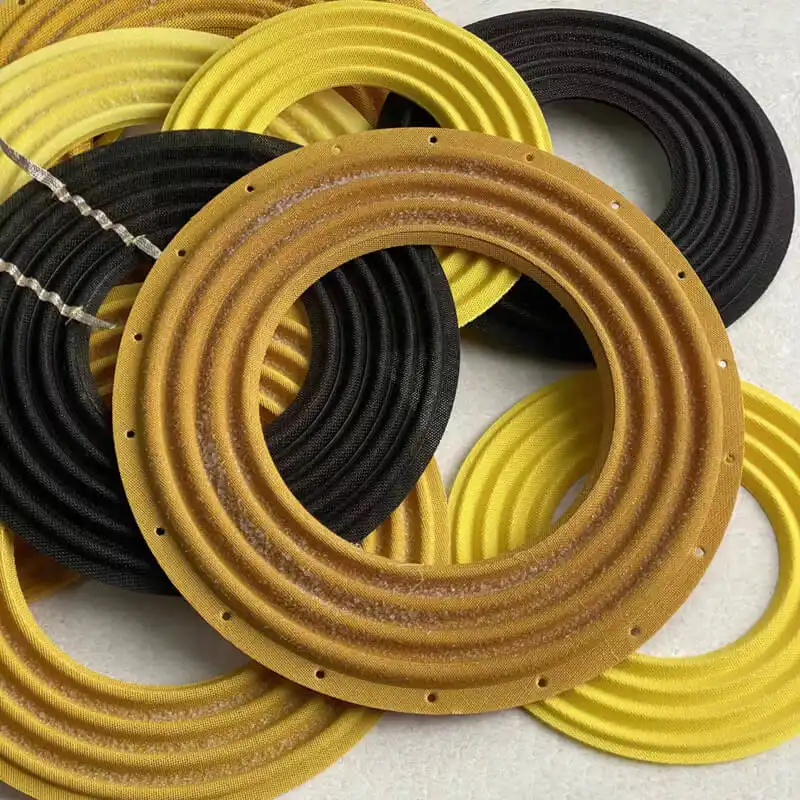
Speaker Spider Materials Compared: Cotton, Conex, Nomex, Poly-Cotton and Treated Cloth
Compare speaker spider material options for OEM buying: cotton, Conex, Nomex, poly-cotton and treated cloth by heat, stiffness, humidity, durability and application.
Speaker spider material has a direct effect on centering stability, compliance, thermal behavior, long-term durability, and production consistency. For OEM teams, woofer builders, repair channels, and component sourcing buyers, material choice is not just a fabric decision. It affects how a loudspeaker behaves during assembly, under power, and over its service life.
Many product listings name cotton, Nomex, Conex, poly-cotton, or treated cloth, but leave out the practical differences that matter during sourcing. Buyers still need to match the spider to the voice-coil group, cone mass, target excursion, power handling, environmental exposure, and application type. A material that works well in a home audio woofer may not be the right choice for a hot-running car subwoofer or a high-output pro audio driver.
This guide compares common speaker spider material options from a buyer's perspective and highlights the specification checkpoints that should be confirmed before sampling and batch production.
Why speaker spider material matters
The spider, also called a damper or centering spider, keeps the voice coil centered in the magnetic gap while allowing controlled axial movement. Material choice affects several critical performance areas:
- Heat resistance around the voice coil
- Stiffness and compliance in the suspension system
- Durability under cyclic motion
- Humidity behavior and dimensional stability
- Resin absorption and treatment response
- Consistency in mass production
- Color and appearance requirements for visible assemblies
In practice, material selection is always tied to geometry and forming details. Two spiders made from different fabrics may look similar in catalog photos, but they can behave very differently once resin treatment, corrugation profile, thickness, and forming height are introduced.
That is why material should never be approved as a standalone item. Buyers should confirm it together with:
- OD: outer diameter
- ID: inner diameter
- SOD: seating or support outer diameter, depending on drawing standard
- FH: flat or forming height notation used by the factory
- EH: effective or edge height notation used on the drawing
- Voice-coil group: coil diameter and assembly match
- Corrugation count and profile
- Compliance target
- Centering requirements
- Resin treatment and hardness level
Common speaker spider materials compared
Cotton speaker spider material
Cotton is one of the most familiar speaker spider material options in the market. It is widely used because it is practical, economical, and suitable for many conventional loudspeaker designs.
Typical strengths:
- Good general-purpose usability
- Familiar processing behavior in manufacturing
- Suitable for many standard woofer applications
- Often attractive for cost-sensitive production and replacement demand
Typical considerations:
- Lower heat tolerance than higher-temperature aramid-based options
- May show more sensitivity to humidity and environmental variation depending on treatment
- Long-term stability depends heavily on resin system and process control
For moderate-power woofers, repair replacement parts, and cost-controlled production programs, cotton can still be a reasonable choice when the suspension design does not require extreme thermal resistance. The key issue is not just the base cloth, but how it is impregnated, formed, and cured.
Buyers should pay close attention to whether the target design needs soft compliance, medium stiffness, or higher restoring force. A cotton spider can be tuned through resin treatment and corrugation profile, but there are practical limits compared with more heat-resistant materials.
Conex speaker spider material
Conex is commonly selected when a buyer needs higher temperature resistance and more demanding durability than basic cotton constructions typically provide. It is often discussed in higher-performance woofer and subwoofer applications where heat and repeated excursion place greater stress on the suspension.
Typical strengths:
- Better thermal capability for more demanding power conditions
- Good durability in cyclic use
- Suitable for stronger suspension control when correctly formed
- Frequently considered for higher-output automotive and professional applications
Typical considerations:
- Material cost is generally a more important factor than with basic cotton options
- Compliance tuning still depends on resin level, weave, thickness, and corrugation geometry
- Sample approval is important because visual similarity does not guarantee matching mechanical behavior
For buyers evaluating a Conex speaker spider, it is important to ask how the fabric grade and treatment are controlled across batch production. A well-made spider depends on repeatable resin pickup, stable forming, and consistent curing, not only on the raw material name.
Nomex speaker spider material
Nomex is widely recognized in the loudspeaker field for heat resistance and durability in demanding conditions. It is often chosen when thermal stability is a priority and the driver is expected to run under sustained load.
Typical strengths:
- Strong heat resistance for high-power applications
- Good long-term durability when properly processed
- Often preferred for demanding woofer and subwoofer designs
- Useful where thermal exposure near the coil is a major concern
Typical considerations:
- Higher material and processing expectations compared with commodity-grade options
- Mechanical feel can vary significantly with treatment level and forming structure
- Buyer approval should focus on full suspension behavior, not just material label
A Nomex speaker spider is often considered for subwoofers, heavy-duty woofers, and some pro audio driver programs where power handling and operating temperature matter. Even so, Nomex alone does not guarantee the correct result. If the compliance is wrong, the corrugation is not matched to the cone and coil assembly, or the forming height is inconsistent, the finished driver can still underperform.
Poly-cotton speaker spider material
Poly-cotton blends are used when buyers want a balance between cost, processability, and improved stability over pure natural-fiber constructions. In real purchasing situations, this can be a useful middle ground.
Typical strengths:
- Balanced material option for many mainstream drivers
- Can support stable processing and appearance
- Often considered where a blend of flexibility and durability is needed
- Practical for volume programs that need repeatable production
Typical considerations:
- Exact behavior depends on blend ratio and resin treatment
- Not all poly-cotton fabrics perform the same way
- RFQs should request a clear material code rather than only a generic name
Poly-cotton is relevant for buyers who need a dependable spider for common woofer or home audio programs without moving immediately to higher-cost high-temperature fabrics. It can also suit some replacement and aftermarket channels where performance needs to be credible and production needs to remain efficient.
Treated cloth speaker damper material
Treated cloth is a broad category rather than a single raw material. In many cases, the real performance difference comes from the resin system, impregnation level, curing control, and forming process applied to the cloth.
Typical strengths:
- Allows tuning of stiffness and compliance
- Can improve shape retention and centering stability
- Can help adapt one fabric family to different driver targets
- Useful for matching customer samples and legacy parts
Typical considerations:
- Treatment variation can create batch inconsistency if process control is weak
- Too much stiffness can reduce the intended compliance
- Insufficient treatment can reduce durability and long-term shape stability
When a buyer asks for a treated cloth speaker damper, the request should be specific. "Treated cloth" by itself is not enough for quality control. It is better to define the exact material code, target hardness or compliance reference, color, geometry, and sample standard.
How to select the right spider material by application
Car audio
Car audio drivers, especially subwoofers, often face heat build-up, repeated high excursion, and changing humidity conditions. Material choice should emphasize thermal behavior, durability, and stable centering under stress.
Buyers often pay attention to:
- Higher heat resistance near the voice coil
- Good fatigue performance under repeated excursion
- Stable formed height and centering
- Resin treatment that does not drift too far in changing conditions
Conex and Nomex often enter consideration here, especially for more demanding subwoofer programs. Cotton or poly-cotton may still be suitable for lower-stress applications if the design target is moderate and the sample match is confirmed.
Pro audio
Pro audio woofers and low-frequency drivers may operate for long periods at elevated power. Reliability and consistency matter as much as initial performance.
Material selection should focus on:
- Thermal stability during extended use
- Consistent compliance across batches
- Strong centering control for production assembly
- Repeatable corrugation shape and cure condition
Nomex and Conex are often favored when the driver is expected to work hard for long periods. The buyer should still verify whether the final suspension is too stiff or too soft for the intended response and sensitivity target.
Home audio
Home audio programs often balance performance, smooth compliance, cost, and low-noise operation. The material decision can be less extreme than in high-output automotive or professional products.
Common priorities include:
- Controlled but smooth compliance
- Dimensional consistency for assembly
- Clean appearance if the spider is visible
- Stable production quality for OEM runs
Cotton and poly-cotton can be practical choices in this category, especially for standard woofers and mid-bass units. If the design uses higher power or a more demanding excursion profile, treated variants or higher-temperature materials may still be justified.
Woofer and subwoofer builds
For woofer and subwoofer sourcing, material selection should always be tied to moving mass, coil diameter, gap design, target excursion, and compliance.
A stiffer or more heat-resistant spider is not automatically better. If the spider over-controls movement, the driver may lose the intended low-frequency behavior. If it is too soft or unstable, centering risk and reliability concerns increase.
What buyers should confirm before RFQ, sampling, and production
A good RFQ for speaker spider material should reduce ambiguity. Buyers can save time and avoid remakes by sending a complete suspension requirement instead of only a generic material name.
RFQ checklist
Include these checkpoints whenever possible:
- Material name and material code
- Required color such as yellow, red, black, or brown if appearance matters
- OD, ID, SOD, FH, EH dimensions with drawing or sample
- Voice-coil group or mating coil diameter
- Corrugation quantity and profile
- Target compliance or reference sample
- Resin treatment requirement if known
- Intended application: home audio, car audio, pro audio, woofer, subwoofer, repair replacement
- Sample quantity and approval standard
- Batch quantity and delivery timing
Sample matching matters more than catalog naming
Two suppliers may both quote "Nomex speaker spider" and still deliver parts with very different feel, height, stiffness, and centering behavior. That is why physical sample matching remains important.
During sampling, buyers should review:
- Dimensional accuracy
- Forming consistency
- Inner and outer bonding area condition
- Corrugation symmetry
- Compliance feel compared with approved standard
- Voice-coil fit and centering in actual assembly
Process control and quality inspection
For batch orders, consistency depends on production control as much as material selection. Buyers should expect clear inspection of dimensions, appearance, forming height, and lot consistency.
Useful control points include:
- Incoming material identification
- Resin treatment control
- Forming and curing stability
- In-process dimensional checks
- Final inspection against approved sample or drawing
- ERP or production record traceability where available
This is especially important when the spider material affects a platform used across multiple SKUs. A small change in stiffness or height can influence assembly yield and acoustic behavior across an entire production run.
Practical selection guidance
For many sourcing teams, the fastest way to narrow the choice is to start with the operating stress level.
- Cotton: practical for standard applications, cost-conscious programs, and some replacement demand
- Poly-cotton: balanced option for mainstream production where stability and cost both matter
- Treated cloth: useful when the design depends on tuning through resin and forming process
- Conex: suitable for more demanding thermal and durability requirements
- Nomex: strong candidate for high-power, high-heat, and long-duty applications
The right speaker spider material is the one that matches the full suspension target, not the one with the most impressive label. For buyers, the best results come from combining material selection with exact dimensions, corrugation design, sample approval, and stable batch process control.
When material, geometry, and process are aligned, the spider supports reliable centering, predictable compliance, and smoother production from prototype to volume order.
FAQ
Which speaker spider material is best for high-power woofers and subwoofers?
High-power woofers and subwoofers often require materials with stronger heat resistance and good fatigue durability, so Conex and Nomex are commonly considered. The final choice still depends on compliance target, corrugation design, voice-coil match, and forming consistency.
Is cotton speaker spider material still used in modern speaker production?
Yes. Cotton is still used in many standard woofer, home audio, and replacement applications where the thermal and mechanical demands are moderate. Its suitability depends heavily on resin treatment, geometry, and production quality control.
What should buyers include in an RFQ for speaker spiders or dampers?
A strong RFQ should include material code, color if required, OD, ID, SOD, FH, EH, voice-coil group, corrugation profile, compliance target or reference sample, intended application, sample quantity, and batch order expectations.
Does treated cloth mean a better speaker damper material?
Not automatically. Treated cloth simply means the fabric has been processed with resin or a similar treatment. Performance depends on how the treatment changes stiffness, shape retention, durability, and consistency across production lots.
Factory RFQ Next Step
Move from research to a specification shortlist with product examples that can be sent for factory quotation.