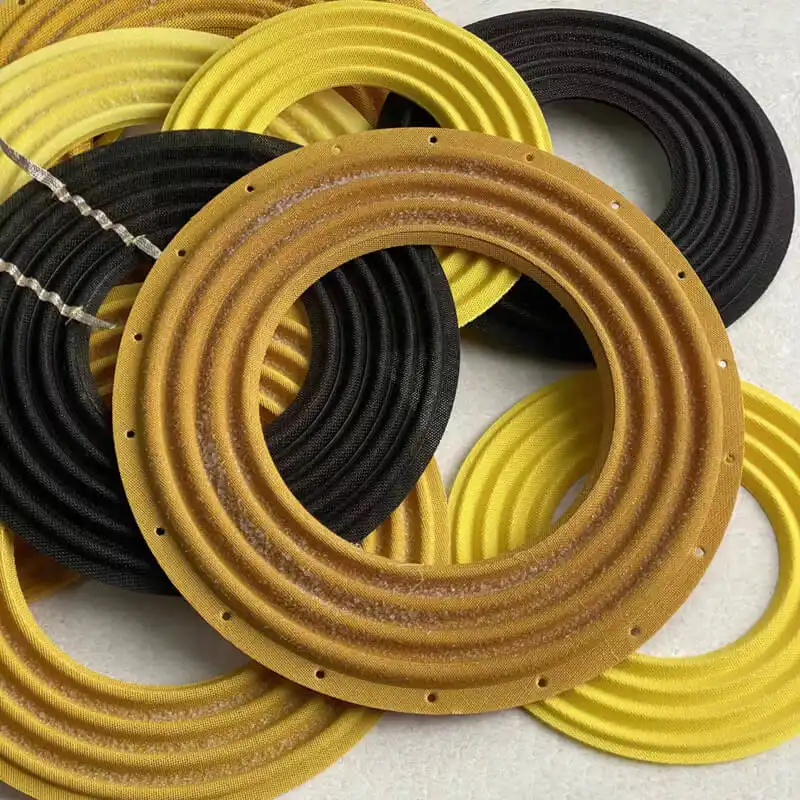
Speaker Spider Corrugation Design: Wave Count, Roll Height, Progressive Roll and Vented Spider Options
A practical guide to speaker spider corrugation design, covering wave count, roll height, progressive roll, venting, centering, stroke, noise, and RFQ checkpoints.
Speaker spider corrugation is one of the most important details in loudspeaker suspension design, yet it is often reduced to a catalog photo and a few basic dimensions. For buyers, OEM teams, woofer builders, and repair channels, that is rarely enough. Corrugation geometry directly affects how the spider flexes, how well it keeps the voice coil centered, how air moves around the coil area, and how the suspension behaves over time in production use.
The challenge is that no single corrugation pattern is "best" for every driver. A woofer, a high-stroke subwoofer, a midrange unit, and a pro-audio driver can all require very different spider behavior. Wave count, roll height, progressive roll layout, venting, base fabric, resin treatment, and dimensional control all interact. That is why spider selection should be treated as a specification and validation task, not just a replacement part lookup.
Why corrugation geometry matters in a speaker spider
A speaker spider, also called a damper or centering spider, helps control the moving system by supporting the voice coil former and keeping the cone assembly centered in the magnetic gap. The corrugations are not only there for appearance. They define how the spider bends and recovers during operation.
In practical terms, corrugation geometry influences:
- Flexibility and compliance: how easily the moving system travels
- Centering force: how firmly the voice coil is held on-axis
- Stroke behavior: how suspension resistance changes at low and high excursion
- Air movement: how the spider allows pressure transfer around the rear of the cone and coil area
- Cooling support: especially when vent paths are part of the design
- Noise risk: including rubbing, ticking, or air-related noises if geometry or fit is poor
- Long-term stability: how the spider maintains shape and function after repeated cycling
For buyers, this matters because a small change in spider wave design can alter assembly behavior, yield, service life, and driver consistency across batch production.
The key corrugation variables buyers should evaluate
Wave count
Wave count refers to the number of corrugation folds around the spider profile. In broad terms, more waves can distribute movement across more folds, while fewer waves may create a different balance of stiffness and travel.
Wave count should never be selected in isolation. It must be reviewed together with material thickness, resin treatment, roll shape, and the target driver stroke.
What wave count can affect:
- The feel of suspension compliance
- How evenly flex is distributed through the spider
- Recovery behavior after excursion
- The balance between centering control and travel capability
For example, a subwoofer spider often needs a geometry that supports larger movement without losing centering control, while a midrange driver may prioritize stability and predictable motion over extreme excursion.
Roll height
Roll height is one of the most visible and functionally important parts of spider geometry. Buyers will often see this discussed through dimensions such as FH and EH, depending on the drawing standard in use.
Higher rolls can support a different movement profile than lower rolls, but higher does not automatically mean better. Excessive roll height for the application may introduce packaging problems, assembly mismatch, or unwanted motion behavior. Too little roll height can also limit the intended excursion window or change suspension feel.
Roll height needs to be checked against:
- Target excursion range
- Cone and voice-coil assembly geometry
- Basket landing height
- Voice-coil gap position
- Dust cap and rear clearance
In sourcing and production, FH and EH should always be confirmed on the approved drawing, not assumed from nominal part naming.
Progressive roll design
A progressive roll spider is designed so the stiffness does not remain constant through the full range of movement. In simple terms, the spider may feel more compliant through smaller movement, then resist more strongly as excursion increases.
This type of design is often discussed for:
- Subwoofers needing better control near higher excursion
- Woofers that must balance low-level sensitivity and higher-level stability
- Some pro-audio drivers where mechanical control under demanding use is important
Why buyers ask for progressive roll spiders:
- To support large-stroke applications without making the suspension feel equally soft across the whole range
- To improve centering control as movement increases
- To manage mechanical behavior near excursion limits
However, progressive roll is not a universal upgrade. It must be matched with the complete suspension system, including surround behavior, cone mass, voice-coil height, and the intended power and displacement range. If the spider is too aggressive, assembly feel and low-level motion may not match the target.
Vented spider options
A vented speaker spider includes openings or vent features intended to improve air passage around the moving assembly. These designs are often considered where air compression, thermal buildup, or pressure-related noise are concerns.
Potential advantages of vented spider designs include:
- Better airflow near the voice-coil area
- Reduced trapped air effects in some structures
- Support for heat dissipation when the full motor and vent path are properly designed
- Lower risk of certain air-related noises in the right application
But venting must be evaluated carefully. A vented spider is not automatically quieter or cooler in every driver. The result depends on the basket windowing, pole venting, cone geometry, former size, adhesive pattern, and clearance around the moving parts.
For sourcing teams, the correct question is not simply "vented or non-vented?" It is whether the total driver structure benefits from that vent path and whether the production version can hold the required dimensional consistency.
How corrugation design affects different driver types
Woofer applications
Woofer spiders usually need a balanced combination of compliance, centering, and durability. They may not require the extreme travel behavior of a subwoofer, but they still need controlled movement over a meaningful stroke range.
Common buyer focus points for woofer spider corrugation:
- Stable centering under normal and elevated power
- Reasonable compliance without losing recovery control
- Low risk of rocking from poor symmetry or uneven resin distribution
- Good production repeatability across batches
A standard corrugated speaker damper with an application-matched wave count and roll height is often suitable, but sample matching remains important because cone mass, voice-coil length, and surround compliance all interact.
Subwoofer applications
Subwoofer spider design draws the most attention to progressive roll, multi-roll geometry, and venting discussions. These drivers often require more excursion and stronger control at the ends of travel.
For subwoofer builds, buyers often evaluate:
- Progressive roll behavior for higher-excursion control
- Roll height sufficient for intended movement
- Material strength for repeated cycling
- Venting support around the coil area
- Symmetry and consistency between sample sets and batch production
A subwoofer progressive spider can be useful when the design target includes substantial movement, but it still has to be checked against coil alignment, glue landings, and basket depth. If the spider geometry is correct on paper but poorly matched to the motor and cone set, the practical result may be assembly difficulty or noise under stress.
Midrange drivers
Midrange applications usually place less emphasis on extreme stroke and more emphasis on controlled, clean, predictable motion. In many cases, a spider with stable centering and moderate compliance is preferred over an aggressive high-travel geometry.
Important considerations include:
- Smooth and repeatable movement in the intended operating range
- Low risk of mechanical noise
- Dimensional stability for voice-coil alignment
- Material and resin choice compatible with the driver's working environment
Over-specifying a spider for stroke can be unnecessary in midrange designs. Buyers should focus on fit, centering accuracy, and consistency rather than assuming a more dramatic corrugation profile is a performance gain.
Pro-audio drivers
Pro-audio woofers and compression-resistant low-frequency drivers often need a spider that can hold alignment and durability under sustained demand. Here, corrugation geometry must support both centering and mechanical reliability.
Typical concerns include:
- Long-term fatigue resistance
- Stable behavior at elevated operating temperatures
- Controlled motion under repeated high-level use
- Tight production tolerance for rebuild and replacement channels
In this category, the practical value of a well-controlled spider may show up less in marketing language and more in lower assembly variation, reduced rubbing risk, and more dependable field life.
Specification checkpoints for sourcing, sampling, and RFQ preparation
A spider should not be ordered from a photo, and it should not be approved from OD alone. The most reliable RFQs and sample programs include dimensional, material, and application checkpoints that allow both buyer and factory to confirm the intended design.
Core dimensional checkpoints
Common items to confirm:
- OD: outside diameter
- ID: inside diameter
- SOD: seating or support outside diameter, depending on drawing convention
- FH: front height
- EH: effective height or installed height, depending on drawing system
- Voice-coil group: voice-coil diameter and former fit range
These dimensions affect assembly fit, landing position, and working geometry. Even a small mismatch can create centering problems or require process changes at the production line.
Material and structure checkpoints
Buyers should also define:
- Base fabric or cloth type
- Material code if a known factory code or approved equivalent is used
- Resin treatment level or stiffness grade if applicable
- Corrugation type and wave count
- Progressive or non-progressive roll design
- Vented or non-vented structure
- Color only if it matters for product family control or replacement matching
The material code matters because two spiders with similar dimensions can behave differently if the base fabric or resin system changes.
Application and validation checkpoints
For sample matching and pilot approval, useful items include:
- Target driver type: woofer, subwoofer, midrange, or pro-audio LF driver
- Intended stroke range and centering requirement
- Cone, surround, and voice-coil combination
- Assembly landing dimensions on basket and former
- Compliance expectation or comparative feel versus current approved sample
- Noise screening during trial builds
- Thermal and repeated-cycle checks where relevant
When replacement channels are involved, sending the original sample and confirming the installed dimensions can prevent avoidable mismatch. In OEM work, a drawing plus a working reference sample is often the safest combination.
What to watch during quality inspection and batch production
Spider corrugation design is only useful if manufacturing can reproduce it consistently. Geometry variation, resin inconsistency, and forming defects can change the suspension behavior from lot to lot.
Quality inspection should pay attention to:
Dimensional consistency
OD, ID, SOD, FH, and EH need controlled measurement. A correct nominal design with poor height control can create voice-coil position errors at assembly.
Corrugation uniformity
Wave shape should be even and symmetrical. Irregular corrugation can affect centering and increase the risk of rocking or inconsistent recovery.
Material and resin stability
The same drawing can behave differently if resin pickup or cure condition drifts. This is especially important for progressive roll speaker spider designs, where the movement profile depends on controlled forming and treatment.
Vent feature accuracy
In vented speaker spider production, vent openings and formed structure should be consistent. Poorly executed vent details can create weakness, assembly issues, or airflow irregularity.
Batch traceability
For OEM supply, process traceability matters. ERP-linked production records, sample approval status, and batch identification help buyers connect incoming parts to the approved specification and reduce repeat failure investigation time.
Choosing the right corrugation approach without overcomplicating the RFQ
A good RFQ does not need to be academic, but it should be specific enough to avoid guesswork. For speaker spider corrugation, buyers usually get better results when they provide:
- Driver application and target use
- Drawing with OD, ID, SOD, FH, and EH
- Voice-coil size or voice-coil group
- Existing sample if replacing or matching
- Material code or reference sample if consistency is critical
- Corrugation details: wave count, progressive roll requirement, vented or non-vented
- Expected sampling timeline and batch quantity range
The main point is simple: corrugation geometry changes more than appearance. It influences flexibility, centering, airflow, noise risk, and long-term stability, so it deserves the same level of attention as cone, surround, and voice-coil matching.
For buyers managing OEM production, repair replacement, or new product development, the safest path is to confirm the geometry on paper, validate it in samples, and then lock the approved version into controlled batch production. That approach reduces costly rework and helps ensure the spider performs as intended in the finished driver.
FAQ
What is speaker spider corrugation?
Speaker spider corrugation is the wave-shaped formed structure in the spider or damper. Its geometry affects how the suspension flexes, how the voice coil stays centered, and how the moving assembly behaves through its working stroke.
How does progressive roll differ from a standard spider design?
A progressive roll spider is designed so stiffness changes as excursion increases. Compared with a more uniform roll pattern, it can provide softer behavior near small movement and stronger control near higher excursion, depending on the full driver design.
When should a vented speaker spider be considered?
A vented speaker spider is worth considering when airflow, pressure management, or thermal support around the voice-coil area is part of the design goal. It should be evaluated together with basket venting, pole venting, cone geometry, and assembly clearances rather than treated as a standalone upgrade.
Which spider dimensions should be confirmed in an RFQ?
At minimum, buyers should confirm OD, ID, SOD, FH, EH, and the voice-coil group. It is also helpful to specify material code, wave count, progressive or non-progressive structure, vented or non-vented design, and whether sample matching is required.
Does more wave count always mean better speaker performance?
No. More wave count does not automatically improve performance. The correct wave design depends on the driver type, target stroke, centering requirement, material, resin treatment, and the full suspension and motor structure.
Factory RFQ Next Step
Move from research to a specification shortlist with product examples that can be sent for factory quotation.